


Utility-scale battery energy storage systems make money by combining several revenue sources rather than relying on a single market. The most common BESS revenue streams include wholesale energy arbitrage, ancillary services such as frequency regulation, capacity payments, and market-specific balancing services.
The important distinction is that these revenues cannot simply be added together. A battery has limited MW, MWh, state of charge, inverter capacity, grid connection capacity, and cycle life. Every market commitment uses part of that physical capability. Profitable BESS revenue stacking therefore depends on deciding which opportunity creates the highest risk-adjusted value at each point in time.
For developers, IPPs, investors, and asset managers evaluating utility-scale battery storage projects, the real question is not only where revenue comes from. It is how much of that theoretical revenue can actually be captured after market rules, dispatch success, efficiency losses, degradation, and grid constraints are considered.

Main BESS Revenue Streams: Contracted Revenue vs Merchant Revenue
BESS cash flow can broadly be divided into contracted revenue and merchant revenue.
Contracted Revenue
Contracted revenue is designed to provide a more predictable cash-flow floor. Depending on the market and project structure, it can come from:
- capacity market payments
- availability payments
- tolling agreements
- long-term flexibility contracts
- resource adequacy contracts
The payment mechanism varies by jurisdiction. Some contracts pay primarily for making capacity available, while others include performance, dispatch, or availability obligations.
Merchant Revenue
Merchant revenue depends more directly on market prices and dispatch decisions. Common sources include:
- day-ahead and real-time energy arbitrage
- frequency regulation
- reserve products
- other ancillary services
- balancing market participation
Merchant BESS revenue is generally more exposed to price volatility, local grid conditions, competition, dispatch performance, and the quality of the trading strategy.
| Revenue Stream | How the BESS Earns | Main Constraint | Revenue Profile |
|---|---|---|---|
| Energy Arbitrage | Charges at lower prices and discharges at higher prices | Price spread, efficiency, degradation, POI limits | Merchant |
| Ancillary Services | Provides frequency, reserve, or other grid-support services | Qualification rules, reserved MW, market saturation | Merchant or availability-based |
| Capacity Payments | Receives payment for qualified capacity availability | Accreditation, duration, performance obligations | More predictable where available |
| Balancing Services | Responds to near-real-time system imbalance | Dispatch probability, bid acceptance, local constraints | Merchant |
Direct Revenue Is Different from Avoided Cost
Utility-scale BESS revenue should not be mixed with every source of economic value created by storage.
A commercial and industrial battery can create value by reducing demand charges, increasing solar self-consumption, shifting loads, or reducing outage exposure. These are often avoided costs or operational savings rather than direct wholesale-market revenue.
By contrast, a front-of-the-meter utility-scale BESS usually earns direct revenue through electricity markets, grid-service contracts, capacity mechanisms, or other contracted arrangements.
The distinction matters because a project's financial model should not combine a dollar of bill savings with a dollar of market revenue unless both are genuinely available to the same asset under the applicable market structure.
What BESS Revenue Stacking Actually Means
BESS revenue stacking means using the same battery asset to access multiple compatible sources of value over time.
It does not mean adding the maximum theoretical revenue from every market and assuming the battery can earn all of it simultaneously.
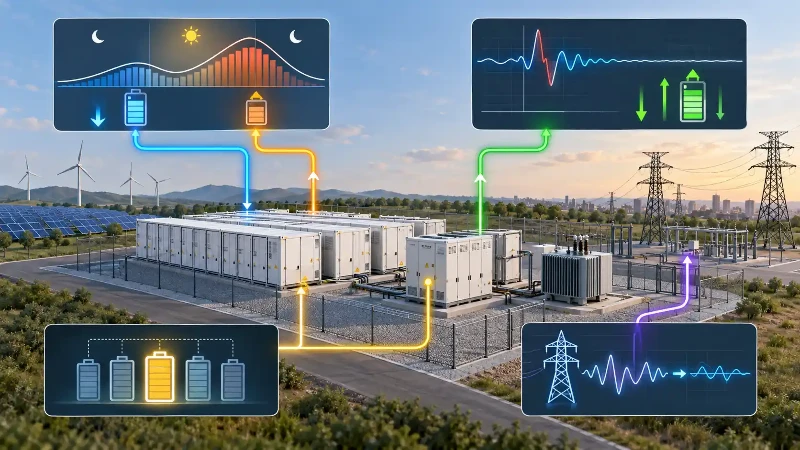
Capacity Reservation Creates Opportunity Cost
Suppose a 100 MW BESS commits 20 MW of power capacity to a frequency-response service for the next hour. That committed capability may need to remain available, together with sufficient state-of-charge headroom, to satisfy the service requirement.
The same 20 MW cannot always be treated as fully available for wholesale arbitrage at the same time.
If real-time energy prices rise sharply, the battery may therefore face a choice:
- keep the existing ancillary-service commitment
- preserve enough SOC to deliver that service
- use the remaining capacity for energy trading
- avoid a new commitment if its expected value is below the alternative market opportunity
That lost alternative is the opportunity cost of the market commitment.
Co-Optimization Turns Market Options into a Dispatch Decision
Effective revenue stacking requires co-optimization rather than a fixed operating schedule.
A trading optimizer or battery energy management system may evaluate:
- day-ahead and real-time prices
- ancillary-service prices
- capacity obligations
- current and forecast state of charge
- available charging and discharging MW
- round-trip efficiency
- battery degradation
- POI import and export limits
- market penalties and non-delivery risk
The objective is not to participate in as many markets as possible. It is to allocate the battery's limited capability to the combination of markets with the best expected value after costs and constraints.
Energy Arbitrage: The Most Familiar BESS Revenue Stream
Energy arbitrage is the simplest BESS revenue model to understand: charge when electricity is relatively inexpensive and discharge when electricity prices are higher.
The same principle underpins many energy storage load-shifting strategies.
Real arbitrage profitability, however, is lower than the visible market price spread because energy is lost during charging and discharging.
Round-Trip Efficiency Changes the Real Spread
The U.S. National Renewable Energy Laboratory's 2024 Annual Technology Baseline uses an 85% round-trip efficiency assumption for utility-scale battery storage. Actual project efficiency varies with system design, operating point, temperature, auxiliary consumption, and equipment configuration.
Source: NREL Utility-Scale Battery Storage ATB.
For a simple example, assume a BESS charges when electricity costs $20/MWh and discharges when the market reaches $70/MWh.
At 85% round-trip efficiency, approximately 1.18 MWh must be purchased to deliver 1 MWh back to the grid. The effective energy purchase cost is therefore about $23.53/MWh before market fees, auxiliary loads, degradation, and other operating costs.
The correct arbitrage decision is therefore not:
Is the selling price higher than the buying price?
It is:
Is the expected price spread large enough to cover efficiency losses, market costs, degradation, and the opportunity cost of using the battery now instead of later?
Arbitrage Is Becoming More Important in Mature Battery Markets
The role of energy arbitrage is increasing as more utility-scale storage enters power markets.
The U.S. Energy Information Administration reported that 41% of U.S. utility-scale battery capacity was primarily used for arbitrage in its latest application data, while frequency regulation was the primary use for 24% of capacity. EIA also reported that arbitrage was among the uses of 66% of utility-scale battery capacity.
Source: U.S. EIA: Utility-scale batteries are more commonly used for price arbitrage.
This does not mean arbitrage will dominate every market. It shows why BESS revenue models need to evolve as storage penetration, renewable generation, price volatility, and ancillary-service competition change.
Ancillary Services and Frequency Regulation
Ancillary services pay flexible resources to help keep the power system stable and reliable.
Batteries are well suited to many of these products because the power conversion system can change charging or discharging power rapidly within its technical operating limits.
Depending on the market, ancillary-service products can include:
- frequency regulation
- frequency response
- spinning or contingency reserves
- non-spinning reserves
- voltage or reactive-power support
Qualification rules differ significantly between grid operators. Response time, minimum duration, telemetry, accuracy, state-of-charge management, and non-delivery penalties should therefore be modeled using the actual market rules rather than a universal BESS assumption.
Why Ancillary-Service Revenue Can Compress
Ancillary-service markets are often much smaller than wholesale energy markets.
If a grid needs only a limited quantity of frequency regulation and many batteries begin competing for that same requirement, additional BESS capacity does not automatically create additional demand for the service.
Competition can therefore reduce clearing prices and change the optimal revenue mix.
This is one reason a revenue model based only on today's ancillary-service prices can overstate long-term profitability. Investors need to test how the asset performs if ancillary-service margins decline and a larger share of revenue must come from arbitrage, balancing, or contracted capacity.
Capacity Markets: Revenue Stability Depends on Local Rules
Capacity markets can provide a more predictable revenue component by paying qualified resources for being available during periods when the power system may need them.
However, capacity-market structures are highly jurisdiction-specific. A BESS may be accredited differently depending on its duration, reliability contribution, availability, and market rules.
PJM Example: Capacity Prices Are Market-Specific
In PJM's 2026/2027 Base Residual Auction, the RTO clearing price reached $329.17/MW-day of UCAP, up from $269.92/MW-day for most of the RTO in the 2025/2026 auction.
Source: PJM 2025 Annual Report.
This is a PJM capacity-market result, not a universal BESS revenue benchmark. A battery's actual eligible capacity and revenue depend on PJM's applicable accreditation and performance rules.
Great Britain Uses a Different Capacity Market Structure
Great Britain's Capacity Market uses its own auction structure, qualification requirements, and agreement rules.
For example, the UK government's 2026 T-4 auction parameters include a capital-expenditure threshold associated with eligibility for 15-year capacity agreements. That does not mean every BESS automatically receives a 15-year contract.
Source: UK Department for Energy Security and Net Zero Capacity Market auction parameters.
The investment lesson is simple: capacity revenue can improve bankability, but the duration, accreditation, payment level, and contract term must be modeled using the rules of the specific market.
Balancing Markets: Theoretical Revenue Is Not the Same as Realized Revenue
Balancing markets create opportunities for BESS to respond to short-term system imbalances after earlier market schedules have been established.
They can produce attractive price opportunities, but the existence of a high balancing price does not guarantee that a battery will actually be dispatched.
Great Britain Revenue Stacking Study
A 2026 peer-reviewed study in the Journal of Energy Storage modeled batteries participating in both Great Britain's wholesale market and Balancing Mechanism.
Under the study's Great Britain assumptions, participation in both markets produced profits up to 250% higher than wholesale-only operation.
However, the same study showed how quickly theoretical stacking value can fall when dispatch is imperfect. A 50% battery bid skip rate reduced modeled profits by about 30% for the combined-market strategy.
Source: Journal of Energy Storage: Balancing with batteries.
This result should not be directly transferred to ERCOT, CAISO, PJM, the NEM, or another electricity market. Market settlement, dispatch, network constraints, bid formats, penalties, and price formation are different.
The broader lesson is more useful than the headline percentage:
Market access does not equal realized revenue. Dispatch probability and actual price capture matter.
Physical Limits Determine How Much Revenue Can Actually Be Stacked
A trading strategy cannot override the physical BESS.
Revenue optimization must remain within the technical limits of the battery, PCS, thermal system, and grid connection.
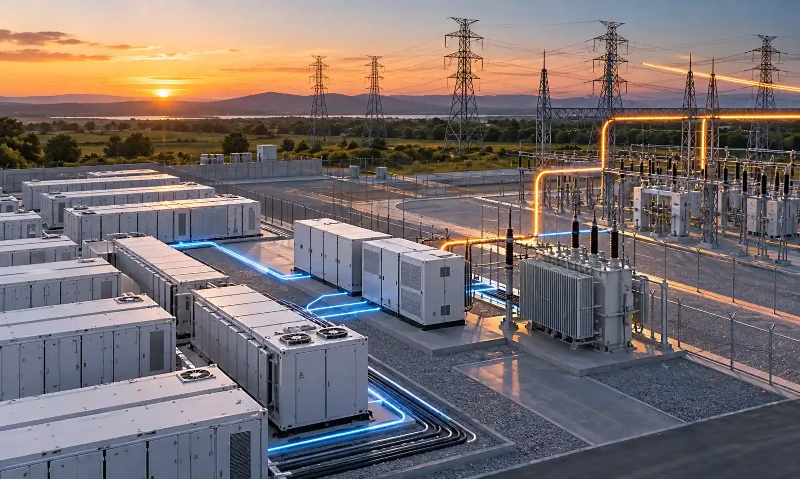
Point of Interconnection Limits
The BESS may contain more inverter or battery capacity than the site can exchange through its point of interconnection.
A 60 MW inverter fleet behind a 50 MW export limit still cannot export more than the approved grid connection allows.
Understanding BESS grid compatibility and connection limits is therefore part of revenue modeling, not only electrical engineering.
PCS Power Limits
The PCS defines how much power can be converted between the battery and the AC system at a given time.
If part of that MW capability is reserved for frequency response, the same PCS headroom may not be fully available for arbitrage or balancing.
State of Charge
Every service needs sufficient stored energy or empty charging capacity.
A battery cannot capture a high-price discharge opportunity if it is already near its minimum operating SOC. It cannot absorb negative-price electricity if it is already near its upper operating limit.
State-of-charge management is therefore one of the central constraints in revenue stacking.
Duration and Energy Capacity
A short-duration BESS may be highly effective for fast-response services but have less energy available for long arbitrage events or extended capacity obligations.
A longer-duration system has more MWh available but requires more capital. The additional revenue must justify the additional energy capacity.
Battery Degradation Is a Real Economic Constraint
Every charge-discharge cycle contributes to battery wear. The economic cost of that wear depends on cell chemistry, depth of discharge, operating temperature, SOC range, cycling frequency, replacement cost, warranty conditions, and the project's augmentation strategy.
There is no universal degradation cost that can be applied to every BESS as a fixed $/MWh value.
NREL's utility-scale battery cost modeling, for example, includes augmentation within fixed operating and maintenance assumptions rather than applying a single universal variable degradation charge to every dispatch.
Revenue optimizers should therefore use project-specific degradation assumptions rather than treating every positive market spread as profitable.
The same principle should be reflected in a broader battery energy storage system cost analysis.
Revenue Stacking in Practice: An Illustrative 24-Hour Logic
The following schedule is an illustrative example only. Actual BESS dispatch depends on the local market, node, contracts, SOC limits, grid connection, weather, battery configuration, and market prices.

| Period | Possible Action | Revenue Stacking Logic |
|---|---|---|
| 00:00-06:00 | Ancillary service or low-price charging | Compare reserve availability payments with expected later arbitrage value while maintaining the required SOC. |
| 06:00-10:00 | Morning market opportunity | Discharge only if the expected spread exceeds efficiency losses, degradation, and the value of keeping capacity available for another market. |
| 10:00-16:00 | Charge during lower-price periods | Rebuild SOC while optionally reserving part of PCS capacity for compatible ancillary or balancing services. |
| 16:00-21:00 | Higher-value wholesale or balancing dispatch | Allocate available MW and MWh to the highest expected value after accounting for existing commitments. |
| 21:00-24:00 | Reposition SOC and meet contracted obligations | Prepare the battery for the next delivery period while maintaining any required capacity or reserve availability. |
The schedule illustrates why revenue stacking is a continuous allocation problem rather than a list of independent income sources.
A forecast price spike has no value if the battery is empty, the PCS is already committed, the POI is constrained, or the asset must preserve energy for a contracted obligation.
Why BESS Revenue Mix Changes as the Market Matures
A BESS business model that works today may not produce the same revenue mix five years from now.
Storage deployment is growing quickly. The U.S. Energy Information Administration reported that utility-scale battery storage capacity reached nearly 52 GW by June 2026, after averaging 70% annual growth over the previous three years.
Source: U.S. EIA battery storage capacity update.
As more batteries enter a market:
- competition for shallow ancillary-service markets can increase
- some high-margin services may experience price compression
- batteries can reduce some of the price volatility they originally monetized
- new grid and capacity products may emerge
- market rules can change
- arbitrage, balancing, and contracted revenue can gain or lose importance
Revenue forecasts should therefore include market-evolution scenarios rather than assuming today's revenue mix remains unchanged throughout the full asset life.
Frequently Asked Questions
How do BESS projects make money?
Utility-scale BESS projects typically earn revenue from a combination of energy arbitrage, ancillary services, capacity payments, and market-specific balancing or flexibility services. The exact mix depends on the electricity market and the technical capabilities of the battery.
What are the main BESS revenue streams?
The main BESS revenue streams are wholesale energy arbitrage, ancillary services such as frequency regulation and reserves, capacity or resource-adequacy payments, and balancing or flexibility services where those markets exist.
What is BESS revenue stacking?
BESS revenue stacking is the coordinated use of one battery asset across multiple compatible revenue opportunities. It requires allocating limited MW, MWh, SOC, and grid capacity between competing market services.
Can a BESS earn several revenue streams at the same time?
Sometimes, but not without limits. Some services can be combined if sufficient power, energy, SOC headroom, and market permissions remain available. Other commitments compete for the same battery capacity, creating opportunity cost.
Is energy arbitrage profitable for BESS?
It can be, but profitability depends on the price spread after accounting for round-trip efficiency, charging costs, market fees, degradation, auxiliary consumption, and alternative revenue opportunities.
What limits BESS revenue stacking?
The main constraints include PCS power, battery energy capacity, SOC, cycle life, thermal limits, POI import and export limits, market qualification rules, contracted obligations, dispatch probability, and battery degradation.
Conclusion: BESS Profitability Depends on Realized Revenue, Not Theoretical Revenue
Battery energy storage systems do not make money simply because several revenue streams exist.
They make money when the project's technical design, market access, grid connection, contracts, and dispatch strategy allow those opportunities to be captured without violating physical or commercial constraints.
Energy arbitrage, ancillary services, capacity payments, and balancing markets can all contribute to BESS profitability, but every revenue decision consumes some combination of MW, MWh, SOC, cycle life, and grid capacity.
That is why the most important concept in BESS revenue stacking is not the number of available markets. It is co-optimization.
A strong project financial model should distinguish contracted revenue from merchant exposure, use market-specific rules, account for dispatch probability and degradation, and test how the revenue mix may change as more storage enters the market.
For asset owners, the real objective is not to maximize paper revenue in every market. It is to maximize sustainable, realizable revenue over the operating life of the BESS.