

Solar Container
A rapid-deploy mobile solar container solution designed for off-grid power, temporary energy supply, and project-based solar storage applications. Polinovel solar container systems integrate foldable PV modules, battery storage, PCS, EMS, and flexible power interfaces to deliver scalable solar power where the grid is limited or unavailable.
Scalable Solar Power Anywhere
-
Rapid-Deploy Solar Power Container
The foldable and containerized design helps reduce on-site installation work, making the system easier to transport, deploy, and relocate for remote sites, construction projects, mining areas, and emergency power needs.

-
Integrated Solar Battery Storage Container
PV generation, lithium battery storage, PCS, EMS, and power distribution can be configured into one scalable solar container system, supporting more stable power output and reducing diesel dependence for off-grid projects.

-
Scalable Solar Container System
From a single portable solar container to multi-unit solar storage systems, the solution can be expanded for larger project loads, hybrid power supply, island microgrids, and utility-scale solar storage projects.

Choose Your Solar Container Solution
-
![Foldable Solar Container System]() Foldable Solar Container SystemThe Foldable Solar Container System integrates foldable PV modules, battery storage, inverter, and power distribution into one containerized solar power unit.● Foldable PV modules with integratedread more
Foldable Solar Container SystemThe Foldable Solar Container System integrates foldable PV modules, battery storage, inverter, and power distribution into one containerized solar power unit.● Foldable PV modules with integratedread more -
![Solar PV Container With BESS]() Solar PV Container With BESSThe Solar PV Container with BESS System transforms containerized solar generation into a dispatchable power plant through medium-voltage conversion, centralized energy storage, and integrated powerread more
Solar PV Container With BESSThe Solar PV Container with BESS System transforms containerized solar generation into a dispatchable power plant through medium-voltage conversion, centralized energy storage, and integrated powerread more -
![Mobile Solar Container]() Mobile Solar ContainerThe Mobile Solar Container integrates PV modules into a containerized structure, helping simplify transport, installation, and relocation across changing project sites.● Foldable PV modules for fastread more
Mobile Solar ContainerThe Mobile Solar Container integrates PV modules into a containerized structure, helping simplify transport, installation, and relocation across changing project sites.● Foldable PV modules for fastread more -
![Solar Container Battery Energy Storage System]() Solar Container Battery Energy Storage SystemThe Solar Container Battery Energy Storage System connects multiple solar containers to a centralized BESS container, creating a scalable solar storage platform for project-level powerread more
Solar Container Battery Energy Storage SystemThe Solar Container Battery Energy Storage System connects multiple solar containers to a centralized BESS container, creating a scalable solar storage platform for project-level powerread more -
![Mobile Solar Container With BESS]() Mobile Solar Container With BESSThe Mobile Solar Container with BESS combines foldable solar generation, battery storage, PCS, and optional diesel or EV charging interfaces in one compact power unit.●144kWp foldable solar containerread more
Mobile Solar Container With BESSThe Mobile Solar Container with BESS combines foldable solar generation, battery storage, PCS, and optional diesel or EV charging interfaces in one compact power unit.●144kWp foldable solar containerread more


Polinovel Solar Container Architecture
Each solar container is pre-integrated at the factory around an ISO container base — PV, storage, conversion, and controls ship as one unit, so site teams connect power rather than assemble equipment.
Container base
A 20HQ, 20 ft, or 40 ft ISO container base with weather-resistant steel construction. The power section is rated IP55; the battery cabinet is IP54. Operates from -30°C to +55°C (derated above 45°C) and up to 4000 m altitude.
Foldable PV array
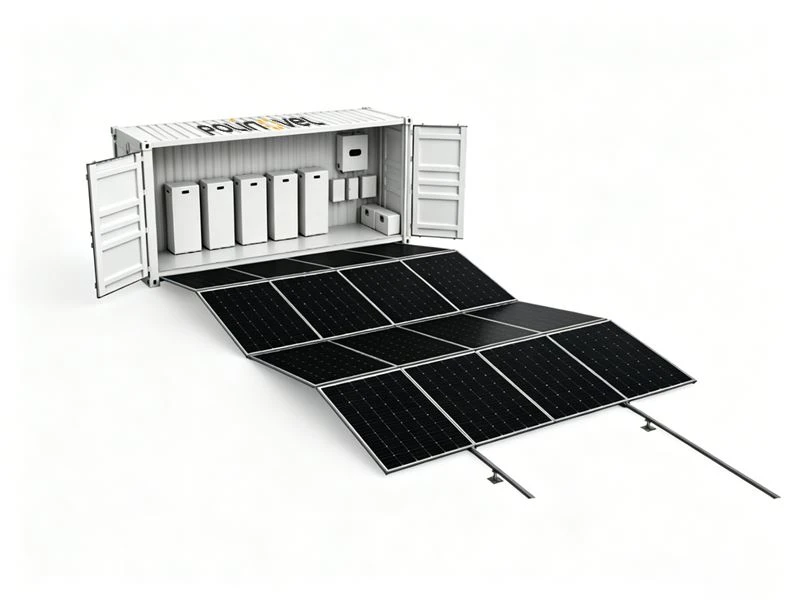
The foldable solar container carries 720 W modules wired 20 pieces per string, reaching up to 144 kWp on a single 20HQ unit. Panels fold flat for road transport and unfold on site, keeping overall dimensions within standard shipping container bounds.
LiFePO4 battery
LFP314Ah cells with liquid cooling. The reference unit holds 261 kWh at 832 V in a cabinet-type pack (1P260S). Supplied as outdoor cabinet BESS for compact builds or containerized BESS for larger capacity. Rated 6000+ cycles at 80% DoD.
Power conversion system
Bidirectional power conversion system (PCS) rated at 125 kW, 230/400 V, 50/60 Hz with 1.25× overload for 10 seconds. Supports on-grid and off-grid modes via an optional external hybrid inverter. Max charge/discharge current: 157 A.
EMS and remote monitoring
Built-in energy management system handles operating-mode switching, power distribution, and dispatch. Cloud-based monitoring delivers real-time status, performance data, and alerts. Annual energy yield at 1460 sun hours: 210,240 kWh for the reference 144 kWp unit.
Safety and thermal systems
Multi-level BMS monitors cell voltage, temperature, and current; triggers current limiting or automatic shutdown on abnormal readings. Fire suppression, smoke detection, and liquid cooling sit alongside the battery pack. Operating humidity: 0–95% non-condensing.
Application of Solar Containers
A solar container fits any site where grid power is weak, expensive, or absent — and moves when the project does.

Mining and oilfields
Sites that run on diesel gain a parallel solar and storage source that cuts generator hours and fuel logistics. Multiple containers scale into utility-scale plant solutions when load demands it.

Off-grid and island microgrids
Several units connect to a centralized battery system for full islanded supply. The same approach powers island microgrids on remote coastlines with no grid infrastructure.

Construction and temporary sites
A mobile solar container relocates with the project, so power follows the work rather than waiting for a permanent grid connection.

Emergency and disaster response
A transport-ready unit arrives at a disaster site and powers critical loads immediately, with no civil works or grid connection required.

Off-grid EV charging
Where no grid connection exists, the container's optional DC charging interface delivers up to 120 kW of EV charging from solar and battery storage with no grid extension cost.

Commercial and industrial solar
Factories and facilities use a solar PV container with BESS for peak shaving and higher self-consumption. Full scope across commercial and industrial solutions.
Hybrid and Grid-Flexible Operation
The solar container runs standalone, grid-tied, or alongside a backup generator. The reference unit reserves a diesel generator interface for hybrid operation — solar and battery carry the base load while the generator handles peaks or low-sun periods. PCS output serves standard AC loads. An optional 120 kW DC interface adds vehicle charging directly from solar and storage, which means one container replaces separate generation, storage, and charging equipment on a single site.
For sites that need to understand the efficiency trade-offs between AC-coupled and DC-coupled architectures, Polinovel's engineering team can model both options against the specific load profile.

Solar Container Deployment
Polinovel factory-configured solar container arrives pre-wired and pre-tested. Site work is placement, connection, and start-up — not assembly. Capacity grows by adding units, so project expansion takes days rather than months.
Conventional site build
Several months
Separate PV mounting, field wiring, equipment matching, and phased commissioning.
- PV, storage, PCS, and wiring integrated at the factory before shipping
- Standard crane or forklift handling for placement and future relocation
- Factory acceptance testing under load before dispatch
Polinovel solar container
Under 2 weeks
Container placement, grid or load connection, and start-up of a pre-integrated unit. Capacity expansion in days.
- Foldable panels eliminate on-site PV racking and mounting labour
- Minimal ground preparation vs. fixed PV construction
- Plug-in expansion: add containers as load grows, no redesign
Cutting the Cost of Off-Grid and Peak Power
On remote sites, solar and storage displace diesel. On grid-tied sites, storage shifts load from peak to off-peak tariffs. The figures below are drawn from results across Polinovel energy storage deployments.
Less diesel runtime
Revenue uplift
Charging during low-cost periods and discharging at peak rates lets solar developers capture price differentials through energy arbitrage and load shifting.
Long asset life
LiFePO4 cells run 6000+ full cycles at 80% depth of discharge. With proper liquid cooling, the 15+ year design life keeps maintenance costs low and total cost of ownership competitive vs. diesel alternatives.
About Polinovel
The battery cells, PCS, and safety systems in every solar container come from a manufacturer with over 3000 energy storage installations worldwide.
R&D Engineers
Delivered Capacity
Export Countries
Successful Projects
Foldable Solar System
Foldable PV modules, battery storage, inverter, and power distribution in one containerised unit. Suited to sites that need solar power on arrival and can't wait for permanent wiring — including temporary construction power, remote farms, and event sites with no grid connection.

Mobile Solar Container Bess
144 kWp foldable solar with 261 kWh of liquid-cooled LFP storage and 125 kW PCS in one 20HQ unit. Optional diesel generator interface for hybrid operation; optional 120 kW DC output for vehicle charging. Covers small and medium off-grid loads without a separate power station.

Solar PV Container With Bess
Containerised solar generation connected to a centralised battery and medium-voltage conversion system, turning distributed PV into a dispatchable power plant. Suited to solar farms, island grid projects, and C&I sites that need to time-shift generation and participate in grid services.
Safety & standards
Battery safety in a solar container depends on catching heat and faults before they escalate. Polinovel systems use liquid cooling to keep cell temperature variance low across all operating conditions — protecting capacity at ambient temperatures up to 45°C, with derating above that threshold. A multi-level BMS tracks voltage, temperature, and current at the cell level; when readings move outside set limits, the system reduces current or initiates a controlled shutdown. Fire suppression and smoke detection are integrated alongside the thermal system inside the liquid-cooled solar container enclosure.
Polinovel energy storage equipment is built to international standards covering fire propagation, grid interconnection, and quality management. For North American and utility-grade projects where UL certification is a project bankability requirement, Polinovel systems are validated to UL9540 and UL9540A. Full certification scope below.
- UL9540 & UL9540A
- UL1741 & IEEE 1547
- IEC 62619 & IEC 62933
- CE & RoHS
Solar Container FAQ
Q: What is a solar container?
A: A solar container is a standard shipping container with foldable PV modules, LiFePO4 battery storage, a power conversion system (PCS), and an energy management system (EMS) pre-integrated at the factory. It ships as one unit and connects to site loads or the grid on arrival — no on-site PV racking or panel wiring required. Polinovel builds foldable, mobile, and grid-tied configurations at different scales.
Q: How much power and storage does one unit provide?
A: The reference Mobile Solar Container With BESS holds 144 kWp of foldable PV, 261 kWh of LFP storage, and 125 kW of PCS output in a single 20HQ container. An optional 120 kW DC interface adds vehicle charging. Capacity is configurable, and multiple units connect in parallel to serve larger loads.
Q: Can it run fully off-grid?
A: Yes. An off-grid solar container runs on solar generation and battery storage with no grid connection. An optional external hybrid inverter supports full islanded operation, and a diesel generator interface provides backup during low-sun periods or high peak loads. This is the standard configuration for remote mining, island microgrids, and emergency power deployments.
Q: What environmental conditions does it operate in?
A: The system operates from -30°C to +55°C (derated above 45°C), up to 4000 m altitude, and 0–95% non-condensing relative humidity. The power section carries IP55 protection; the battery cabinet is IP54. Liquid cooling keeps cell temperature stable across this range.
Q: Why liquid cooling rather than air cooling?
A: Liquid cooling keeps cell temperature variance tighter than air cooling, which matters most in hot climates and high-discharge use cases. Consistent thermal management preserves cycle life — LiFePO4 cells in Polinovel systems are rated 6000+ cycles at 80% depth of discharge over a 15+ year design life. Air-cooled alternatives typically see accelerated degradation in high-ambient environments. More on selecting the right approach: how to choose the cooling system for BESS.
Q: Can the container charge electric vehicles on site?
A: Yes. An optional DC charging module rated at 120 kW and 200–1000 V connects to the PCS output, allowing one solar container to supply both general site power and vehicle charging directly from solar generation and battery storage — with no grid extension required.
Q: How do I specify the right configuration?
A: Share your daily load profile (kWh), peak demand (kW), required backup duration, and site conditions (ambient temperature, altitude, space constraints). The engineering team sizes the PV, storage, and PCS to match and recommends between foldable, mobile, and BESS-integrated configurations. Start with the inquiry form or compare the full range on the FAQ page.

Find the right solar container for your site
Share your load profile and site conditions — the team will size the PV, storage, and PCS and recommend the right configuration.
We are one of the most professional solar container manufacturers and suppliers in China, specialized in providing high quality customized service. We warmly welcome you to wholesale high-grade solar container made in China here from our factory.