


A commercial battery energy storage system (BESS) quote does not necessarily cover the cost of putting that system into service. Battery cabinets and power conversion equipment may be priced separately from transformers, cabling, civil works, utility requirements and site commissioning. The full installation budget depends on which of those items the supplier, EPC contractor and owner have agreed to provide.
That distinction matters when reviewing proposals for commercial and industrial energy storage projects. Two vendors can quote equipment with similar power and energy ratings yet offer substantially different delivery scopes. The useful comparison is not the lowest quoted price per kWh; it is the cost of delivering the same specified, operational system at the same site.
This guide explains what different BESS prices include, which installation items are often left for the buyer, and how to bring competing quotations onto a comparable basis.
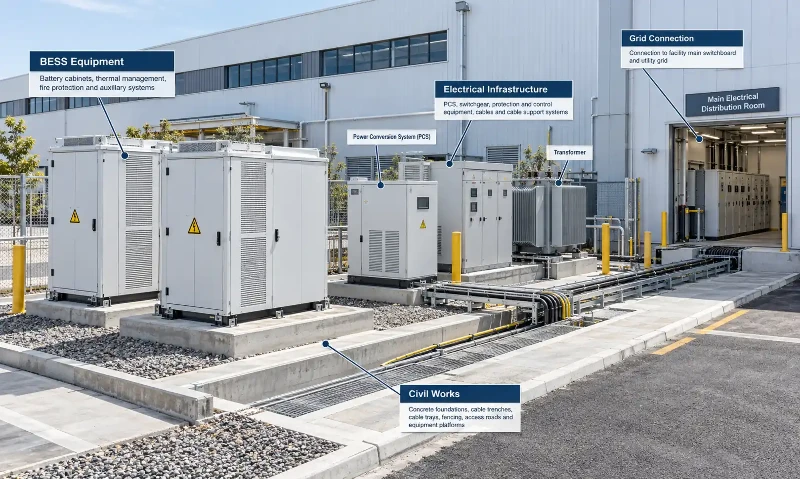
What Is Included in a Commercial BESS Installed Cost?
Total installed cost generally covers the equipment and the work required to install, connect, test and commission a BESS within a defined project boundary. It is not interchangeable with the battery pack price, the equipment supply price or a manufacturer's catalog price.
Before using any quoted cost, establish what the seller means by the following terms:
| Pricing term | What the price may cover | What still needs confirmation |
|---|---|---|
| Battery pack price | Cells, modules or assembled battery packs within a stated DC supply boundary. | Racks, BMS, enclosure, protection, PCS, cooling and installation may be outside the price. |
| Equipment-only package | Contracted BESS hardware, potentially including cabinets, BMS, PCS, cooling and local controls. | The exact bill of materials, factory tests, delivery location, unloading and field services. |
| Delivered equipment | Equipment plus transport to an agreed destination. | Incoterms, customs clearance, duties, insurance, unloading and on-site placement. Delivery to a port is not delivery to the final pad. |
| Turnkey EPC | Engineering, procurement and construction services within the EPC contract's defined limits. | Utility-owned works, permits, taxes, interconnection charges, owner-supplied facilities and other explicit exclusions. |
| Owner's total project cost | The contracted work plus remaining owner costs needed to complete the project. | Financing, land, independent engineering, utility charges, taxes, contingency and any work outside the EPC scope. |
Neither "equipment-only" nor "turnkey" is a universal bill of materials. An outdoor battery storage cabinet may integrate several subsystems, but its equipment scope says nothing by itself about the site's foundation, upstream protection or utility approval. These boundaries must be written into the quotation and contract.
Equipment Cost vs. Total Installed Project Cost
The most common purchasing mistake is treating a hardware proposal and an EPC proposal as competing prices for the same deliverable. A supply-only vendor may provide a tested cabinet at an agreed shipping point. A separate contractor must then receive it, build the electrical connection, commission it and resolve interfaces with the existing facility.
The following matrix is a scope-checking tool, not a statement that all EPC contracts include every listed item.
| Scope item | Equipment-only purchase | Turnkey EPC proposal | Item to confirm |
|---|---|---|---|
| Battery system, BMS and PCS | Confirm supplied components. | Confirm complete equipment schedule. | Integrated or separately supplied equipment; interface responsibility. |
| Factory acceptance testing (FAT) | Confirm tests and documentation included in supply. | Confirm test witnessing and acceptance requirements. | Test procedure, travel costs and remedy of deficiencies. |
| Freight and customs | Defined by delivery terms. | Included only if listed. | Incoterms, destination, duties and insurance. |
| Unloading, lifting and placement | Often outside supply; verify. | Confirm explicit responsibility. | Equipment weight, crane or forklift, access and lift plan. |
| Foundations, drainage and trenches | Usually assigned to site contractor or owner. | Included only within agreed civil scope. | Geotechnical assumptions and site restoration. |
| Transformers, switchgear and AC cabling | Confirm package electrical boundary. | Confirm point of connection and supplied ratings. | Existing equipment upgrades, protection and metering. |
| Utility studies and connection fees | Typically managed outside equipment supply. | Responsibility varies by contract. | Study fees, applications and utility-owned assets. |
| Site acceptance testing (SAT) and commissioning | Remote support or optional site service as quoted. | Confirm test scope and handover criteria. | Labor, travel, grid witness testing and retesting. |
| Training, software and service | Confirm licenses and support term. | Confirm handover and service obligations. | Subscriptions, spare parts, warranty labor and response times. |
Each row needs one named party responsible for delivery and another, where necessary, responsible for acceptance. A shared understanding that an item is "by others" is not enough unless those others are identified.
Commercial BESS Installation Cost Breakdown
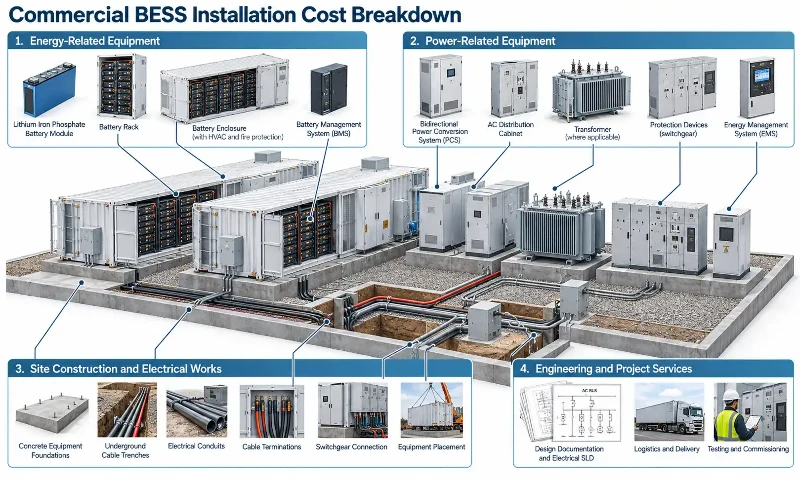
Commercial BESS cost is easier to assess when the budget is split into energy-related equipment, power-related equipment, installation work and project-specific expenses. This is more informative than comparing systems on $/kWh alone.
The 2025 Annual Technology Baseline commercial battery storage model, published by the National Laboratory of the Rockies, separates battery energy cost, balance-of-system power cost and a fixed cost component. Its published benchmarks use modeled historical assumptions and projections; they are not universal 2026 quotations for commercial sites.
Battery and Power Equipment
- Cells, modules, racks and battery management: the battery's DC energy block, monitoring, electrical protection and associated enclosure components.
- Power conversion system: the bidirectional inverter, controls and associated AC/DC interfaces. The power conversion system (PCS) determines which power-conversion functions are provided within the package; a separate transformer or switchboard may still be required.
- Thermal management: fans, HVAC or liquid-cooling components and their electrical supplies, pipework and maintenance interfaces, as applicable.
- Safety equipment: monitoring, detection, emergency shutdown, protective devices and fire-safety features appropriate to the tested system and installation design.
- Energy management and communications: the energy management system (EMS), controller, meters, communications hardware and any licenses required to operate the specified use case.
Site Construction and Electrical Balance of Plant
- Civil works: foundations, earthworks, cable trenches, ducts, drainage, protection barriers and restoration of affected surfaces.
- Electrical balance of plant: AC distribution boards, transformers where required, switchgear, protection relays, meters, conduits, power and control cabling, earthing and lightning protection as specified.
- Installation labor: receiving and positioning equipment, electrical termination, functional testing, integration and on-site supervision.
- Grid interface: equipment and studies needed for the agreed connection point, including utility-specific metering and protection if required.
Engineering, Logistics and Other Project Costs
- Design and approvals: drawings, protection coordination, structural assessments, fire reviews, permit submissions and independent engineering where required.
- Delivery: freight, insurance, customs, inland transport, storage, unloading and specialist lifting within the agreed delivery boundary.
- Testing and handover: FAT witnessing, site tests, commissioning, operator training, documentation and acceptance support.
- Owner's costs: financing, utility charges, taxes, insurance, contingency and any separately contracted work.
For budgeting, a useful classification is energy-related costs ($/kWh), power-related costs ($/kW), fixed or site-specific costs, and owner costs. A higher energy capacity may spread some fixed costs over more kWh, but it does not eliminate site-specific electrical or construction work.
When a vendor supplies a price per kWh, check its denominator as carefully as its numerator. Nominal DC battery capacity, beginning-of-life usable DC capacity and usable AC energy at the delivery point are different measurements. A quote based on one should not be compared directly with a quote based on another.
Which Site Conditions Increase Installation Cost?
The equipment schedule only describes part of the project. Existing electrical infrastructure and physical access often determine the amount of construction needed to connect it.
| Site condition | Potential additional work | Evidence needed |
|---|---|---|
| Limited spare transformer or switchboard capacity | New transformer, breaker, switchboard section or revised connection arrangement. | Existing single-line diagram, equipment ratings, load data and connection study. |
| Protection or fault-level constraints | Protection upgrades, coordination studies, control integration or additional switching equipment. | Protective-device schedule, fault-level assessment and utility requirements. |
| Long distance to the connection point | Longer power cables, ducts, trenching and possibly a revised voltage architecture. | Site plan, cable route, installation method and voltage-drop assessment. |
| Restricted access or weak ground conditions | Special lifting arrangements, ground improvement, foundations or temporary access. | Delivery route, lifting study, equipment mass, soil and foundation details. |
| Limited fire clearances or access | Layout changes, additional engineered protection or a different siting approach. | Installation instructions, fire-test documentation, applicable code and AHJ review. |
| Operating-site restrictions | Night or weekend work, planned outages, phased cutover and additional testing. | Plant shutdown windows, work permits and commissioning plan. |
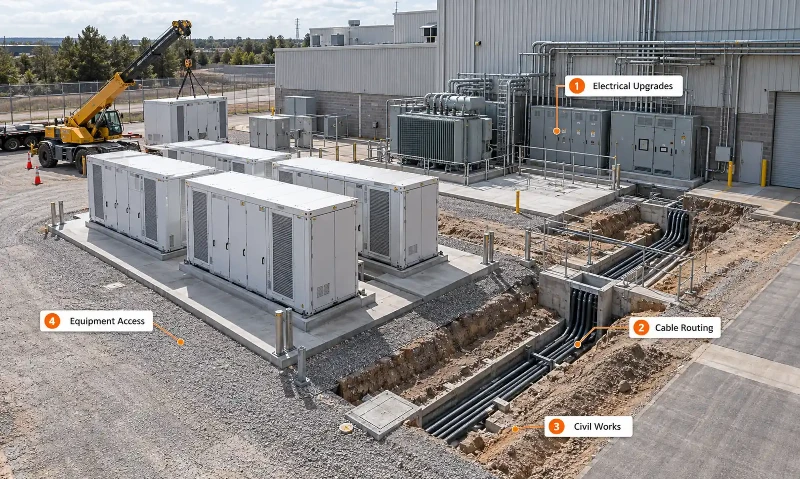
For a larger containerized BESS installation, the receiving route, lifting access, foundation and AC equipment location can change the work substantially. Equipment weight and required lifting method should be taken from the selected unit's approved drawings rather than assumed from a typical container.
Fire-safety requirements also affect layout and civil cost. In the United States, NFPA 855 addresses stationary energy storage installation; NFPA lists a 2026 edition, but the edition adopted by a particular jurisdiction may differ. The necessary spacing, protection features and installation conditions depend on the applicable rules and the equipment's tested configuration. As UL Solutions explains in its energy storage installation FAQ, UL 9540A is a fire-test method used to assess thermal-runaway propagation, not a stand-alone certification of every proposed site layout. The local authority having jurisdiction (AHJ) must be consulted before treating an installation arrangement as approved.
How Application Requirements Change the Installation Scope
The project application changes the interface work. The same battery rating may need different controls, switching and metering at a site designed for peak shaving, solar integration or backup power. The items below are possible additions, not a universal equipment list.
| Application | Equipment or controls that may be needed | Additional site work to check |
|---|---|---|
| Peak shaving and tariff management | Load meters, EMS integration and dispatch controls. | Connection-point metering, communication with existing site controls and utility requirements. |
| Solar PV retrofit | AC-side switching and controls, or DC-side equipment if a DC-coupled design is selected. | Existing PV inverter compatibility, protection changes, cable routes and revised single-line diagrams. |
| Backup power and islanding | Grid-forming capability where specified, transfer or isolation equipment, microgrid controls and protection coordination. | Critical-load separation, grounding and neutral arrangements, transfer testing and safe reconnection. |
| EV charging support | Load-management controls, charging interface equipment and compatible distribution architecture. | Parking-area cable routes, feeder capacity and possible service upgrades. |
| Grid services or market participation | Qualified metering, communications, telemetry or dispatch interfaces as required by the program. | Meter installation, communications testing and market or utility qualification work. |
Solar retrofits illustrate the importance of defining the interface before pricing: AC-coupled and DC-coupled battery storage can have different conversion equipment and integration requirements. A supplier should not price a PV retrofit as if its interconnection arrangement were already known.
Backup capability also requires a deliberate specification. A grid-tied BESS should not be assumed to operate as an islanded backup supply unless the agreed PCS, switching, protection and controls support that function.
Where Commercial BESS Quotes Commonly Exclude Costs
When quotations are incomplete, the missing cost often appears at a handoff between contracts. Check the exclusions page and the drawing showing exactly where the vendor's scope ends.
Electrical Infrastructure
- Transformers and medium-voltage equipment: a quote may stop at the PCS AC terminals rather than include a required transformer, switchgear or upstream feeder.
- Protection and utility metering: additional relays, witness tests or approved meters may be specified after an interconnection review.
- Cable runs and terminations: a unit price may allow for internal cabinet wiring but not field cabling to the main distribution point.
Logistics and Civil Works
- Unloading and rigging: delivery terms may end at the truck or site gate, with lifting and placement left to the buyer.
- Trenching and foundations: unknown soil conditions, buried services and surface reinstatement can change the civil scope.
- Site safety integration: emergency stops, fire-alarm interfaces, signage, barriers and access arrangements may require coordination with existing facility systems.
Software, Testing and After-Sales Services
- Software licenses: a functional EMS may still depend on separately priced cloud access, data services or future subscription renewals.
- Commissioning: remote technical support is different from an on-site team responsible for testing and grid energization.
- Warranty service: parts coverage does not automatically include site labor, travel, shipping or guaranteed response time.
A stated exclusion is not automatically a problem. An exclusion becomes a budget risk when the purchaser has neither priced it nor assigned responsibility for completing the work.
How to Normalize Two Commercial BESS Quotations
Start with the same technical requirement, then compare the delivery scope. Otherwise, a cheaper quotation may simply describe a smaller system or a lower level of service.
Illustrative RFQ basis: 125 kW continuous AC output, at least 200 kWh of usable AC energy at the specified delivery point and test conditions, the same ambient design requirements, agreed grid connection point, and identical acceptance criteria. These are comparison assumptions, not published performance claims for a particular product or actual supplier bids.
For reference, a manufacturer's 125 kW / 241 kWh cabinet specification identifies a product's advertised power and nominal energy ratings. It does not establish the required usable AC energy, installed project scope or total site cost. Those must be confirmed separately.
| Comparison item | Supplier A: equipment-only | Supplier B: installation package | Clarification before comparison |
|---|---|---|---|
| Continuous AC power | 125 kW required | 125 kW required | Confirm rating duration, temperature and AC measurement point. |
| Usable AC energy | Minimum 200 kWh required | Minimum 200 kWh required | Same test boundary, beginning-of-life assumptions and reserve conditions. |
| Battery, PCS, BMS and cooling | Quoted equipment package | Quoted equipment package | Compare bill of materials, warranties and approved datasheets. |
| Freight and site delivery | Supplier's delivery term to be confirmed | Included to agreed point only if stated | Incoterms, duties, insurance, unloading and storage. |
| Foundation and drainage | Excluded pending civil quote | Scope to be confirmed | Drawings, ground assumptions and reinstatement. |
| AC cable and switchgear work | Excluded pending site electrical quote | Scope to be confirmed | Connection boundary, cable length and protection upgrades. |
| Commissioning | Remote support; on-site attendance to be priced | On-site scope to be confirmed | Grid testing, travel, retesting and handover documents. |
| Utility studies and fees | Outside equipment price | Confirm EPC or owner responsibility | Application, utility works and meter approval. |
| Software and after-sales service | Confirm licenses and service terms | Confirm licenses and service terms | Renewals, monitoring access, parts and site labor. |
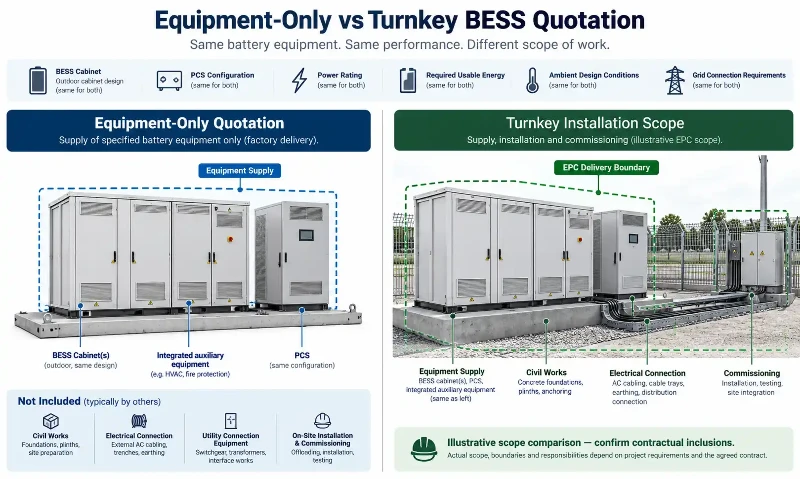
The table deliberately does not assign prices. The buyer should obtain a priced schedule for every excluded item from the party who will perform it. If Supplier B includes a task but Supplier A does not, add a like-for-like third-party quotation to Supplier A's budget rather than assuming that the item is free or already covered.
A Practical Cost-Comparison Method
- Freeze the design basis: agree on AC power, usable AC energy, ambient conditions, use case and point of interconnection.
- Mark scope boundaries: record what each vendor supplies, installs, tests and warrants.
- Price the exclusions: request site-specific electrical, civil, transport, permitting and commissioning costs.
- Add owner costs: include utility charges, taxes, independent services and appropriate project contingency without double counting contractor allowances.
- Compare the same deliverable: review the resulting installed project budgets alongside interface risk, warranty responsibilities and acceptance conditions.
Comparable installed budget = quoted supplier scope + independently priced excluded work + applicable owner costs + identified contingency. If an EPC price already includes an item, do not add it again. Equally, do not treat a provisional sum as a firm price without checking its assumptions.
A quoted cost per kWh can help with an initial comparison only after these boundaries are aligned. It should not replace a line-by-line scope review.
What Information Is Needed for a Reliable Installed-Cost Estimate?
An accurate project estimate depends on the quality of the site information available. A manufacturer can provide an equipment budget before detailed site engineering, but a firm installed price usually requires a defined connection design and agreed exclusions.
| Estimate stage | Information needed | What it can support |
|---|---|---|
| Budgetary estimate | Project location, target kW/kWh, application, intended connection voltage, preliminary layout and available electricity or load data. | Early screening and a preliminary equipment-and-installation allowance. |
| Preliminary proposal | Existing single-line diagram, transformer and main switchboard ratings, site photographs, proposed cable route, physical access and utility requirements known to date. | Supplier comparison, engineering options and a developing responsibility matrix. |
| Firm contractual quotation | Controlled technical specification, confirmed installation scope, site surveys, agreed drawings, named exclusions, delivery terms, acceptance criteria and contractual conditions. | Contract negotiation and procurement, subject to the stated validity period, assumptions and change-control terms. |
The U.S. Department of Energy's Battery Energy Storage System Procurement Checklist provides a structured set of early-stage tasks and questions for commercial-scale lithium-ion BESS procurement. It is a useful reference for preparing technical information and identifying open responsibilities before issuing a request for quotation.
A practical RFQ package should include:
- Project address, intended service and applicable regulatory or utility jurisdiction.
- Required continuous power (kW), usable energy (kWh), duty profile and operating conditions.
- Existing single-line diagram, main incoming voltage, transformer data and protection arrangement.
- Site plan showing proposed equipment location, cable route, access and drainage.
- Any existing PV, backup generation, critical-load or EV-charging interfaces.
- Delivery destination, unloading arrangements, target energization date and work-window restrictions.
- Known fire-safety, permitting, grid-study and monitoring requirements.
- Requested delivery boundary, commissioning services, warranty and maintenance provisions.
Unresolved site conditions should be listed as assumptions, allowances or exclusions, not silently included in a supposedly final price. A binding price is only binding within its agreed contractual scope; it is not a promise that all later site changes are covered.
Frequently Asked Questions
What does commercial BESS installation cost include?
It can include the battery and PCS, supporting electrical equipment, foundations, cabling, construction labor, commissioning and grid-interface work. The exact total depends on the contractual boundary. Always review what is excluded from the quoted amount.
Does an equipment-only BESS quotation include installation?
Not unless the quotation says so. Equipment supply may include factory testing and agreed delivery services, but civil work, AC cabling, installation labor, connection studies and site acceptance work often require separate contracts.
Are transformers and switchgear included in a turnkey BESS price?
Not automatically. A turnkey proposal covers the work defined in its contract, which may stop at a stated connection point. Confirm transformer, switchgear, relay, metering and utility-owned equipment responsibilities in the electrical scope schedule.
Why can two commercial BESS quotations differ so much?
The proposals may differ in rated or usable energy, power, cooling, equipment integration, delivery terms, installation works, testing, warranties and excluded costs. Compare both the technical basis and the scope before drawing conclusions from price per kWh.
Which site conditions can increase battery storage installation cost?
Limited transformer capacity, obsolete switchgear, long cable routes, difficult soil conditions, restricted equipment access, fire-safety layout requirements and complex utility connection rules can add work. Their impact must be assessed for the actual site.
What documents are needed for a BESS installed-cost quotation?
Start with the required kW/kWh, project location, application, site plan and existing electrical single-line diagram. More developed quotations need connection ratings, cable routes, civil conditions, technical specifications, delivery terms, testing requirements and a responsibility matrix.
Conclusion
The installed cost of a commercial battery storage system is the cost of delivering an operational project within a stated boundary-not simply the price of its battery cabinets. The most reliable comparison sets the same technical requirements for each supplier, prices work left outside each contract and names who is responsible for every interface. That is how buyers distinguish a genuinely competitive proposal from a low equipment price followed by unbudgeted site work.