


Commercial battery backup systems are often sized by battery capacity first-but that is not always the right starting point.
During an outage, only part of a facility's connected load may need to stay online, and different loads can have very different interruption tolerances.
The key questions are: Which loads are critical? How much interruption can they tolerate? And how long must backup power continue?
The sections below explain how to identify critical loads, determine the required backup power and energy, and select a suitable system configuration.
What Is a Commercial Battery Backup System?
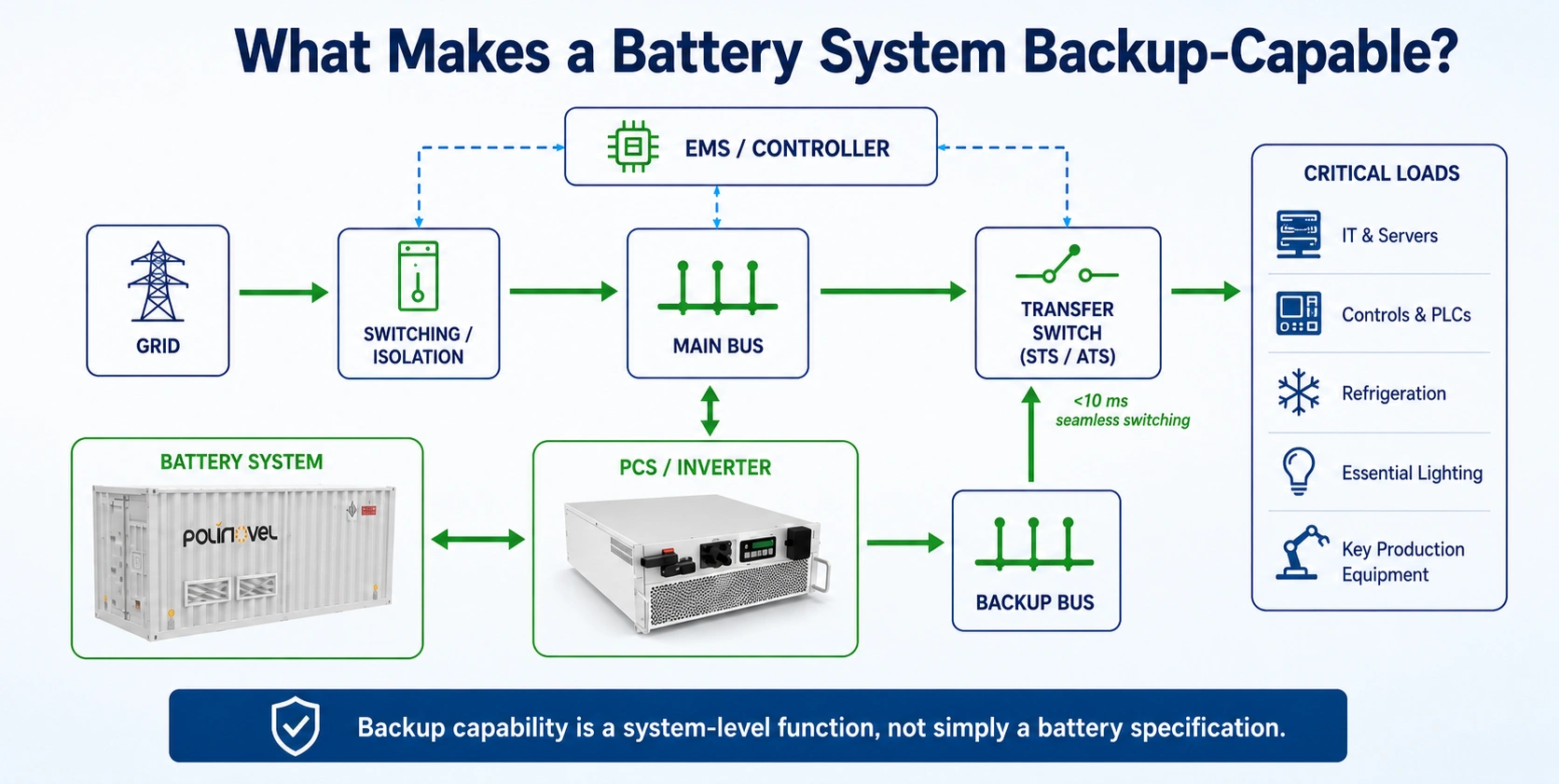
A battery backup system stores energy and supplies selected facility loads when utility power is lost. However, having a battery on site does not automatically mean the facility has backup power.
For backup operation to work, the system also needs the right:
- Energy Storage Inverter / Power Conversion System (PCS) - to supply power to the loads
- Switching and isolation - to separate the site from the utility grid
- Control and protection - to manage the transition and keep operation within safe limits
- Backup circuits - to determine which loads remain powered
For equipment that cannot tolerate even a short interruption, such as servers, PLCs, and communication systems, a dedicated Energy Storage UPS may provide an additional protection layer.
Which Loads Need Backup-and How Sensitive Are They to Interruption?
Not every load needs the same level of protection during an outage.
Identify the Critical Loads
Three factors are especially useful when setting backup priority:
- Safety and compliance - Could losing the load create a safety or regulatory risk?
- Operational impact - Could the interruption stop an essential process, damage products, or cause costly downtime?
- Interruption tolerance - Can the load tolerate seconds or minutes without power, or must it remain continuously energized?
These factors help explain why backup priorities differ across a facility. NREL identifies critical load and anticipated outage duration among the key considerations when selecting and sizing technologies for resilience.
| Load Type | Typical Backup Priority | Interruption Sensitivity |
| Servers/IT /controls | High | Very high |
| Safety/security systems | High | High |
| Refrigeration / cold storage | Often high | Depends on process |
| Pumps/process equipment | Application-dependent | Application-dependent |
| Selected production equipment | Process-dependent | Process-dependent |
| EV charging | Often reducible | Usually lower |
| Non-essential HVAC/lighting | Often reducible or shed | Lower |
These are typical examples only. Actual priority depends on the consequence of losing the load and how much interruption the process can tolerate.
Critical-Load Backup vs Full-Site Backup
After the critical loads are identified, the next question is how much of the facility needs to remain operational.
Critical-load backup supports only the essential loads. Full-site backup is designed to support the entire facility load included within the defined backup boundary during an outage.
For example:
Facility peak demand: 500 kW
Required outage load: 130 kW
The backup system therefore does not automatically need to match the full 500 kW facility demand. A 500 kW facility does not necessarily need a 500 kW battery backup system.
How Much Backup Power and Energy Does the Facility Need?
After the backup scope is defined, system sizing comes down to two basic requirements: how much load must be supported and how long it must remain powered.
For a commercial battery backup system, these are expressed as power (kW) and energy (kWh).
Determine the Required Backup Power
Backup power should be based on the loads expected to operate at the same time during an outage.
Required Backup Power ≈ Simultaneous Critical Load
For example:
| Critical Load | Power |
| IT and controls | 20kW |
| Refrigeration | 40kW |
| Essential lighting | 10kW |
| Selected production equipment | 60kW |
| Total | 130 kW |
If all four load groups need to operate together, the starting backup power requirement is about 130 kW.
The final power rating may need to be higher if the site has motor starting currents, short power peaks, or equipment that starts at the same time. For AC loads, the design should also check kVA requirements, power factor, and the inverter or PCS transient overload capability. Load sequencing and load shedding can also affect the required inverter or PCS rating.
Determine the Required Backup Energy
Power tells you how much load the system must support. Energy determines how long the backup can continue.
Required Usable Energy ≈ Backup Load × Backup Duration
Using the same 130 kW critical load:
| Backup Duration | Required Usable Energy |
| 30 minutes | 65 kWh |
| 1 hour | 130 kWh |
| 2 hours | 260 kWh |
These figures are the basic energy requirement. Actual battery capacity should also account for usable SOC range, conversion losses, operating reserve, and battery degradation.
One point is easy to overlook: Enough battery capacity does not mean the system has enough backup power. The inverter or PCS must also be able to carry the required critical load.
How Does a Commercial Battery Backup System Respond to a Power Outage?
A commercial battery backup system operates differently before and after a grid outage. The key change is whether the facility is connected to the utility or operating from stored battery energy.
Before the Outage: Normal Grid Operation
Under normal conditions, the utility grid supplies the facility loads.
- Grid / Solar → Facility Loads
- Grid / Solar ↔ C&I Battery Energy Storage Systems (C&I BESS)
The C&I BESS can charge from the grid or solar and may also support peak shaving, solar energy shifting, or other site energy management functions.
After Grid Loss: Backup Operation
When utility power is lost, a backup-capable system can switch to supplying the designated critical loads:
C&I BESS → Designated Backup Loads
But a grid-connected battery does not automatically become backup power during an outage. The system must also support:
- Utility isolation to separate the facility from the grid
- Switching or transfer equipment to change the power source
- An inverter / PCS capable of the required backup or islanded operation
- Energy Management System (EMS) or controller logic to manage the transition
- Electrical protection and backup load distribution
Interconnection and islanding requirements must also be considered in the system design. IEEE 1547 addresses the interconnection and interoperability of distributed energy resources, including requirements related to abnormal grid conditions, power quality, and islanding.
For loads that cannot tolerate even a short transfer interruption, such as servers, PLCs, or communication systems, a dedicated Energy Storage UPS can provide a separate layer of backup protection.
Which Backup Configuration Fits the Project?
Once the backup requirements are defined, the next step is to select a configuration that matches the facility's load type, interruption tolerance, required power, and backup duration.
| Backup Requirement | More Natural Starting Point |
| Selected loads with very low interruption tolerance | Dedicated Energy Storage UPS |
| Critical facility loads requiring backup for a defined period | C&l BESS |
| Different load groups with different interruption requirements | UPS+C&IBESS |
| Backup + solar / peak shaving / energy management | C&I BESS |
| Large continuous load + long outage duration | BESS + Generator / Hybrid System |
| Entire defined facility load must remain online | Full-Site Backup Architecture |
1. UPS and C&I BESS Are Not Necessarily Either/Or
A commercial facility does not always need to choose between a UPS and a C&I BESS. The two can serve different backup requirements within the same site.
A UPS may protect selected loads where near-continuous power is required, while a C&I BESS can provide sustained backup for designated critical loads. In some projects, both systems may be used together.
The appropriate architecture depends on interruption tolerance, load characteristics, required power, and backup duration-not equipment category alone.
2. Long Backup Duration Can Change the Architecture
If a project involves both:
- Large continuous loads
- Long outage duration
simply increasing battery capacity may not always be the most practical approach. In these cases, a BESS + generator or another hybrid backup architecture may be considered for longer-duration support.
3. No Single Architecture Fits Every Facility
A backup design that works for one facility may not be suitable for another. The final architecture should reflect the site's load sensitivity, required backup power, backup duration, switching requirements, and existing electrical infrastructure.
A practical checklist
Before selecting a system, confirm the following project requirements:
- Critical load - How many kW must remain powered during an outage?
- Required backup duration - How long must those loads remain online?
- Maximum acceptable interruption - Does the load require near-continuous power, or is a short transfer acceptable?
- Load characteristics - Are there motors, compressors, pumps, or other loads with high starting or transient power requirements?
- Site electrical conditions - What are the site voltage, phase, and existing distribution arrangements?
- Existing energy sources - Will the backup system integrate with solar, generators, or other on-site generation?
- Backup scope - Is the project protecting selected critical loads or the full defined facility load?
- Safety and interconnection requirements - Which local codes, utility requirements, and applicable ESS standards must the project meet?
System-level safety and interconnection requirements should be confirmed for the target market and installation. Standards such as UL 9540 and IEC 62933-5-2:2025 address system-level safety considerations for energy storage systems, while grid-connected DER projects may also be subject to applicable interconnection requirements.
Overall, commercial battery backup should be sized around the facility's actual backup requirement-not battery capacity alone.
Once the critical loads, acceptable interruption, and required backup duration are defined, the appropriate power rating, energy capacity, and system architecture can be evaluated.
Planning a commercial battery backup project?
Share your critical load, required backup duration, site voltage, and existing power infrastructure with Polinovel. Our team can help evaluate a suitable backup configuration for your facility.