


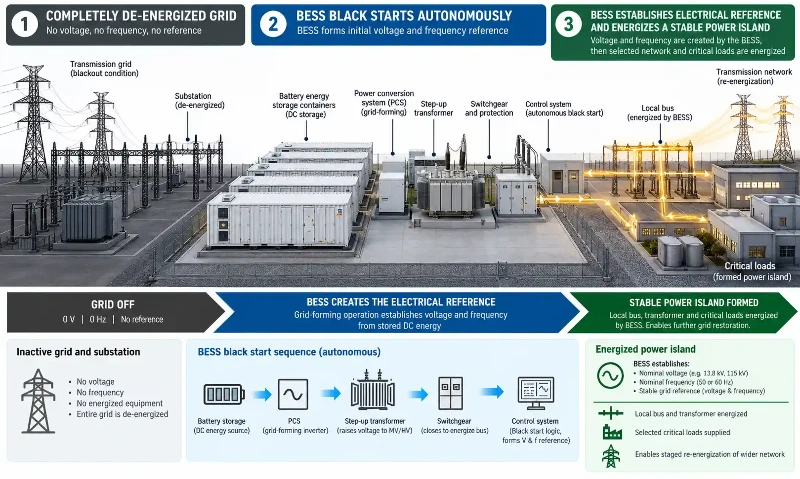
BESS black start is the ability of a battery energy storage plant to energize itself and a de-energized section of the power system without external grid power. A grid-forming power conversion system establishes the initial voltage and frequency reference, while the plant provides the auxiliary power, switching sequence, transformer energization and energy needed to build a stable electrical island.
Grid-forming capability is necessary for BESS black start, but it is not sufficient on its own. A plant also needs autonomous auxiliary power, sufficient state of charge, suitable protection, coordinated switchgear, compatible transformers, plant-level controls and a tested restoration sequence.
For utility-scale battery storage projects, black start is therefore a plant-level capability rather than a battery-cell specification or a single PCS operating mode.
What Is BESS Black Start?
A black start resource can begin operating when the surrounding network is de-energized and no external AC supply is available. In a BESS, stored DC energy provides the initial source of power, while the PCS converts that energy into a controlled AC voltage and frequency reference.
The first objective is not to restore the entire grid at once. It is to establish a stable energized section of the network. From there, operators can energize transformers and feeders, reconnect selected loads, start other generators or distributed energy resources, expand the energized island and eventually synchronize it with the wider system.
The U.S. Department of Energy explains that grid-forming inverters can establish their own voltage and frequency reference instead of relying on an already energized grid. That capability is one of the technical foundations for inverter-based black start and islanded operation. DOE guidance on grid-forming inverter services provides the broader grid-services context.
Why Grid-Forming Is Necessary-but Not Sufficient
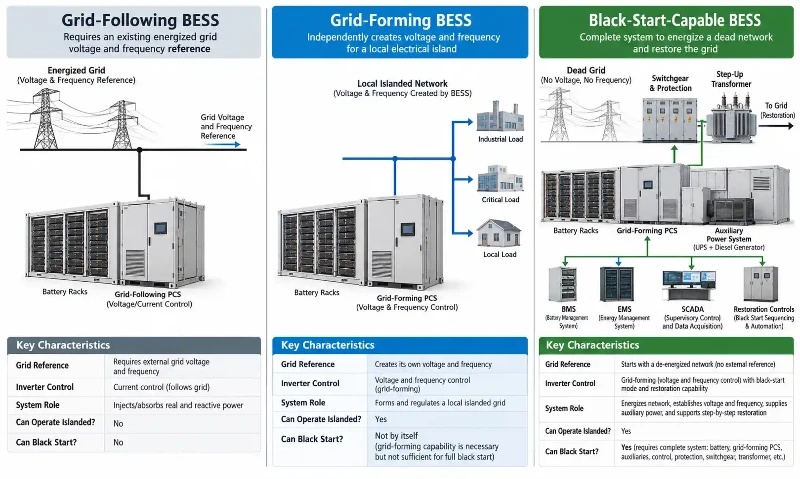
A standard grid-following inverter depends on an existing voltage waveform to synchronize its output. During a total blackout, that reference is absent. A grid-forming inverter can instead establish a local AC reference and regulate voltage and frequency within its operating limits.
That distinction is fundamental, but black-start capability requires more than an inverter control mode.
| Capability | What It Does | Role in Black Start |
|---|---|---|
| Grid-following | Synchronizes to an existing voltage and frequency reference | Cannot normally initiate restoration on a dead bus |
| Grid-forming | Establishes and regulates a local voltage and frequency reference | Provides the electrical reference needed to form an island |
| Black-start capable BESS | Combines grid-forming operation with autonomous auxiliaries, switching logic, protection, energy reserve and validated restoration procedures | Can execute a complete plant-level restoration sequence |
The power conversion system is central because it must regulate the island while remaining inside current, voltage, apparent-power and thermal limits. The energy management system also has an important role in preserving energy reserve, coordinating operating modes and preventing normal market dispatch from conflicting with restoration readiness.
Auxiliary Power Is Part of Black-Start Readiness
A BESS cannot form a grid if its own controls cannot wake up. During a widespread outage, the plant may need independent power for the BMS, PCS controls, switchgear controls, SCADA, communications, cooling, pumps and safety systems before the main inverter can begin energizing the AC network.
The auxiliary supply may come from station batteries, UPS systems or another dedicated design, but its size and required runtime are project-specific. It should be based on the actual restoration sequence, expected restart attempts and contingency margin rather than a universal kVA or hourly rule.
How Does a BESS Restore a Dead Grid?
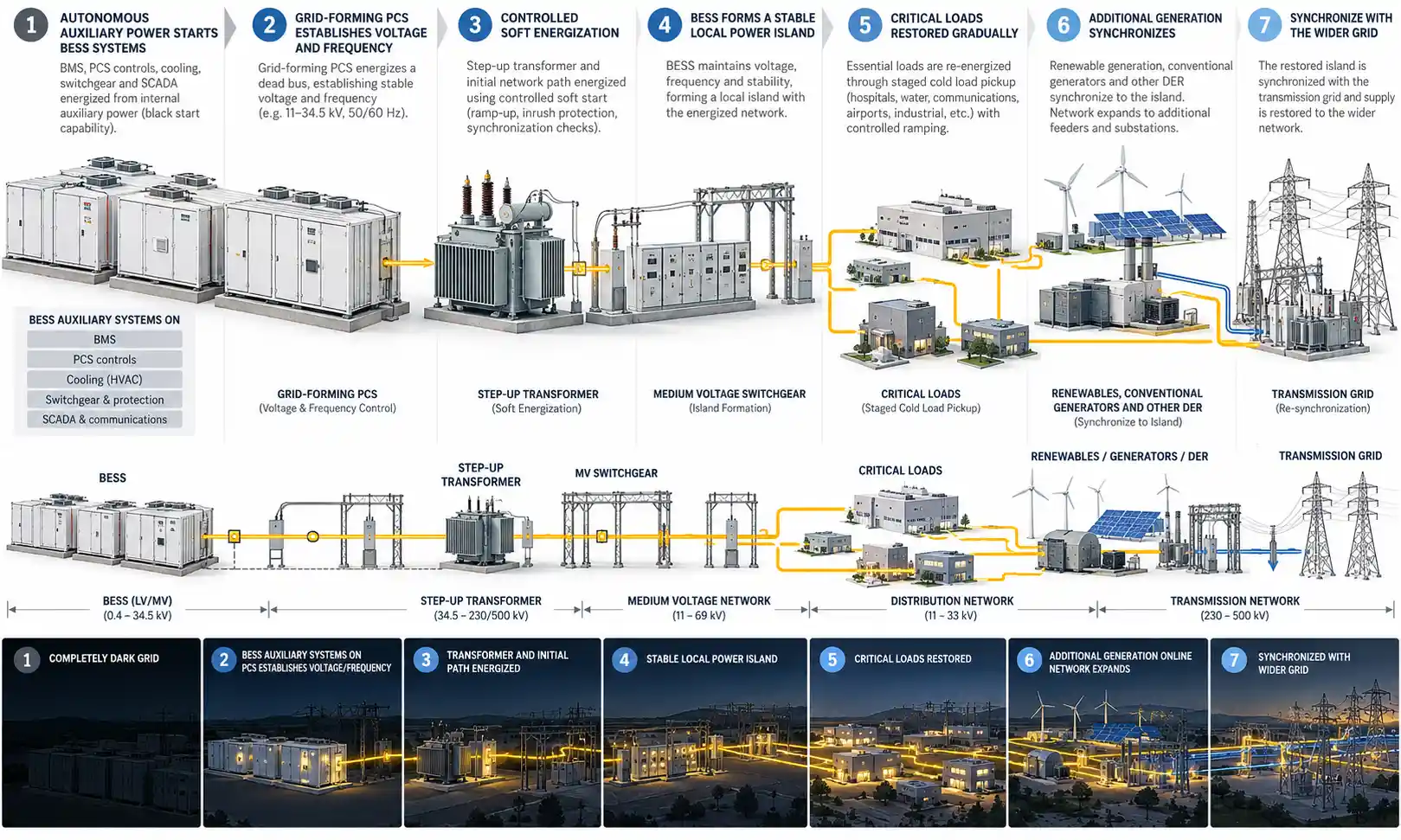
A practical black-start sequence is staged. Each step must leave enough active power, reactive power, current capability and stored energy for the next step.
Step 1: Start the Plant Auxiliaries
Internal DC reserves or an independent auxiliary supply start the BMS, PCS control boards, plant controller, communications, switchgear controls and the cooling or safety equipment required for operation.
Step 2: Establish Voltage and Frequency
The grid-forming PCS establishes the first AC voltage and frequency reference on the dead bus. At this stage the BESS is not simply injecting power into a grid; it is creating the electrical reference that other equipment will follow.
Step 3: Energize Transformers and the Initial Cranking Path
The next task is to energize step-up transformers, busbars, cables and selected feeder sections. Transformer energization can be one of the most demanding parts of the sequence because magnetizing inrush can push a current-limited inverter beyond its operating envelope.
Controlled voltage ramping or other soft-energization methods can reduce the transient compared with applying full voltage immediately. The correct method depends on transformer characteristics, residual flux, inverter controls and the protection scheme.
Step 4: Form a Stable Power Island
Once the initial electrical path is energized, the BESS maintains voltage and frequency while the restoration island is established. The plant must continue to support its own auxiliaries and remain inside PCS current and apparent-power limits.
This operating state is closely related to microgrid battery storage design, where stable island operation depends on coordinated controls, protection and load management rather than battery capacity alone.
Step 5: Pick Up Critical Loads in Stages
Loads are restored incrementally. Each pickup changes active and reactive power demand and can cause frequency and voltage excursions, particularly in a weak inverter-dominated island.
Cold load pickup makes this harder. After an outage, thermostatically controlled appliances, motors and other equipment may reconnect with less diversity than during normal operation, causing temporary demand above the eventual steady-state level.
Step 6: Add Other Generation and Expand the Island
As the island becomes stronger, grid-following renewable generation, additional BESS units or conventional generators can synchronize to the reference established by the grid-forming resource. The energized area can then expand along validated restoration paths.
Step 7: Resynchronize With the Wider Grid
Before two energized islands or an island and the restored bulk grid are connected, voltage, frequency and phase conditions must be within the allowable synchronization window. Tie breakers can then close according to the operator's restoration plan.
This staged sequence is consistent with the 2026 Nature Communications review of bottom-up blackstart restoration, which describes grid-forming resources establishing local islands, supporting stepwise load pickup, extending energized networks and merging islands after synchronization conditions are satisfied.
Why MW and MWh Alone Do Not Define Black-Start Capability
A 100 MW / 200 MWh BESS is not automatically capable of black-starting a 100 MW network. Nameplate MW and MWh describe only part of the system.
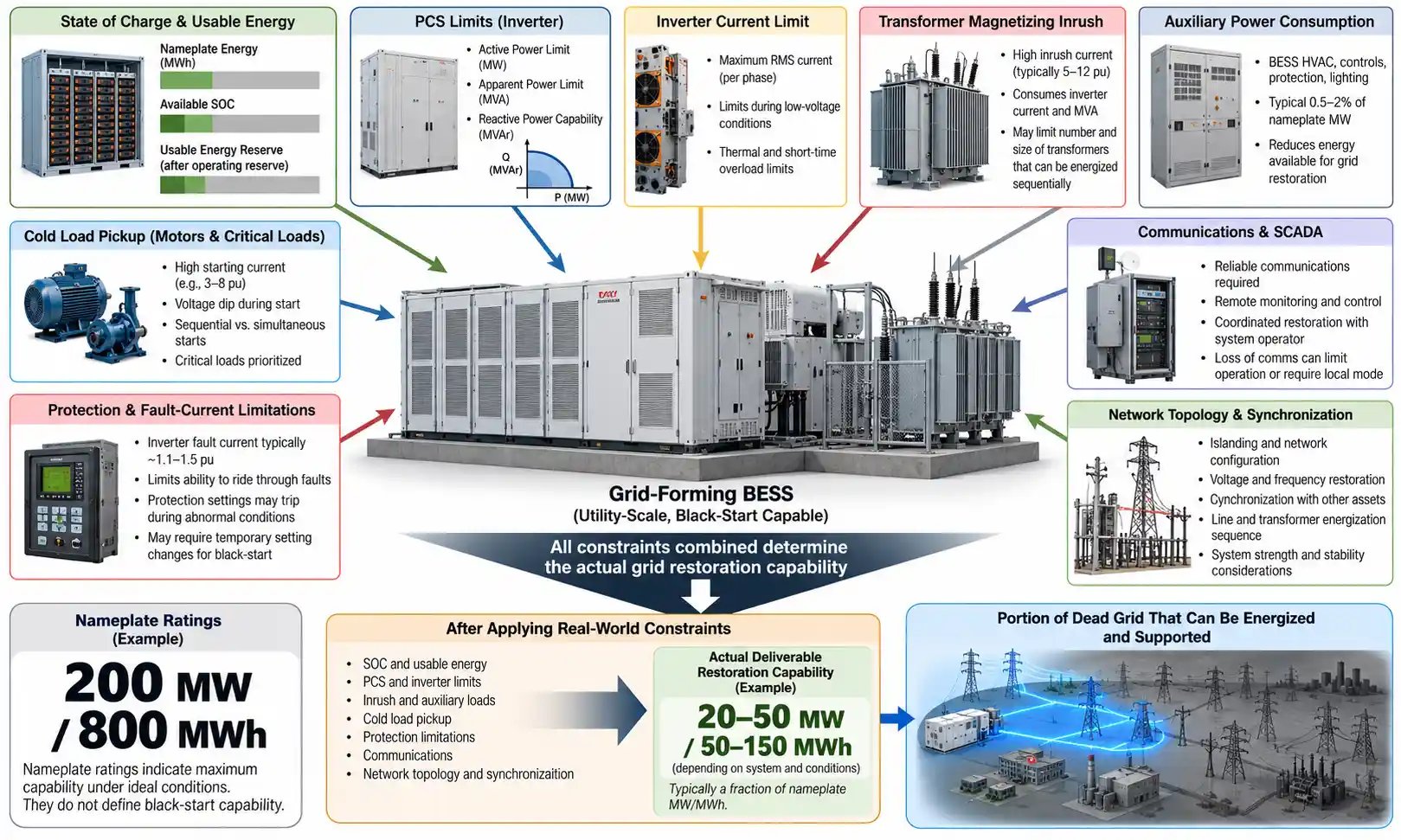
Actual black-start capability depends on the deliverable power and energy available at the specific restoration step.
| Factor | Why It Matters |
|---|---|
| Available state of charge | Determines how much energy remains for auxiliaries, energization, load pickup and subsequent restart attempts |
| PCS MW and MVA capability | Limits simultaneous active and reactive power delivery |
| Converter current limit | Constrains transformer energization, motor starting and fault response |
| Reactive-power headroom | Supports voltage control, transformer magnetization and line charging |
| Auxiliary load | Consumes part of the available battery power before external loads are restored |
| Transformer characteristics | Influence inrush, residual-flux behavior and energization strategy |
| Cold load pickup | Can temporarily raise restored active and reactive demand |
| Protection scheme | Must remain dependable despite inverter-limited fault current and changing topology |
| Network topology | Determines which cranking paths and switching sequences are feasible |
| Communications and controls | Support switching, monitoring, dispatch and synchronization through the restoration sequence |
The Nature review emphasizes the same point: bottom-up restoration feasibility is governed less by installed capacity than by deliverable active and reactive headroom, inverter current and apparent-power limits, load transients, protection and network conditions.
Transformer Energization Is One of the Hardest Black-Start Steps
Traditional synchronous generators can tolerate short-duration electrical transients differently from semiconductor-based converters. A BESS PCS protects its power electronics through explicit current limits, so transformer inrush cannot be treated as an unlimited short-duration event.
When a transformer is energized from a dead state, the core can enter saturation depending on the switching instant, residual magnetic flux and applied voltage waveform. The resulting current may be much higher than the steady-state magnetizing current.
A grid-forming BESS therefore needs an energization strategy that has been tested against the actual transformer and network model. Depending on the design, that may include controlled voltage ramping, flux management, switching coordination or other current-limiting measures.
The National Laboratory of the Rockies notes that inverter-based black start must account for inductive equipment and startup loads whose transient current can exceed what a current-limited inverter can supply. NLR's black-start research also stresses the need for testing to confirm that inverter-based resources can energize the equipment required by a restoration plan.
Cold Load Pickup and Reactive Power Can Limit Island Expansion
After a feeder has been de-energized, its first restored demand can be materially different from its normal pre-outage demand. Motors, compressors and thermostatically controlled equipment can reconnect at the same time, increasing both active and reactive demand.
The BESS must therefore preserve enough active-power and reactive-power headroom for each load step. Large voltage excursions or current saturation during pickup can destabilize the newly formed island.
Long cables and transmission lines create another challenge. Their charging behavior changes reactive-power requirements and can produce overvoltage under light-load conditions. The PCS must remain inside its MVA and current capability while simultaneously supporting frequency and voltage.
These constraints are why staged pickup and network-specific studies matter more than a generic rule such as restoring a fixed number of megawatts per step.
State of Charge Determines Whether Black Start Is Available When Needed
A BESS may be technically capable of black start but unavailable for the service if its state of charge is too low when the outage occurs.
There is no universal minimum SOC that applies to every black-start project. The reserve should be derived from the expected restoration duty, including:
- plant auxiliary energy
- transformer and network energization
- critical-load pickup
- generator cranking loads, where applicable
- expected island support duration
- the number of restart attempts required by the restoration plan
- contingency margin
That reserve creates an operating trade-off. Energy held for emergency restoration cannot always be committed fully to normal arbitrage or other market services. The plant's operating strategy must therefore balance revenue optimization with contractual black-start availability.
Protection Must Work With Inverter-Limited Fault Current
Protection is another reason black start cannot be evaluated from battery capacity alone. During restoration, network topology changes step by step, fault-current contribution can be much lower than in a synchronous system, and current direction can change as new resources and feeders are connected.
Conventional relay settings may lose sensitivity or selectivity under these conditions. The appropriate solution depends on the project and may involve differential, directional, adaptive or other protection approaches together with updated switching logic and communications.
For utility-scale projects, BESS grid compatibility should therefore include restoration-mode protection, not just normal grid-connected operation.
Traditional Top-Down vs Bottom-Up Grid Restoration
Conventional black start usually follows a top-down path: selected black-start generators energize transmission corridors, start larger generating units and progressively restore downstream networks.
Grid-forming BESS and other inverter-based resources create another option. They can establish local islands close to loads and then expand or merge those islands as additional resources become available.
| Restoration Feature | Traditional Top-Down | Inverter-Based Bottom-Up |
|---|---|---|
| Initial source | Black-start capable synchronous or conventional generation | Grid-forming BESS or other grid-forming DER |
| Initial energized area | Transmission path and selected generating stations | Local distribution or microgrid island |
| Restoration direction | Bulk system toward downstream loads | Local island toward larger network |
| Main constraints | Cranking paths, generator startup, transmission voltage control | Inverter headroom, current limits, cold load pickup, protection and island coordination |
| Expansion | Energize transmission and add generation | Pick up loads, add DER and merge synchronized islands |
Bottom-up restoration does not eliminate traditional black-start resources. It broadens the set of resources that can participate in system restoration and can allow some areas to be energized before the full upstream transmission path is restored.
Real-World Example: NESO Redhouse Grid-Forming BESS Trial
The UK's National Energy System Operator tested a grid-forming BESS as the anchor generator for a power island during the Distributed ReStart Redhouse live trial.
The test network included an 11.6 MVA, 8 MW / 8 MWh grid-forming capable BESS, two 11/33 kV distribution transformers, a 90 MVA 33/132 kV transmission transformer, a 10.6 km 132 kV overhead line, a 5 MVA load bank and a 3 MVA solar farm.
NESO reported that the BESS successfully acted as the anchor generator for the island. The trial is important because it demonstrates that inverter-based storage can do more than start itself: it can establish the electrical reference needed to energize and support a wider restoration island. The project details are available in the NESO Redhouse live-trial summary.
Another Black-Start Role: Starting Conventional Generation
BESS black start does not always mean the battery will carry the entire restoration island for an extended period. Storage can also provide the cranking power needed to restart conventional generators, which then take over a larger share of the restoration duty.
The California Energy Commission documents this approach at the Marsh Landing Generating Station. Its BESS provides 11.5 MW and 10.5 MWh and was installed to start the gas turbines after a grid blackout, supporting system restoration. The California Energy Commission project record describes the black-start function and the battery installation.
This example shows why black-start design must consider the complete cranking path rather than the BESS alone. The target generator's auxiliary loads, startup sequence, transformer path and required support duration all affect battery sizing.
Testing Matters More Than Marketing Claims
A black-start specification is meaningful only if the plant can perform the required sequence under the conditions defined by the restoration plan.
In North America, NERC Reliability Standard EOP-005-3 requires restoration plans to identify black-start resources, cranking paths and acceptable voltage and frequency limits. It also requires verification that black-start resources can meet real and reactive power requirements and dynamic initial-load requirements. Testing provisions include the ability to start while isolated and to energize a bus.
These requirements are summarized in NERC EOP-005-3, System Restoration from Blackstart Resources.
For a BESS project, validation may include steady-state studies, dynamic studies, electromagnetic transient models, protection studies, hardware-in-the-loop testing and field commissioning. The exact program depends on the grid operator and project scope, but the engineering objective is the same: demonstrate that the whole plant can execute the required restoration sequence without relying on assumptions that have not been tested.
Can Every Grid-Forming BESS Provide Black Start?
No. Grid-forming control gives a BESS the ability to establish an electrical reference, but a black-start plant must also be able to start itself, energize the required equipment, support the restoration island and remain coordinated through switching and synchronization.
A credible black-start assessment should confirm:
- autonomous auxiliary power
- sufficient SOC and usable energy reserve
- grid-forming PCS operation from a dead bus
- active and reactive power capability through the full sequence
- transformer and cable energization performance
- acceptable current-limited transient behavior
- protection performance under inverter-dominated conditions
- switchgear and breaker sequencing
- EMS, SCADA and communication availability
- validated cranking paths
- safe island expansion and load pickup
- synchronization with other energized areas
These requirements involve the wider battery energy storage system architecture, not only the battery racks or inverter firmware.
What Should Developers Specify for a Black-Start-Capable BESS?
Procurement documents should define the restoration duty instead of asking only whether the PCS has a grid-forming mode.
Useful project requirements include:
- the dead-bus starting condition
- required auxiliary loads and runtime
- minimum restoration energy reserve
- transformers and lines to be energized
- expected cold-load pickup blocks
- target generators or DER to be started
- required voltage and frequency operating envelope
- active, reactive and apparent-power requirements
- converter current and overload limits
- protection philosophy for islanded operation
- communications and SCADA requirements
- synchronization conditions
- modeling and commissioning tests
The design should also account for normal BESS duties. A system expected to provide energy arbitrage, ancillary services and black start needs an operating strategy that preserves restoration readiness without unnecessarily sacrificing the commercial use of the asset.
Frequently Asked Questions
What is BESS black start?
BESS black start is the ability of a battery energy storage plant to start without external grid power, establish voltage and frequency, energize part of a dead network and support a staged restoration sequence.
Does BESS black start require a grid-forming inverter?
Yes, a black-start BESS needs a source capable of establishing the initial AC voltage and frequency reference. Grid-forming control provides that function, but plant-level auxiliaries, protection, controls, energy reserve and switching capability are also required.
Can a grid-following BESS black start a dead grid?
A conventional grid-following BESS normally cannot initiate restoration because it depends on an existing voltage and frequency reference. It may join the restored island after a grid-forming resource has established that reference.
How much state of charge does a BESS need for black start?
There is no universal SOC requirement. The reserve depends on auxiliary consumption, transformer and network energization, load pickup, generator cranking duty, expected island duration, restart attempts and the margin required by the system operator.
Why is transformer energization difficult for a BESS?
Transformer magnetizing inrush can exceed a converter's short-duration current capability. The energization strategy therefore needs to account for PCS current limits, transformer characteristics, residual flux and protection settings.
Can BESS restore an entire grid by itself?
Usually not as a single step. A BESS can form and support an initial island, energize selected network sections and help start additional resources. Wider restoration normally proceeds through staged load pickup, network expansion, synchronization and coordination with other generation.
What is bottom-up grid restoration?
Bottom-up restoration starts with local grid-forming resources that establish energized islands near loads. Those islands expand, add other resources and eventually synchronize with neighboring islands or the restored bulk system.
Can BESS replace diesel or gas black-start generators?
BESS can replace or complement conventional black-start resources in some projects, but suitability depends on cranking loads, required duration, current capability, grid conditions and the restoration plan. Storage should be evaluated as one restoration resource rather than assumed to be a universal replacement.
Conclusion: Black Start Is a Whole-Plant Capability
BESS black start begins with grid-forming control, but successful grid restoration depends on much more than forming a voltage waveform. The plant must start its own auxiliaries, energize transformers and network sections within converter limits, maintain enough active and reactive headroom for cold load pickup, protect an inverter-dominated island and synchronize restored sections safely.
The most important sizing question is therefore not simply how many MW or MWh the battery has. It is whether the complete BESS component system can deliver the required restoration sequence under the actual network, load and protection conditions.
A grid-forming BESS can be a powerful black-start resource, but only when battery reserve, PCS capability, auxiliaries, controls, switchgear, transformers, protection and operator procedures are engineered and validated as one system.