


BESS repowering should be evaluated when an aging battery storage asset can no longer meet required usable capacity, availability, market, or compliance targets and restoring those capabilities is worth more than continuing to operate the existing system as-is. The decision should be based on measured asset condition and remaining-life economics, not a fixed calendar age.
A system that has operated for many years does not automatically need replacement. Some projects can continue operating with acceptable performance, while others are better served by augmentation, partial replacement, or a broader repowering program. For owners of utility-scale battery storage projects, the practical question is whether the remaining value of the site, grid connection, and reusable equipment justifies new investment in batteries and controls.
What Is BESS Repowering?
BESS repowering is a system-level renewal of an operating battery storage asset. It usually involves replacing a significant share of degraded battery cells, modules, racks, or complete DC blocks and may also include upgrades to the power conversion system, battery management system, energy management system, thermal management equipment, controls, or communications.
Repowering is different from routine maintenance. Replacing an isolated failed module does not automatically make a project a repowering program. The term is more useful when the work is intended to restore or materially improve the long-term performance, compatibility, or commercial capability of the asset.
The distinction matters because repowering affects more than battery capacity. A new battery block must still operate correctly with the existing electrical architecture, protection system, controls, cooling equipment, transformer, switchgear, site layout, and grid connection.
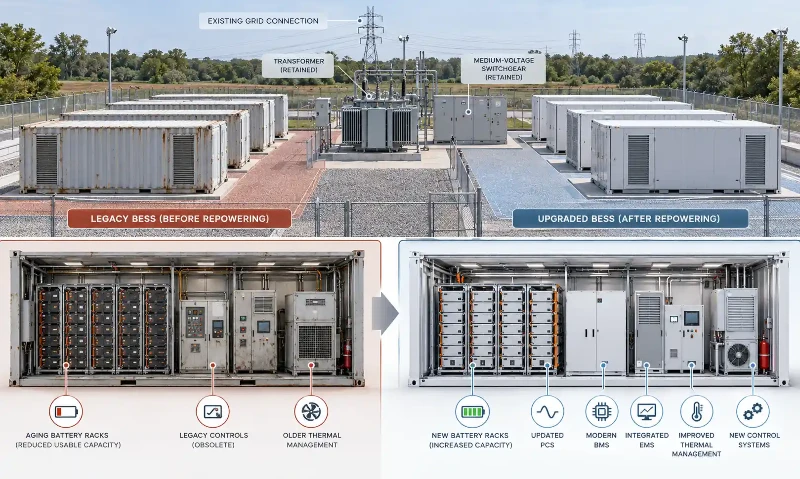
BESS Repowering vs Augmentation, Replacement, and Decommissioning
These lifecycle strategies solve different problems and should not be treated as interchangeable.
| Strategy | Primary Objective | Typical Trigger | Battery Scope | System Impact |
|---|---|---|---|---|
| Continue operating | Use remaining asset capability without major capital work | Usable energy, availability, and compliance remain acceptable | No major change | Low |
| Augmentation | Add capacity to offset fade or increase duration | Capacity has declined but the legacy system remains healthy and compatible | Adds new battery capacity alongside existing capacity | Low to medium |
| Repowering | Restore asset performance and renew aging technology | Material battery degradation, technology obsolescence, compatibility problems, or changing project requirements | Partial or substantial replacement of battery blocks, often with associated system upgrades | Medium to high |
| Component replacement | Correct a failed or severely degraded component | Localized failure or warranty event | Limited to affected equipment | Depends on component |
| Decommissioning | Retire the asset safely | Remaining project value no longer supports further investment | Equipment removed or otherwise retired | Permanent shutdown |
Augmentation is most useful when the existing battery and balance-of-system remain serviceable but usable energy has fallen below a preferred level. Repowering becomes more relevant when the problem is broader: widespread module aging, obsolete controls, poor compatibility with replacement batteries, rising forced outages, or new operating requirements that the original system was not designed to meet.
When Should a BESS Be Repowered? Five Decision Triggers
Capacity fade alone is not enough to justify a major asset renewal. A credible BESS repowering decision should examine at least five separate triggers.

1. Capacity Trigger
The first question is whether the system can still deliver the usable MWh required by its contract, market position, or operating strategy.
Battery aging gradually reduces usable energy. The relevant measure is not a generic annual degradation percentage but the difference between actual performance and the project's expected degradation curve. Owners should compare measured state of health, usable energy at the point of interconnection, discharge duration, and energy throughput against the original performance guarantees and current commercial requirements.
Existing BESS performance indicators such as usable capacity, efficiency, availability, and state of health are more useful for this decision than the calendar age of the plant.
2. Availability Trigger
A project can still have acceptable nominal capacity while producing poor commercial results because too many racks or subsystems are unavailable.
Warning signs include repeated module faults, rising inverter trips, frequent DC contactor or fuse failures, increasing rack isolation, extended maintenance outages, or recurring thermal-management alarms. If the plant spends more time unavailable during valuable market periods, the economic effect can become more important than capacity fade itself.
3. Technology Trigger
Battery cells are not the only components that age. Older PCS, BMS, EMS, communication hardware, and control platforms can become operational bottlenecks even when much of the battery capacity remains usable.
A legacy power conversion system may limit charging and discharging behavior, fault response, or compatibility with a new battery voltage window. Likewise, an outdated energy management system may no longer support the data, communications, or dispatch logic expected in current market operations.
In these cases, adding more battery capacity may not solve the underlying problem. Repowering may need to address both the battery block and the control or power-conversion layer.
4. Compliance and Grid Trigger
Older storage assets may have been designed under different grid, safety, telemetry, cybersecurity, or interconnection requirements. A project that once qualified for its intended service may require equipment or control changes before it can continue participating in the same way or enter a new market.
Grid compatibility should therefore be reviewed before selecting a repowering scope. Changes in battery chemistry, PCS characteristics, fault current behavior, protection settings, or maximum import and export capability can affect the approved electrical design. Existing BESS grid compatibility requirements remain relevant even when the physical site and interconnection point do not change.
5. Economic Trigger
The final trigger is economic. Repowering becomes worth serious evaluation when the value recovered from renewed performance is greater than the full cost and risk of the upgrade.
That comparison should include lost revenue from degraded performance, rising O&M costs, expected future failures, remaining warranty coverage, project downtime, replacement equipment, engineering work, integration, recycling, and the value of extending the commercial life of the site.
A 2026 peer-reviewed study on battery storage repowering models capacity degradation and long-term replacement decisions together, reinforcing the point that repowering is an optimization problem rather than an age-based maintenance event. The study in Future Batteries evaluates replacement of degraded cells as part of long-term revenue optimization.
Signs an Aging BESS May Need Repowering
A repowering assessment should start with measurable evidence. The following conditions do not automatically require repowering, but several appearing together usually justify a deeper technical and financial review.
- Usable energy repeatedly falls below contractual or operational requirements.
- Measured degradation is materially worse than the original OEM or financial model.
- Rack-to-rack or module-to-module imbalance is increasing.
- Forced outages or maintenance events are becoming more frequent.
- Cooling equipment requires repeated repair or can no longer maintain stable operating conditions.
- Replacement modules or spare parts are difficult to source.
- Original warranties are expiring while failure risk is increasing.
- The existing PCS, BMS, EMS, or communications platform limits new operating strategies.
- Previous augmentation has created a fragmented site with several generations of cells or software.
- The project can no longer satisfy new grid, safety, or market participation requirements without substantial modification.
Thermal history deserves particular attention because long-term cell performance is closely tied to operating temperature and thermal consistency. Rather than applying one universal temperature rule, owners should compare actual operating data against the manufacturer's allowable range and expected degradation model. For system-level context, BESS thermal management should be reviewed alongside cell condition and cooling-system reliability.
Use Asset Data, Not Generic Repowering Thresholds
There is no reliable universal rule such as "repower after 10 years" or "replace the battery after a fixed percentage of annual capacity loss." Different duty cycles, climates, cell chemistries, C-rates, state-of-charge windows, market strategies, and maintenance practices produce different aging paths.
A useful assessment therefore tracks project-specific metrics over time.
| Metric | Why It Matters |
|---|---|
| Usable energy at POI | Shows whether the asset can still deliver the required MWh and duration |
| State-of-health trend | Shows whether actual degradation is tracking above or below the expected curve |
| Rack and module availability | Identifies localized reliability problems that reduce usable system capacity |
| Forced outage rate | Measures the commercial impact of equipment aging |
| Equivalent full cycles and throughput | Provides context for cyclic aging and warranty use |
| Round-trip efficiency | Indicates whether system losses are materially changing with age |
| O&M cost trend | Shows whether continuing to operate the legacy platform is becoming uneconomic |
| Warranty status | Changes who carries the cost of future failures |
| Spare-parts availability | Indicates whether the existing battery and controls remain maintainable |
| Remaining project and site life | Sets the time available to recover repowering CAPEX |
BESS Repowering Decision Framework
The objective is not to repower every aging asset. It is to identify the least-cost path that preserves or improves the remaining value of the project.
| Asset Condition | Continue Operating | Augmentation | Repowering | Decommissioning |
|---|---|---|---|---|
| Usable capacity still meets contract and operating requirements | Preferred | Usually unnecessary | Usually unnecessary | No |
| Capacity fade is material, but legacy equipment remains healthy and compatible | Assess | Strong candidate | Assess | Usually no |
| Widespread module aging or severe imbalance | Weak option | May not solve root cause | Strong candidate | Assess |
| PCS, BMS, or EMS is obsolete | Weak option | Usually insufficient | Strong candidate | Assess |
| New and old battery technologies are difficult to integrate | Assess | Difficult | Strong candidate | Assess |
| Interconnection remains valuable but the battery block is obsolete | Weak option | Assess | Strong candidate | Usually weak |
| Project cannot meet updated grid or market requirements | Weak option | May be insufficient | Strong candidate if compliance can be restored | Assess |
| Remaining lease, permit, or commercial life is short | Assess | Weak economics | Often weak economics | Strong candidate |
What BESS Equipment Can Be Reused During Repowering?
Repowering should not assume that every part of the original project must be removed. The battery often has a shorter service life than several balance-of-system components, so reuse can preserve substantial project value.
UK government guidance on grid-scale battery storage specifically notes that repowering may involve replacing or upgrading battery modules while retaining some electrical equipment. It also stresses that the condition and rated lifetime of reused equipment must be checked and that the repowered battery must remain technically matched with the electrical system. The UK grid-scale BESS health and safety guidance treats repowering and life extension as part of the asset lifecycle rather than a simple battery swap.
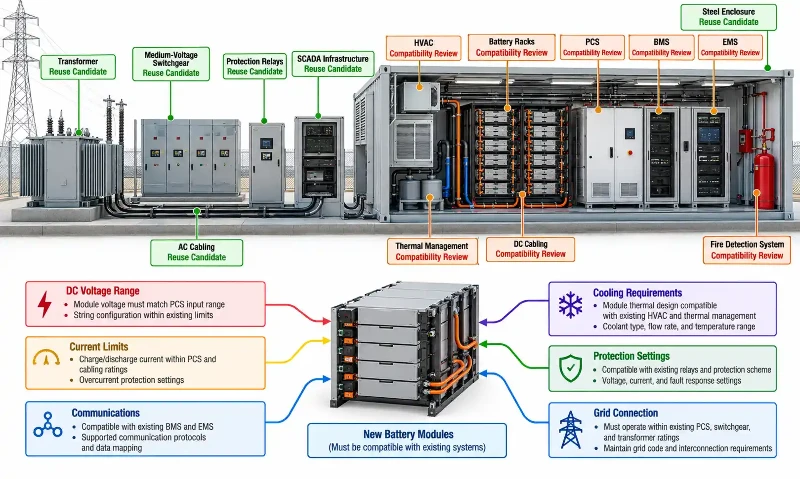
Equipment Commonly Considered for Reuse
- step-up transformers
- medium-voltage switchgear
- AC cabling
- protection and relay equipment
- steel enclosures or site infrastructure
- SCADA and communications infrastructure
- fire detection or suppression equipment, where still compliant and suitable
Reuse should follow condition assessment, not assumption. Equipment that appears physically serviceable may still be unsuitable if fault ratings, protection settings, communications, cooling capability, or certification no longer match the new battery design.
Components That Often Need Deeper Review
The PCS, BMS, EMS, DC cabling, racks, thermal system, and protection architecture deserve particular attention because their compatibility is closely tied to the selected replacement battery.
Changes in battery chemistry or module design can affect:
- DC voltage range
- maximum charge and discharge current
- BMS communications
- rack architecture
- cooling requirements
- state-of-charge limits
- fault-current characteristics
- fire and gas detection requirements
Understanding the wider battery energy storage system architecture is therefore essential before deciding which parts of an older plant can remain in service.
How to Evaluate BESS Repowering Economics
The basic financial test is straightforward: the expected value of restored performance over the remaining project life should exceed the full cost and risk of the repowering program.
The calculation should not compare battery purchase price alone. A credible model includes both value recovered and costs introduced by the upgrade.
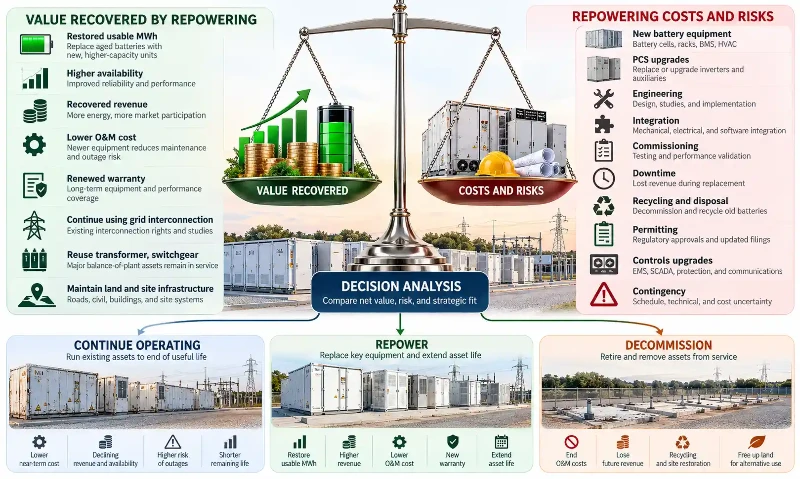
Potential Value Recovered
- revenue recovered from restored usable MWh
- revenue recovered from improved availability
- avoided repair and maintenance costs
- additional value from a renewed warranty
- continued use of an existing site and grid connection
- ability to meet new market or contract requirements
- residual value of transformers, switchgear, civil works, and other reusable equipment
Costs and Risks to Subtract
- new battery and power-conversion equipment
- engineering and integration
- installation and commissioning
- downtime and lost market revenue
- recycling or disposal
- permitting and compliance work
- software, controls, and communications upgrades
- contingency for unknown legacy-site conditions
Falling storage costs can materially change this calculation. The International Renewable Energy Agency reports that the total installed cost of utility-scale battery storage fell by 93% between 2010 and 2024, from USD 2,571/kWh to USD 192/kWh. IRENA's 2024 cost analysis provides market context for why owners of older assets increasingly need to compare continued operation with newer replacement technology.
Those figures are market-wide installed-cost data, not a repowering quotation. Actual repowering economics depend on the equipment being replaced, what can be reused, the project location, integration scope, downtime, and remaining commercial life. A project-specific BESS cost analysis should therefore be used instead of a universal $/kWh threshold.
Why the Existing Grid Connection Can Matter as Much as the Battery
An aging BESS is more than its battery cells. An operating site may already have an established interconnection, transformer capacity, land rights, permits, civil works, communications infrastructure, and market registration.
In regions where new projects face lengthy interconnection studies or limited grid capacity, those existing site rights can represent a material share of the asset's remaining value. This can strengthen the case for repowering even when the original battery block has reached the end of its economic life.
However, repowering behind an existing POI is not automatically exempt from review. A major change to battery capacity, PCS rating, fault contribution, controls, or operating mode may require approval from the relevant network operator or authority. The existing grid connection should therefore be treated as an asset to preserve, not as permission to change the plant without technical review.
Safety, Permitting, and Compliance During Repowering
A repowered project may have to satisfy requirements that did not exist, or were interpreted differently, when the original BESS was commissioned.
The exact requirements vary by jurisdiction, but the review commonly covers:
- fire detection and suppression
- thermal runaway and gas management
- electrical protection
- emergency response planning
- battery and equipment certification
- site layout and access
- grid protection and communications
- recycling and end-of-life responsibilities
The UK government guidance also states that emergency response plans should be reviewed when site equipment or layout changes and that life-extension work should assess risks introduced by integrating new battery options with existing equipment. This is why compliance review belongs early in repowering design rather than after equipment has already been selected.
When Repowering Does Not Make Economic Sense
Repowering is not always the correct answer. Some assets should continue operating with limited investment, while others are better retired.
Repowering may have weak economics when:
- the remaining project or land-lease term is too short to recover upgrade CAPEX
- the interconnection agreement or major permits cannot be extended
- the local revenue outlook no longer supports a renewed asset
- major balance-of-system equipment is also approaching end of life
- legacy site constraints make integration unusually complex
- the cost of rebuilding within the old layout approaches the value of a new project
- new batteries cannot be integrated safely or reliably with the retained equipment
- required safety or grid upgrades would materially change the project scope
The correct comparison is not simply "repowering cost versus new battery price." Owners should compare the net present value of continued operation, augmentation, repowering, and retirement while accounting for the value of existing infrastructure and interconnection rights.
A Practical Repowering Assessment Sequence
- Measure current performance. Confirm usable MWh, efficiency, availability, state of health, fault history, and throughput.
- Identify the limiting subsystem. Determine whether lost value is caused mainly by cells, PCS, thermal management, controls, grid constraints, or several issues together.
- Check augmentation feasibility. If the original platform remains healthy, adding capacity may solve the problem with less disruption.
- Assess reuse candidates. Test transformer, switchgear, PCS, HVAC, protection, cabling, enclosures, controls, and communications against the proposed replacement system.
- Review grid and compliance implications. Confirm whether the planned changes affect interconnection, permits, safety review, or market qualification.
- Build a remaining-life financial model. Compare recovered revenue and avoided O&M costs with equipment, downtime, integration, and disposal costs.
- Compare all lifecycle options. Continue operating, augment, repower, or decommission based on total remaining asset value rather than sunk cost.
Frequently Asked Questions
What is BESS repowering?
BESS repowering is the system-level renewal of an operating battery storage asset, usually involving substantial battery replacement and, where necessary, upgrades to PCS, BMS, EMS, controls, thermal management, or other supporting equipment.
What is the difference between BESS augmentation and repowering?
Augmentation normally adds battery capacity while retaining the existing system. Repowering goes further by renewing degraded or obsolete parts of the original asset. The best choice depends on whether the legacy battery and balance-of-system remain healthy and compatible with new equipment.
When should a battery storage system be repowered?
Repowering should be assessed when declining usable capacity, poor availability, obsolete controls, compatibility problems, compliance limitations, or rising O&M costs materially reduce asset value and renewal can recover more value than continued operation.
Can an existing PCS or transformer be reused?
Potentially. Reuse depends on equipment condition, rated lifetime, voltage and current compatibility, protection requirements, communications, fault behavior, and the design of the replacement battery. Reuse should be confirmed through engineering assessment rather than assumed.
Does battery degradation automatically mean a BESS should be repowered?
No. Capacity fade is expected during operation. The key question is whether measured degradation prevents the asset from meeting its technical or commercial requirements and whether repowering offers better remaining-life economics than augmentation or continued operation.
Is repowering always cheaper than building a new BESS?
No. Repowering can preserve valuable grid, land, and balance-of-system assets, but extensive integration work or widespread equipment obsolescence can reduce that advantage. The decision should compare complete project economics rather than battery hardware cost alone.
When should an aging BESS be decommissioned instead?
Decommissioning becomes more attractive when remaining site life is short, major infrastructure also needs replacement, grid or permit rights cannot be maintained, market revenue is insufficient, or the cost and risk of repowering cannot be recovered over the remaining project life.
Conclusion: Repower the Asset When the Remaining Value Supports It
An aging BESS should not be repowered simply because it has reached a certain age or cycle count. The decision becomes compelling when measured performance loss, system obsolescence, compatibility problems, or compliance requirements materially reduce the value of the asset and the expected benefit of restored performance exceeds the full cost and risk of renewal.
That requires a system-level review. Battery condition matters, but so do the PCS, BMS, EMS, thermal system, protection equipment, transformer, switchgear, grid connection, permits, warranties, and remaining project life.
For some assets, augmentation will be enough. For others, replacing the battery block while retaining valuable grid and electrical infrastructure can extend the site's useful commercial life. And when the remaining project value cannot support another major capital cycle, planned decommissioning may be the better decision.
The purpose of BESS repowering is therefore not simply to install newer batteries. It is to recover the maximum safe and economically justified value from an existing storage asset over the rest of its lifecycle.