


Spain's new capacity market creates another potential revenue stream for battery energy storage systems (BESS), but qualifying capacity is not the same as installed battery capacity. A storage system must be capable of providing dependable power when the electricity system needs it, rather than simply having a high MW or MWh rating on its datasheet.
For battery storage, this distinction brings several engineering factors into the commercial discussion. Battery duration determines how long the system can sustain its output. State of charge (SOC) affects the energy available for discharge. The power conversion system (PCS) determines the AC power that can reach the grid, while the energy management system (EMS) coordinates charging, discharging and market commitments.
Spain established its capacity market through Order TED/966/2026, published on September 17, 2026, and effective from September 18. The framework introduces competitive auctions for firm power availability and allows eligible electricity storage facilities to participate alongside generation and demand-side resources.
The important question for the energy storage industry is how these market requirements translate into actual BESS performance. Understanding the relationship between firm capacity, battery duration, grid connection, power conversion and long-term availability helps explain what separates an installed battery system from one capable of delivering dependable capacity.
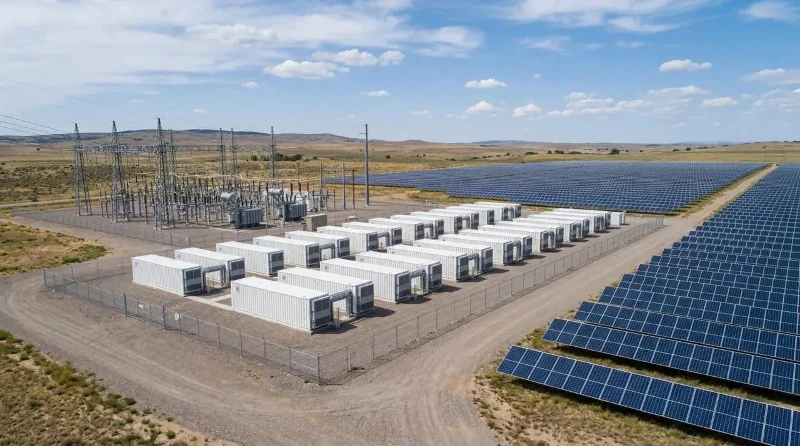
How Spain's New Capacity Market Creates Opportunities for Battery Storage
Spain's capacity market addresses a problem that cannot always be solved through electricity trading alone. As wind and solar generation account for a larger share of the electricity mix, the system needs sufficient dependable capacity to meet demand when renewable output is low, conventional generators are unavailable or electricity supply becomes constrained.
Energy arbitrage allows a battery to charge when electricity prices are low and discharge when prices are higher. However, the revenue available from price differences can vary considerably with market conditions. It may not always provide enough predictable income to support investment in new flexible capacity.
A capacity market addresses a different part of the problem. Instead of paying only for electricity delivered, it compensates eligible resources for maintaining an agreed level of firm power availability during the contracted service period.
For BESS, this creates a potential source of revenue that is linked to dependable power availability rather than relying entirely on daily electricity price movements.
How Spain's Capacity Auction Works
Spain's framework uses competitive auctions to procure the firm capacity identified through electricity system adequacy assessments. The product being purchased is firm active power, measured in MW, rather than stored energy measured in MWh.
Participants submit sealed bids under a pay-as-bid mechanism. The bid price is expressed in euros per MW of firm capacity per year. Successful participants receive their accepted bid price, subject to the service obligations and applicable settlement rules.
The framework distinguishes between several auction arrangements:
- Main capacity auctions: Procure firm capacity for future system requirements. Existing storage installations receive a 12-month service period, while new storage investments receive technology-specific service periods that can extend to a maximum of 15 years.
- Adjustment auctions: Address remaining capacity requirements that are not covered by the main auction. These auctions are intended for facilities already in operation and provide 12-month service periods.
- Transitional auctions: Provide capacity coverage between the establishment of the mechanism and the start of the first main-auction service period.
The possibility of longer service periods is important for new battery storage investments. A longer capacity contract can provide greater revenue visibility, but it also makes battery performance over the full service period more important. The maximum 15-year term is not automatically available to every project; the actual duration depends on the reference technology and auction conditions.
Another important feature is that individual generation, storage and consumption installations generally need at least 1 MW of firm capacity to participate. Smaller production and storage installations may participate through qualifying aggregation arrangements, provided that the individual installations and combined capacity satisfy the regulatory conditions.
This creates a potential connection between larger grid-scale BESS and aggregated distributed energy resources. However, a collection of commercial battery cabinets does not automatically qualify as a capacity market resource. Market participation, aggregation, measurement and operational requirements still apply.
The full legal framework is available in Spain's Order TED/966/2026.
Why Installed Battery Power Is Not the Same as Firm Capacity
One of the most important distinctions in the Spain capacity market is the difference between installed power and firm capacity.
Installed power describes the rated power of an energy storage installation. Firm capacity represents the average active power that the installation is recognized as capable of contributing to electricity supply, taking the reliability characteristics of its reference technology into account.
Under Order TED/966/2026, the basic calculation is:
Firm Capacity = Installed Power × Firmness Coefficient
The firmness coefficient ranges from 0 to 1 and is determined for each reference technology. The calculated firm capacity cannot exceed the installation's authorized grid access capacity.
A Practical Example of BESS Firm Capacity
Consider a hypothetical battery energy storage system with 100 MW of installed power. For illustration, assume its applicable firmness coefficient is 0.80.
| Parameter | Value |
|---|---|
| Installed battery power | 100 MW |
| Illustrative firmness coefficient | 0.80 |
| Calculated firm capacity | 80 MW |
| Authorized grid access capacity | 75 MW |
| Maximum firm capacity under the access limit | 75 MW |
Although the initial calculation produces 80 MW, the installation cannot offer more than its authorized grid access capacity of 75 MW.
The 0.80 coefficient is an illustrative assumption, not an official Spanish BESS coefficient. The actual coefficient for each reference technology must be established through the applicable auction arrangements.
Why the Grid Connection Limit Matters
A battery may have sufficient installed power and energy to support a particular operating profile, but its ability to deliver power to the electricity system is also constrained by the approved connection capacity.
For example, a 100 MW PCS installation connected through infrastructure with a lower authorized export limit cannot continuously deliver its full rated power to the grid. The transformer, switchgear, cables and point-of-connection restrictions also influence the power that can be exported.
Charging capacity matters as well. A BESS may have a high permitted export rating but a lower import limit. If the available charging window is restricted, the system may not recover enough energy before its next required discharge period.
This is why grid access, installed MW and usable MWh must be understood as separate but related characteristics of a battery storage project.
For a broader explanation of how power, energy and system architecture relate to one another, see Utility-Scale Battery Storage: From MW/MWh Requirements to BESS Configuration.
How Battery Duration Affects Capacity Delivery
Firm capacity is expressed in MW, but the battery must have enough usable energy to maintain the required output for the relevant operating period. This makes battery duration an important part of capacity delivery.
Battery duration is the relationship between usable energy and discharge power:
Discharge Duration (hours) = Usable Energy (MWh) ÷ Discharge Power (MW)
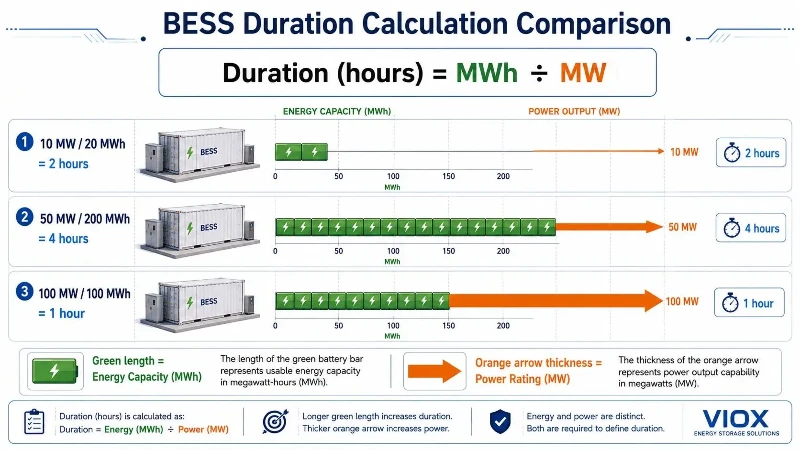
Consider a 100 MW / 400 MWh BESS. Its nominal power-to-energy ratio represents four hours of discharge at rated power under the corresponding rating conditions.
However, a nominal four-hour rating does not automatically mean the system can deliver 100 MW of net AC power for four hours at the grid connection point. The actual result depends on the usable SOC range, conversion losses, auxiliary consumption, temperature, operating limits and battery condition.
How Different Battery Durations Affect Operating Capability
| BESS configuration | Nominal duration | Typical operating characteristic |
|---|---|---|
| 100 MW / 200 MWh | 2 hours | Higher power relative to stored energy, suitable for shorter discharge periods. |
| 100 MW / 400 MWh | 4 hours | More stored energy available for sustained power delivery. |
| 100 MW / 600 MWh | 6 hours | Larger energy reserve for longer discharge periods and extended operating requirements. |
These configurations illustrate the relationship between MW and MWh. They are not prescribed durations for Spain's capacity market.
Why Usable Energy Matters More Than the Nameplate Rating
The nominal energy rating of a battery does not represent the energy that can always be delivered to the grid.
Several operating factors affect the available energy:
- SOC operating range: The battery may not use its entire electrochemical energy range because minimum and maximum SOC limits are required for safe and reliable operation.
- Conversion losses: Energy stored on the DC side is not delivered entirely as usable AC energy after passing through the PCS and electrical infrastructure.
- Auxiliary consumption: Cooling, control, protection and other auxiliary equipment consume energy during operation.
- Temperature: Low or high temperatures can affect battery performance and the available charging or discharging power.
- Battery aging: Capacity fade gradually reduces the energy available from the battery over its operating life.
For a capacity service requiring sustained AC power, the relevant question is how much net energy can be delivered at the point of connection, not simply how many MWh appear on the battery datasheet.
Why Consecutive Discharge Events Create Additional Challenges
A battery that can complete one full discharge event may not be ready to deliver the same power again immediately afterward.
After discharging, the system needs sufficient time and charging power to restore its SOC. If the available charging window is short, or grid import capacity is restricted, the battery may enter the next operating period with less stored energy than required.
This becomes particularly important when a BESS participates in multiple electricity market activities. A commercial dispatch decision made earlier in the day can affect the energy available for a later capacity commitment.
Spain's capacity market defines system stress hours, which cannot exceed 10% of the hours in a calendar year. These hours must be communicated to capacity service providers before the start of each service year.
The 10% limit does not mean that a battery must discharge continuously for 10% of the year. It defines an upper limit on the designated stress hours. Their actual timing and operating pattern determine the energy reserve needed by the storage system.
Consequently, a four-hour BESS is not automatically suitable for every capacity service, just as a two-hour system is not automatically excluded. The relevant requirements depend on the actual market rules, the technology's qualification conditions and the system's ability to maintain its committed availability.
How PCS and EMS Maintain BESS Availability During Grid Stress Events
The battery cells determine how much energy can be stored, but they do not independently determine how much power the complete system can deliver to the grid.
Actual BESS output depends on the interaction between the battery, battery management system (BMS), power conversion system (PCS), energy management system (EMS), transformer and grid connection equipment.
PCS Output Determines the Available AC Power
The PCS converts DC power from the battery into AC power for grid export. Its rated output is an important specification, but the available active power can change depending on operating conditions.
One important relationship is between active power, reactive power and apparent power:
P² + Q² ≤ S²
Where P represents active power, Q represents reactive power and S represents apparent power.
When a PCS operates close to its apparent power limit, the reactive power required by the grid can reduce the active power available for export, depending on the inverter's capability curve and control settings.
Temperature can also affect output. Inverters operating at high ambient temperatures may experience power derating to remain within semiconductor and thermal limits. The battery itself can impose additional discharge restrictions when cell temperature, voltage or current reaches operating limits.
For example, a BESS with a nominal 100 MW PCS rating may not deliver the same active power under every temperature and reactive power condition. Transformer ratings, auxiliary consumption and grid-side restrictions further influence the net output available at the point of connection.
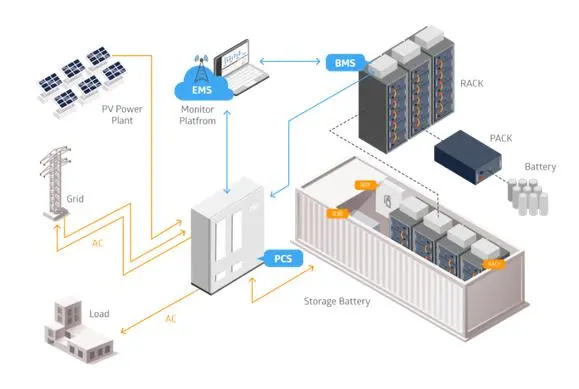
How BMS and EMS Influence Available Capacity
The BMS and EMS have different responsibilities, but both affect the battery's ability to provide dependable power.
The BMS monitors individual cell and battery-pack conditions, including voltage, current, temperature and SOC. It protects the battery by enforcing permitted charging and discharging limits.
The EMS coordinates the operation of the complete storage installation. It considers market schedules, electricity prices, grid restrictions, battery availability and the energy reserve needed for future operating periods.
For a BESS participating in a capacity market, SOC management becomes especially important. If the battery discharges too much energy during an earlier trading period, it may not have sufficient stored energy when a designated stress period arrives.
The EMS therefore needs to coordinate charging and discharging around the expected availability requirement, rather than optimizing every dispatch decision independently.
Communication and monitoring also matter. The BMS, PCS, EMS, site controller and metering equipment must exchange consistent operating information. Without reliable communication and measurement, it becomes more difficult to monitor available power, identify equipment restrictions and demonstrate actual performance.
These interfaces are also important when integrating equipment from different suppliers. See BESS Software Interoperability: Keep Your Data Usable for a closer look at system communication and data integration.
Availability Is a Measured Operating Requirement
Spain's capacity market does not treat availability as a marketing claim. The system operator is responsible for verifying whether awarded firm capacity is available during the designated system stress periods.
The regulation also allows the system operator to conduct availability tests at least once per year for installations that meet the criteria established by the applicable operating procedure.
For qualifying installations, repeated unsuccessful tests can have significant financial consequences. The regulation establishes progressively stronger payment obligations for failed tests, with the third unsuccessful test potentially resulting in the loss of the annual service remuneration and disqualification from providing the service.
This makes the reliability of the complete BESS important. Battery availability, PCS performance, thermal management, protection, communications and metering all contribute to the system's ability to demonstrate its contracted performance.
Can BESS Combine Capacity Payments With Other Revenue Streams?
Capacity payments can become an additional revenue source for battery energy storage, but they should not be viewed as completely independent of other market activities.
A BESS may participate in several electricity market activities, depending on its technical capabilities, market qualification and the applicable rules.
| Revenue source | How the BESS creates value | Operating consideration |
|---|---|---|
| Capacity payments | Maintains an awarded level of firm power availability. | Must satisfy the contracted availability requirements. |
| Energy arbitrage | Charges during lower-price periods and discharges when prices rise. | Charging and discharging decisions affect available SOC. |
| Balancing services | Provides eligible power adjustments to support system balancing. | Requires suitable qualification, power headroom and energy reserves. |
| Renewable energy shifting | Stores surplus solar or wind generation for later use. | Depends on generation availability, connection limits and storage capacity. |
Why Revenue Stacking Is Not Simply Adding Multiple Payments
Consider a battery that receives capacity payments while also participating in energy arbitrage.
During an ordinary trading period, electricity prices may encourage the operator to discharge the battery. However, if the battery needs to maintain sufficient SOC for an upcoming system stress period, the operator may need to reduce that discharge or arrange additional charging beforehand.
This creates an operating trade-off. The same stored energy cannot be fully allocated to several conflicting discharge commitments at the same time.
Spain's capacity market framework also restricts overlapping remuneration for the same firm capacity and service period. In particular, an installation cannot receive remuneration for the same offered firm power and service period through a specific balancing product where the applicable prohibition applies.
This does not mean that every form of energy trading is prohibited alongside capacity payments. Energy arbitrage and other market activities need to be assessed separately under their applicable rules and operating constraints.
The financial value of revenue stacking therefore depends on the amount of power and energy that can actually be allocated to each service, the market prices involved and the cost of maintaining sufficient battery availability.
A realistic BESS revenue model needs to account for:
- Accepted capacity bid prices and awarded firm MW.
- Electricity purchase costs for battery charging.
- Round-trip efficiency and auxiliary consumption.
- Market participation and operating costs.
- Battery degradation associated with additional cycling.
- Potential non-availability payments and performance penalties.
The objective is to maximize the value of the available battery capacity without compromising the performance required by its contracted services.
What European Capacity Auctions Reveal About Battery Storage
Spain's new mechanism is part of a wider European shift toward recognizing dependable capacity as a distinct part of electricity system security. However, the value of battery storage in these markets depends heavily on auction design, technical qualification and the capacity product being purchased.
Germany: Competitive Auctions for Long-Term Capacity
On November 3, 2026, Germany's Federal Network Agency announced the results of its first auction for long-term capacity under the Electricity Supply Security and Capacity Act (StromVKG).
The auction offered 4,500 MW of reduced capacity (rMW). It received 41 bids representing approximately 11,958 rMW, with 11 bids awarded a combined volume of approximately 5,160 rMW.
The volume-weighted average award price was €155,296 per rMW per year.
The regulator described the auction as involving competition between power plants and electricity storage facilities. However, its published summary does not provide a complete battery-specific breakdown of the awarded capacity.
Germany's rMW product should also not be directly compared with Spain's firm MW. The two mechanisms use different capacity definitions, qualification arrangements and auction structures.
The useful market observation is that long-term capacity procurement is becoming an active investment consideration in another major European electricity market. The commercial value of storage still depends on the specific product and the rules under which it competes.
Official results: Germany's Federal Network Agency, November 3, 2026.
Belgium: An Established Capacity Remuneration Mechanism
Belgium's capacity remuneration mechanism provides another example of how European electricity markets procure dependable capacity through recurring auctions.
On October 28, 2026, Belgium's energy regulator CREG validated the results of Elia's Y-2 auction for the 2028–2029 capacity delivery period.
This demonstrates the continued operation of a structured capacity procurement mechanism. However, the regulator's validation notice alone does not establish the technology-specific share awarded to batteries. The auction's detailed results must be consulted before drawing conclusions about BESS participation.
Official source: CREG Decision B3311.
These European examples should not be treated as interchangeable market benchmarks. Differences in capacity definitions, delivery periods, eligibility rules and settlement mechanisms can change the commercial value of the same battery configuration.
How Grid-Forming Requirements Are Changing BESS Design
Capacity availability and grid stability are related, but they are not the same technical service.
A battery may be able to deliver its contracted active power while providing limited support for grid voltage and frequency. Conversely, a grid-forming inverter may provide valuable stability functions without automatically increasing the installation's accredited firm capacity.
This distinction is becoming more important as European electricity systems integrate more inverter-based resources.
Why Grid-Forming Capability Is Receiving More Attention
Traditional grid-following inverters synchronize with an existing grid voltage and frequency reference. They regulate their current output according to that reference.
Grid-forming inverters establish and regulate an internal voltage and frequency reference. Depending on the control design and complete plant configuration, they can contribute to frequency stability, voltage regulation and synthetic inertia.
These capabilities become particularly relevant in systems with high shares of inverter-based generation, where the availability of conventional synchronous generation may be lower.
However, grid-forming operation does not automatically provide black-start capability, unlimited fault current or every form of grid support. These functions depend on the inverter, plant controls, auxiliary systems and the applicable grid connection requirements.
Portugal's October 2026 Regulation Shows the Direction of Grid Connection Requirements
On October 22, 2026, Portugal published Portaria n.º 464-A/2026/1, establishing general technical connection requirements for electricity storage installations.
The regulation addresses frequency response, grid-forming operation and synthetic inertia. Its requirements apply to new storage installations and qualifying significant expansions, modernization or equipment replacements, with specific technical applicability determined by the relevant installation category and provisions.
Portugal's regulation is particularly relevant because it shows how storage grid connection requirements are expanding beyond basic active power injection and absorption.
It should not be interpreted as a universal Spanish grid-forming mandate. Spain and Portugal have separate national grid connection rules, even though both are responding to the technical requirements of increasingly inverter-dominated electricity systems.
Official regulation: Portaria n.º 464-A/2026/1.
For a deeper explanation of inverter control behavior, voltage-source characteristics and grid connection applications, see Grid-Forming vs. Grid-Following BESS.
Grid Connection Capacity and Storage Investment Are Also Evolving
Portugal also opened new competitive procedures in October 2026 for allocating up to 750 MVA of grid connection capacity to standalone storage installations and 300 MVA to generation projects.
These are grid connection capacity auctions, not capacity remuneration auctions. Their purpose is to allocate access to the electricity network for new installations, rather than directly pay batteries for maintaining firm capacity.
The distinction is important. Grid access determines how a storage system can connect and exchange power with the network, while a capacity market compensates eligible resources for making dependable capacity available.
Both can influence the commercial feasibility of a BESS project, but they solve different problems.
Official announcement: Portuguese Government, October 26, 2026.
How Battery Degradation Affects Long-Term Capacity Availability
A battery storage system does not retain its original energy capacity throughout its operating life. As the battery ages, its available energy gradually decreases, while internal resistance and operating characteristics can also change.
This matters for capacity market participation because a battery must continue to maintain the required operating performance throughout its service period.
Why Initial Battery Capacity May Not Be Enough
Consider a battery system originally rated at 400 MWh. After years of operation, its available energy may be lower because of calendar aging and cycling-related degradation.
If the original system was configured to deliver a specific power output over a defined duration, a reduction in usable energy can shorten the period for which that output can be maintained.
Battery degradation can affect capacity delivery in several ways:
- Capacity fade: Reduces the total energy available for charging and discharging.
- Increased internal resistance: Can increase voltage drop and heat generation under high-power operation.
- Temperature sensitivity: Aging cells may require more conservative operating limits under demanding conditions.
- Uneven battery aging: Differences between battery racks or clusters can cause the complete system to operate according to the most restrictive available units.
As a result, a battery system that initially meets its rated discharge duration may not maintain the same performance near the end of its service life.
Oversizing and Battery Augmentation
Two common approaches help maintain energy availability as the battery ages.
Initial oversizing provides additional battery energy at commissioning. The extra capacity creates an operating reserve that can accommodate expected degradation over time.
Battery augmentation adds new battery capacity during the project life. This can restore usable energy and help maintain the original system performance as existing battery modules age.
These approaches affect different parts of the project economics. Initial oversizing increases upfront investment, while augmentation introduces future equipment, installation and integration costs.
Both strategies also depend on the original system architecture. Battery rack configuration, DC voltage range, PCS compatibility, thermal management and control interfaces influence how additional battery capacity can be integrated.
For a long-term capacity service, battery warranty conditions and the definition of end-of-life performance are therefore important to the overall value of the storage installation.
The objective is not simply to maintain the original MWh rating. It is to preserve enough usable energy and power capability to meet the required operating conditions throughout the service period.
Frequently Asked Questions About Spain's Capacity Market and BESS
Does Spain's capacity market pay battery storage based on installed MW or MWh?
The capacity market purchases firm power measured in MW, not stored energy measured in MWh. Firm capacity is calculated using the installed power and the applicable technology-specific firmness coefficient, subject to the authorized grid access capacity.
Does Spain require a four-hour battery storage system?
Order TED/966/2026 does not establish a universal four-hour duration requirement for all BESS installations. The appropriate battery duration depends on the applicable technology qualification conditions, the capacity service requirements and the system's ability to maintain its committed output.
Can a BESS receive capacity payments and earn revenue from energy arbitrage?
Potentially, yes. Capacity provision and energy arbitrage can form part of a broader battery revenue strategy, subject to the applicable market rules. The same firm capacity cannot be used to obtain prohibited overlapping compensation for the same service period, and the EMS must preserve sufficient SOC for capacity availability.
How does SOC management affect BESS capacity availability?
SOC determines how much stored energy is available for discharge. If a battery is discharged too deeply before a system stress period, it may not have enough usable energy to sustain its required output. Charging schedules and reserve management therefore affect the system's ability to maintain availability.
Does grid-forming capability increase a battery's firm capacity?
Not automatically. Grid-forming capability allows a PCS to provide specific voltage and frequency support functions, depending on its design. Capacity market firm power is determined through the applicable market qualification and firmness coefficient methodology.
Why is battery degradation important for long-term capacity services?
Battery degradation reduces usable energy and can affect high-power discharge capability. For longer service periods, battery aging must be considered when assessing whether the system can maintain its required discharge duration and output performance over time.
Conclusion
Spain's new capacity market creates an additional commercial opportunity for battery energy storage, but its value depends on more than the installed MW and MWh ratings of a battery system.
Firm capacity reflects the dependable power recognized under the market's qualification framework. Actual delivery also depends on battery duration, usable energy, grid access, PCS output, SOC management and the operating condition of the complete installation.
These factors are closely connected. A battery may have sufficient installed energy but limited AC output. A PCS may have sufficient rated power but face thermal or reactive power constraints. An EMS may optimize electricity trading but still needs to preserve enough SOC for future capacity commitments.
Long-term battery degradation adds another dimension because the energy and power available at commissioning may not remain unchanged throughout the service period.
For energy storage projects, the commercial value of capacity provision ultimately depends on whether the complete BESS can maintain dependable power when the electricity system needs it. Battery configuration, power conversion, energy management and lifecycle performance all contribute to that result.
Explore Polinovel's utility-scale and commercial battery energy storage solutions and containerized BESS configurations for different power, energy and system integration requirements.