

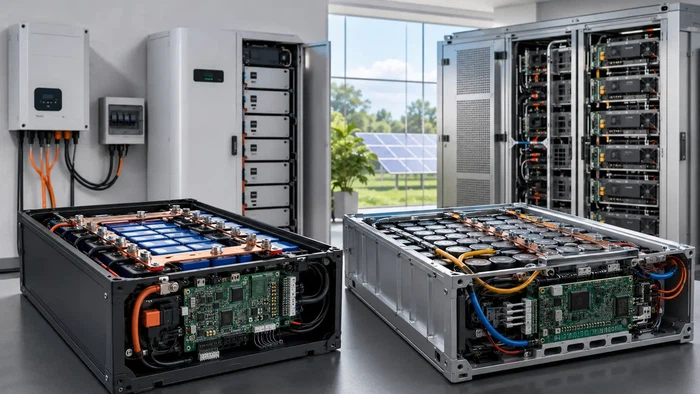
If you are comparing LiFePO4 vs lithium-ion batteries for an energy storage project, LiFePO4 (lithium iron phosphate, or LFP) is normally the preferred chemistry for stationary storage, solar pairing, home backup, commercial BESS and most off-grid applications. Conventional lithium-ion chemistries such as NMC and NCA remain the stronger choice when energy density and weight dominate the design, as in smartphones, drones, laptops and some mobility products.
One clarification matters before any comparison: LiFePO4 is itself a lithium-ion chemistry. When say "lithium-ion battery," they usually mean cobalt- or nickel-blended chemistries (NMC, NCA, LCO). This article uses the term "conventional lithium-ion" in that practical sense, while treating LFP as the lithium-ion subtype it actually is. Battery University classifies LFP as a lithium-ion chemistry with lower nominal voltage and lower specific energy than most cobalt-blended cells.
How to choose?
LiFePO4 is normally preferred when the application involves:
- Daily or near-daily cycling over a multi-year service life
- Fixed installation, where weight and footprint are secondary
- Solar self-consumption, peak shaving, backup or off-grid duty
- Strict fire-safety and thermal-runaway requirements
- Long-term value measured in cost per usable cycle, not sticker price
Conventional lithium-ion (NMC, NCA, LCO) becomes the stronger choice when:
- The product is hand-carried or flown, and every gram counts
- Volumetric energy density drives the industrial design
- The duty cycle is light and replacement is expected within a few years
What Is a LiFePO4 Battery?
A LiFePO4 battery uses lithium iron phosphate as its cathode material. At cell level, the nominal voltage sits around 3.2 V, with a typical charging cut-off near 3.65 V. The voltage curve is unusually flat, which simplifies state-of-charge estimation and inverter coordination but also requires careful BMS design to detect the knee at low SOC.
Why integrators select LFP for stationary storage:
- Long cycle life - typically rated at 3,000 to 6,000+ cycles depending on depth of discharge, temperature and C-rate
- High thermal-runaway onset temperature relative to nickel-rich chemistries
- Cobalt-free supply chain with more stable raw-material pricing
- Flat discharge curve that supports stable inverter and PCS operation
- Compatibility with modular rack-mount and stacked architectures used in residential and commercial systems
The trade-offs are real and should not be hidden:
- Lower volumetric and gravimetric energy density than NMC
- Heavier pack mass per usable kilowatt-hour
- Reduced low-temperature charging capability without active heating
- Higher upfront cost at the cell level for some capacity classes, although the cost-per-cycle is normally lower
For project-level deployment, LFP is the dominant chemistry across our high-voltage LiFePO4 storage systems and outdoor cabinet BESS product lines, because the cycle life and safety margins fit the warranty conditions that commercial buyers demand.
What Is a Conventional Lithium-Ion Battery?
"Conventional lithium-ion" in industry usage typically refers to:
- LCO - lithium cobalt oxide, common in consumer electronics
- NMC - lithium nickel manganese cobalt oxide, widely used in EV packs and some stationary systems
- NCA - lithium nickel cobalt aluminum oxide, used in select EV applications
- LMO - lithium manganese oxide, often blended with NMC
These chemistries operate at a higher nominal voltage (typically 3.6 to 3.7 V) and deliver higher specific energy, which is why they remain the default for phones, laptops, drones, power tools and many electric vehicles. For stationary storage, NMC is occasionally chosen when space is restricted, but the thermal-runaway profile and cycle life trade-offs need to be addressed at the system level.
LiFePO4 vs Lithium-Ion: Side-by-Side Comparison
| Factor | LiFePO4 (LFP) | Conventional Li-ion (NMC/NCA/LCO) |
|---|---|---|
| Cell nominal voltage | ~3.2 V | ~3.6–3.7 V |
| Specific energy | ~90–160 Wh/kg | ~150–250 Wh/kg |
| Cycle life (typical, 80% DoD, 25 °C) | 3,000–6,000+ | 1,000–3,000 |
| Thermal-runaway onset | Higher, milder propagation | Lower, more energetic propagation |
| Calendar life | Generally longer | Generally shorter at high SOC |
| Cost per usable cycle | Lower for cycling-heavy duty | Higher in deep-cycle stationary use |
| Cobalt content | None | Yes (varies by chemistry) |
| Best fit | Solar, BESS, backup, RV, marine, off-grid | Phones, laptops, drones, weight-critical devices |
These figures are indicative ranges. Real-world performance depends on cell grade, pack design, BMS logic and operating conditions; manufacturer datasheets remain the authoritative reference for any specific product.

Safety and Thermal Stability
LFP cells have a higher thermal-runaway onset temperature than NMC or NCA cells, and the released energy during runaway is generally lower. Research published by Oak Ridge National Laboratory comparing large-format lithium-ion cells under overcharge abuse found that LFP cells exhibited a milder thermal response than NCM cells, several of which ignited or vented violently during testing. This does not make LFP "safe by default": any lithium chemistry can fail if subjected to mechanical damage, manufacturing defects, overcharge or improper BMS settings.
For stationary systems, safety performance is determined as much by integration as by chemistry. Pack-level fire performance, cell-to-cell propagation, gas detection, fire suppression and enclosure rating all carry significant weight. UL certification for BESS (for example UL 9540 and UL 9540A) and IEC 62619 testing offer a more useful comparison framework than chemistry labels alone.

Cycle Life: How to Read the Numbers
"Cycle life" is the single most misread specification in battery datasheets. A "6,000 cycle" rating is meaningful only when read together with:
- Depth of discharge (e.g. 80% DoD, 90% DoD, 100% DoD)
- Ambient or cell temperature during cycling
- Charge and discharge C-rate
- End-of-life capacity retention threshold (commonly 80% or 70%)
- Calendar age during the test
For a home backup system cycled daily, ask for cycle life at 80% DoD and 25 °C with capacity retention to 80%, not the headline number. For a peak-shaving project running multiple cycles per day, the relevant metric is throughput in MWh delivered over the warranty period.
Energy Density and Weight
This is the area where conventional lithium-ion still wins decisively. NMC and NCA cells store more energy per kilogram and per liter, which is why they dominate portable electronics, drones and EVs where mass directly affects performance. LFP packs are heavier and larger for the same usable capacity, which rarely matters in a rack-mounted cabinet but matters enormously in a quadcopter.
One caveat: at the pack level, the gap narrows. LFP's better thermal behavior allows tighter cell spacing and reduced thermal-management hardware in many stationary applications, which partially offsets the cell-level density disadvantage.
Charging Behavior and System Compatibility
LFP and conventional lithium-ion cannot share the same charging profile. The voltage windows, taper logic and balancing strategies differ, and using the wrong profile reduces life and creates safety risk. Before replacing one chemistry with another, verify:
- Pack nominal and full-charge voltage (e.g. 51.2 V LFP vs 48 V "lithium" labelling)
- Maximum charging voltage and float behavior
- Solar charge controller or PCS firmware compatibility
- Inverter low-voltage cut-off and re-connect thresholds
- BMS communication protocol (CAN, RS485, Modbus) and matching inverter support
- Manufacturer-approved compatibility list
Two batteries labelled "lithium" are not interchangeable. This is one of the most common field failures in retrofit projects.
Temperature Performance and Low-Temperature Charging
Charging any lithium battery below 0 °C risks lithium plating on the anode, which permanently reduces capacity and can compromise safety. LFP is not exempt from this. The practical solutions are either active heating built into the pack or BMS-enforced charge cut-off below a threshold temperature. Discharge at low temperature is generally tolerated more broadly, though available capacity drops.
For outdoor cabinets installed in cold climates, the specifications worth checking include heater wattage, allowed charge temperature range, and whether the heating is powered from the pack itself or from a separate auxiliary supply. Our detailed write-up on lithium battery temperature range covers the operating windows used in commercial installations.
Cost Comparison
Conventional lithium-ion often appears cheaper on the bill of materials, but this comparison rarely holds at the system level. The drivers of total cost include cell pricing, BMS complexity, thermal-management hardware, enclosure, certification, warranty conditions, expected cycle life and replacement logistics. For a project cycled daily over ten years, a higher-upfront LFP pack frequently delivers a lower cost per kWh delivered than a cheaper NMC pack that needs earlier replacement.
Procurement teams should request cost per usable cycle and cost per warranted kWh of throughput, not just $/kWh of nameplate capacity.
Application-Specific Guidance
Solar Generators and Portable Power Stations
LFP dominates this category for the same reasons it dominates fixed storage: long cycle life and stable thermal behavior. NMC versions still exist where minimum weight is the selling point, but the market has largely shifted to LFP.
Residential Home Backup and Off-Grid Solar
LFP is the default. For a 48 V or 51.2 V home backup system designed for daily cycling, the relevant comparison is between LFP packs of different cell grades, BMS quality and inverter compatibility - not between LFP and NMC.
Commercial and Industrial Energy Storage
LFP is the standard chemistry in modern commercial and industrial energy storage deployments. At this scale, chemistry alone does not determine outcome; pack architecture, thermal management, fire-safety design and certification carry more weight. Our reference on core BESS components covers the subsystems that actually drive long-term reliability.
Utility-Scale and Containerized BESS
Almost universally LFP. Energy density matters far less than safety, cycle life, parts standardization and serviceability. Most large containerized BESS solutions in the current market use LFP cells from major suppliers, with system-level differentiation coming from BMS, EMS, cooling strategy and integration quality.
RV, Marine and Off-Grid Cabins
LFP is normally preferred for deep-cycle auxiliary power. Confirm low-temperature protection and proper alternator or shore-power charging profiles before swapping legacy lead-acid for LFP.
Phones, Laptops, Drones
Conventional lithium-ion remains the right answer. Energy density and form-factor dominate; cycle life is acceptable because replacement is expected within the product lifecycle.

Common Mistakes When Comparing the Two Chemistries
- Treating LFP and lithium-ion as separate categories. LFP is a lithium-ion chemistry. The real comparison is across chemistries within the lithium-ion family.
- Comparing only nameplate capacity. Usable capacity, DoD limits, derating with temperature and C-rate matter more.
- Ignoring charger and inverter compatibility. Mismatched voltage windows cause warranty failures and field incidents.
- Optimizing for upfront price in a cycling-heavy duty. Cost per delivered MWh is the meaningful metric.
- Reading cycle-life numbers without conditions. A "6,000 cycle" claim without DoD, temperature and retention threshold is marketing, not data.
- Assuming any lithium chemistry tolerates sub-zero charging. Both LFP and conventional Li-ion require protection or heating below 0 °C.
Decision Framework
Step 1 - Define the duty cycle. Daily cycling, occasional backup, frequency regulation or seasonal storage each push the answer in a different direction.
Step 2 - Set the physical constraints. Footprint, mass, ambient temperature range, indoor vs outdoor, ventilation, fire code.
Step 3 - Define the warranty target. Years of service, MWh throughput, expected DoD, capacity retention floor. The chemistry choice should support these contractually, not just numerically.
Step 4 - Verify system compatibility. Inverter, PCS, EMS, communication protocols, and any existing renewable hardware.
Step 5 - Review safety and certification fit. Match the certification set to the deployment country and the insurer's requirements before purchasing.
FAQ
Q: Is LiFePO4 Better Than Lithium-Ion?
A: LiFePO4 is itself a lithium-ion chemistry. Compared with NMC, NCA and LCO, LFP offers longer cycle life and better thermal stability, at the cost of lower energy density. For stationary storage and most solar applications, LFP is normally the better choice; for weight-critical portable devices, NMC and similar chemistries remain stronger.
Q: Is LiFePO4 Safer Than Other Lithium-Ion Chemistries?
A: LFP has a higher thermal-runaway onset temperature and milder runaway behavior than nickel-rich chemistries. However, system-level safety depends on pack design, BMS logic, thermal management and certification testing such as UL 9540A, not on chemistry alone.
Q: Can I Replace A Lithium-Ion Battery With A LiFePO4 Battery?
A: Not without verification. The voltage profile, charging cut-off, BMS communication and inverter compatibility differ. Always confirm with the equipment manufacturer before retrofitting.
Q: How Long Does A LiFePO4 Battery Last?
A: Typical commercial LFP packs are rated for 3,000 to 6,000+ cycles at 80% DoD and 25 °C, with capacity retention to 80%. Real lifespan depends on operating temperature, charge/discharge rate and how aggressively the system uses the available DoD window.
Q: Can LiFePO4 Batteries Be Charged In Cold Weather?
A: Charging below 0 °C risks lithium plating and permanent capacity loss. LFP packs designed for cold climates include either active heating or BMS-enforced charge cut-off below a threshold temperature.
Q: Why Is LiFePO4 Used In Most BESS Projects?
A: Cycle life, thermal-runaway behavior, cobalt-free supply chain and warranty economics all favor LFP for stationary storage operated over a multi-year service life. The trade-off in energy density is acceptable when the pack is mounted in a cabinet or container.
Q: What Certifications Should I Look For In A LiFePO4 BESS?
A: For the U.S. market, UL 1973 (cells/packs), UL 9540 (system) and UL 9540A (fire propagation testing) are commonly required. For international projects, IEC 62619, IEC 63056 and UN 38.3 are widely referenced. Local grid codes may add further interconnection requirements.
Final Takeaway
LiFePO4 has become the default chemistry for energy storage projects because the engineering and warranty math favor it: more cycles, milder failure modes, more predictable economics over a ten-year horizon. Conventional lithium-ion chemistries remain the right answer when weight and energy density drive the product, which is rarely the case in stationary storage.
For project-specific guidance - sizing, inverter compatibility, certification fit, or warranty terms - contact our engineering team with your load profile, voltage platform and deployment environment.