

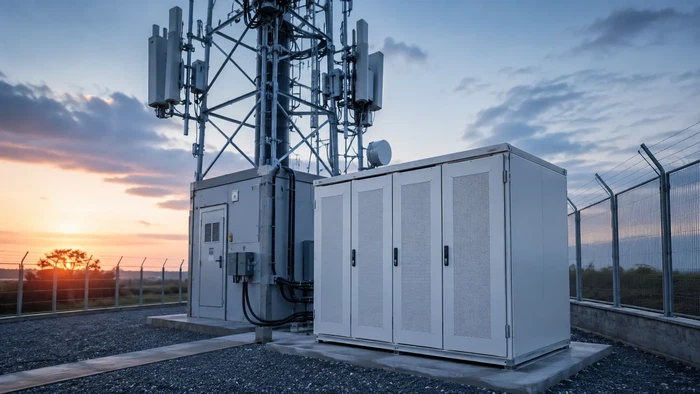
A telecom battery energy storage system (BESS) stores electrical energy at cell towers, base stations, and remote communication sites so that critical network equipment stays powered during grid outages, voltage instability, or complete off-grid operation. The system typically combines lithium or lead-acid battery modules, a battery management system (BMS), DC power distribution, protective enclosures, thermal management, and remote monitoring software - all engineered around the ETSI EN 300 132-2 standard for −48 V DC telecom power interfaces.
For telecom operators, network availability is not a vague goal - it is a contractual obligation. A single tower outage can break service-level agreements, disrupt emergency communications, and force expensive field truck rolls. The purpose of a telecom BESS is to eliminate unplanned downtime by providing immediate, automatic backup power and, in hybrid configurations, to reduce diesel generator runtime and integrate renewable energy sources.
What Does a Telecom Battery Energy Storage System Actually Do?
At the most basic level, a telecom BESS sits between the site's DC power bus and its critical loads - radios, transmission equipment, routers, cooling fans, and monitoring devices. When the rectifier output drops because the grid fails or a generator stalls, the battery bank takes over within milliseconds. There is no manual switching and no interruption to the RF signal.
But modern telecom energy storage goes well beyond simple backup. Depending on site architecture, a BESS can also stabilize voltage during brown-outs and short grid fluctuations, store solar energy during the day for overnight discharge at off-grid towers, reduce peak demand on undersized grid connections, limit generator runtime to cut fuel cost and maintenance cycles, and provide the data layer - state of charge, cell temperatures, fault history - that enables predictive maintenance across hundreds or thousands of distributed sites.
These systems are deployed at macro cell towers, rooftop small cells, rural base transceiver stations, edge data shelters, off-grid communication hubs, and renewable-hybrid telecom sites. The common thread is that every site needs uninterrupted −48 V DC power, and the battery system is the last line of defense when all other sources fail.
Core Components of a Telecom BESS
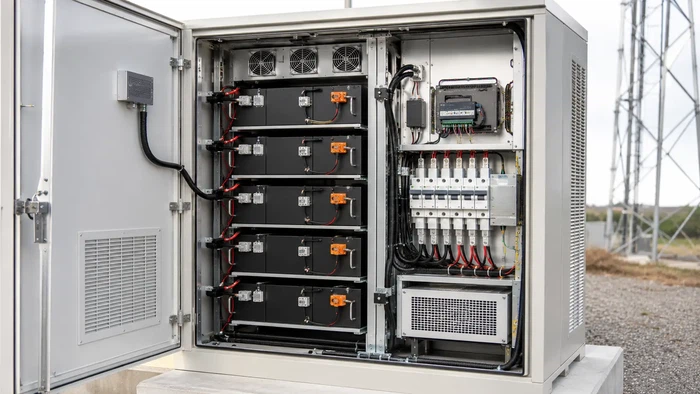
Battery Modules
The battery bank stores the energy that keeps equipment running during outages. Most new telecom deployments now specify lithium iron phosphate (LiFePO4) cells because of their high energy density, long cycle life (typically 3,000–6,000 cycles at 80 % depth of discharge), thermal stability, and minimal maintenance. Lead-acid VRLA batteries remain in service at many legacy sites but are increasingly replaced where space, weight, or maintenance access is constrained. For a deeper look at how different battery types compare for energy storage, consider the trade-offs between chemistry, cycle life, and total cost of ownership.
Battery Management System (BMS)
The BMS monitors each cell's voltage, current, temperature, state of charge (SoC), and state of health (SoH). It enforces protection limits for overcharge, deep discharge, overcurrent, and thermal runaway. In telecom applications the BMS typically communicates via SNMP, Modbus, or CAN bus so that the site controller and the operator's network management system can read battery status remotely. A well-configured BMS also logs historical data - charge/discharge cycles, peak temperatures, capacity fade - that drives maintenance scheduling and replacement planning.
Power Conversion and DC Distribution
Telecom sites standardize on −48 V DC (positive ground) as defined in ETSI EN 300 132-2, with a normal operating range of −40.5 V to −57.0 V. The BESS must integrate cleanly with existing rectifiers, DC distribution panels, and - at hybrid sites - solar charge controllers or DC-DC converters. Compatibility matters: mismatched voltage set-points, incorrect current-limiting, or missing reverse-polarity protection can cause equipment damage or unsafe battery charging. Understanding core BESS components and how they interact helps prevent integration failures.
Enclosure and Thermal Management
Outdoor telecom cabinets must withstand temperature extremes, humidity, dust, salt fog, and in some regions, sand and insects. The enclosure's IP rating (commonly IP55 or higher), ventilation or active cooling design, and corrosion-resistant materials directly affect battery life. LiFePO4 cells perform best between 15 °C and 35 °C; operating outside this window accelerates capacity fade. Sites in hot climates often require forced-air or compressor-based cooling inside the cabinet, while cold-climate sites may need heating elements to prevent low-temperature charge damage. For operators evaluating cabinet-based systems, outdoor cabinet BESS options offer pre-engineered thermal management and weatherproofing.
Remote Monitoring and Communication
A distributed telecom network may include thousands of battery-powered sites. Manual inspection is impractical. Remote monitoring - delivered over the operator's own network or a dedicated management channel - lets operations teams track SoC, SoH, cell imbalance, ambient temperature, door status, and fault alarms in near real-time. The ITU-T L.1397 standard defines monitoring and control interfaces for telecom battery systems, including architectures for Integrated Battery Units (IBU) and Integrated Battery Systems (IBS) that communicate via CAN bus with external management applications.
Why Network Availability Depends on the Battery System
Telecom operators measure network quality in uptime percentages. Carrier-grade availability - often expressed as "five nines" or 99.999 % - allows less than 5.3 minutes of unplanned downtime per year. Achieving that target at every site in a large network is impossible without reliable, fast-switching backup power.
When grid power fails, the consequences cascade quickly. Voice and data services drop. Emergency calls cannot be completed. Network congestion spills onto neighboring cells. Revenue is lost by the minute, and regulatory penalties can follow. For sites in weak-grid or off-grid areas - common across Africa, South Asia, and parts of Latin America - the problem is chronic rather than exceptional. According to the GSMA, energy costs account for 20 % to 40 % of network operating expenditure for mobile operators in emerging markets, and unreliable power is a leading barrier to network expansion in rural areas.
A properly sized telecom BESS addresses these risks in several ways. It provides immediate backup switching - typically under 10 ms - so loads never see an interruption. It extends autonomy from minutes to hours, giving field teams time to dispatch a generator or wait for grid restoration. It stabilizes voltage during grid fluctuations, protecting sensitive radio and transmission equipment from damage. And through remote monitoring, it gives the operations center early warning of capacity degradation, allowing preventive battery replacement before an outage occurs.
Lithium vs. Lead-Acid Batteries for Telecom Backup Power
The transition from lead-acid to lithium in telecom backup is well underway, driven by space constraints at rooftop and pole-mounted sites, the need for lower maintenance at remote locations, and falling lithium cell prices. However, lead-acid is not obsolete - it remains a reasonable choice for certain applications. The table below summarizes the key differences.
| Factor | LiFePO4 Battery System | Lead-Acid VRLA System |
|---|---|---|
| Energy density | Approximately 3–4× higher by volume; significantly smaller footprint for equal capacity | Lower density; larger cabinets or more floor space required |
| Usable capacity (DoD) | 80–90 % depth of discharge typical | 50 % DoD recommended to preserve cycle life |
| Cycle life | 3,000–6,000 cycles at 80 % DoD (chemistry and temperature dependent) | 300–500 cycles at 50 % DoD for standard VRLA |
| Charging speed | Can accept 0.5 C–1 C charge rates; full recharge in 1–2 hours | Typically limited to 0.1 C–0.2 C; full recharge in 8–12 hours |
| Maintenance | No watering, no equalization charge, minimal routine checks | Periodic impedance testing, terminal cleaning, and (for flooded types) water refilling |
| Weight | 60–70 % lighter for equivalent usable energy | Heavier; may require structural reinforcement at rooftop sites |
| Service life | 10–15 years under managed conditions | 3–5 years for VRLA in high-temperature environments |
| Upfront cost | Higher initial purchase price | Lower initial cost per kWh |
| Total cost of ownership | Often lower over 10 years due to fewer replacements, less maintenance, and lower site-visit costs | Can be higher over time when replacement cycles, maintenance labor, and downtime risk are included |
| BMS and monitoring | Integrated BMS with cell-level monitoring and remote communication standard | Basic voltage monitoring; advanced BMS available but not always included |
| Temperature sensitivity | Performs well in 15–35 °C range; requires thermal management outside this range | Capacity degrades significantly above 25 °C; every 10 °C rise halves expected life |
When lead-acid still makes sense: short-duration backup at well-maintained, climate-controlled indoor sites where budget is the primary constraint and the battery will be cycled infrequently. When lithium is the stronger choice: space-limited rooftop or pole-mounted sites, remote locations with difficult maintenance access, weak-grid or off-grid sites with frequent cycling, and any deployment where the operator plans to hold the site for 10 years or more.
How to Size a Telecom Battery Energy Storage System
Undersized batteries cause outages. Oversized batteries waste capital. Correct sizing starts with the site's actual load profile and required autonomy, not a generic rule of thumb.
Step 1: Measure the Critical Load
Identify every piece of equipment that must remain powered during an outage - radios, baseband units, transmission links, routers, cooling fans, obstruction lights, and monitoring hardware. Sum their power draw at peak traffic hours, not just average consumption. A typical macro cell site draws 2–6 kW depending on technology (2G/3G/4G/5G) and number of sectors. 5G sites with massive MIMO antennas can draw considerably more.
Step 2: Define Required Autonomy
Backup duration depends on site risk. Urban sites with reliable grid and fast repair response may need 2–4 hours. Weak-grid rural sites may need 8–12 hours to cover overnight or weekend outages. Off-grid solar-hybrid sites may need 16–24 hours of battery autonomy to bridge low-sunlight periods and generator start delays. These requirements should be defined by the operator's availability targets and maintenance response times, not assumed.
Step 3: Apply the Sizing Formula
A practical sizing approach uses this relationship:
Required Battery Capacity (kWh) = Critical Load (kW) × Autonomy (hours) ÷ Usable DoD ÷ System Efficiency ÷ Temperature Derating Factor ÷ Aging Margin
For example, a rural site with a 3 kW critical load requiring 8 hours of autonomy using LiFePO4 batteries at 85 % DoD, 95 % system efficiency, 0.95 temperature derating, and 0.85 aging margin over the battery's service life would need approximately 3 × 8 ÷ 0.85 ÷ 0.95 ÷ 0.95 ÷ 0.85 ≈ 39.2 kWh of installed battery capacity. Rounding up to available module sizes and allowing for future load growth (e.g., additional radio carriers or 5G upgrade) is standard practice.
Step 4: Match the System to Site Conditions
Beyond capacity, the system must fit the physical and environmental constraints of the site.
| Site Type | Key Design Priorities | Typical Autonomy |
|---|---|---|
| Urban macro tower (grid-connected) | Compact footprint, fast recharge, integration with existing −48 V rectifier system | 2–4 hours |
| Suburban / weak-grid site | Frequent cycling capability, voltage stabilization, remote monitoring | 4–8 hours |
| Rural off-grid tower (solar-hybrid) | High usable capacity, solar charge controller compatibility, generator coordination, extended autonomy | 12–24 hours |
| Rooftop small cell / 5G node | Minimal size and weight, easy installation, integrated BMS | 1–4 hours |
| Disaster-recovery / mobile site | Portable design, rapid deployment, standalone operation | 4–12 hours |
For operators exploring containerized or mobile configurations for rapid deployment, containerized BESS solutions can be pre-integrated and shipped ready to connect.
Deployment Workflow for Telecom BESS Projects
Successful deployment requires more than purchasing batteries. The following workflow covers the critical stages from site survey to operational handover.
Site Assessment
Survey the site's existing power infrastructure: rectifier model and capacity, DC distribution panel configuration, grounding system, available cabinet or shelter space, structural load limits (especially for rooftop sites), ambient temperature range, ventilation, and access road conditions for equipment delivery. Document the existing battery type, age, and condition if replacing a lead-acid bank.
System Design and Integration Planning
Design the BESS to integrate with the site's −48 V DC bus. Confirm rectifier compatibility - verify that the rectifier's float and boost voltage set-points match the lithium battery's charge profile, or install a dedicated lithium-compatible charger. Plan cable routing, circuit breaker sizing (rated at no more than 80 % of continuous load), and communication wiring between the BMS and site controller. If the site includes solar panels or a diesel generator, map the energy flow and control logic before procurement.
Installation and Protection
Install the battery cabinet on a level surface with adequate ventilation clearance. Connect DC power cables with correct polarity and torque specifications. Verify grounding continuity. Install surge protection. Confirm that the enclosure's IP rating matches the site environment - outdoor sites in coastal regions, for example, need salt-fog-resistant hardware.
Testing and Commissioning
Before declaring the site operational, test backup switchover timing (target: under 10 ms), full discharge and recharge cycles, BMS alarm thresholds, remote communication link to the network operations center, generator start coordination (if applicable), and emergency manual disconnect. Record baseline performance data for future comparison.
Ongoing Monitoring and Maintenance
After commissioning, integrate the site into the operator's centralized monitoring platform. Track SoC, SoH, cell-level voltage balance, temperature trends, and alarm history. Use this data to schedule preventive maintenance - cleaning ventilation filters, checking cable terminations, verifying firmware updates - and to forecast battery replacement timing based on actual capacity fade rather than calendar age alone.
Off-Grid and Renewable-Hybrid Telecom BESS Applications
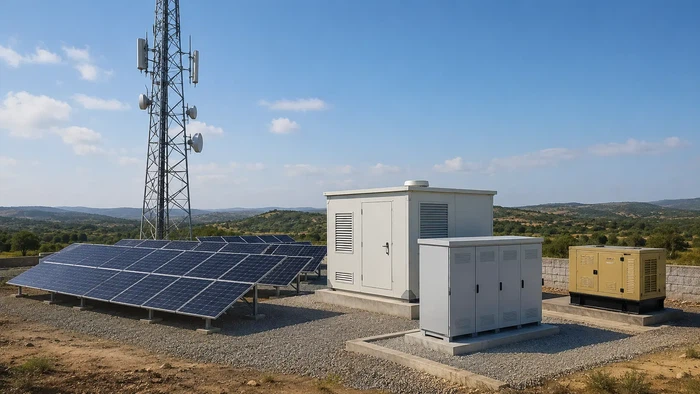
At off-grid telecom sites, the battery is not just a backup - it is the primary energy buffer in a system that typically combines solar panels, a battery bank, and a diesel or propane generator. During daylight hours, solar generation charges the batteries and directly powers the load. After sunset, the battery supplies the site until its SoC reaches a low threshold, at which point the generator starts automatically.
The economic case for solar-hybrid configurations is strongest where diesel delivery is expensive or unreliable. The GSMA has reported that transitioning to energy-efficient alternative power sources - including renewable-hybrid systems with advanced batteries - could save the telecom sector USD 13–14 billion annually. In practice, a well-designed solar-battery-generator hybrid can reduce generator runtime by 50–70 %, cutting fuel cost, engine maintenance, and carbon emissions simultaneously.
For these applications, the BESS must support deep cycling (daily charge-discharge), wide temperature operation, and intelligent coordination with solar charge controllers and generator auto-start logic. Modular designs that allow capacity expansion as load grows - for instance, when additional radio carriers are added - reduce the need for full system replacement. Operators can explore how solar energy storage systems work for a more detailed look at hybrid integration.
FAQ
Q: How Do You Calculate The Required Battery Capacity For A Telecom Site?
A: Start with the site's critical load in kilowatts, multiply by the required autonomy in hours, then divide by usable depth of discharge, system efficiency, temperature derating, and aging margin. For a detailed walkthrough, refer to the sizing section above. The key is to base every input on measured site data, not generic assumptions.
Q: What Backup Autonomy Is Typical For Remote Telecom Sites?
A: Urban grid-connected sites commonly specify 2–4 hours. Weak-grid rural sites may need 8–12 hours. Off-grid solar-hybrid sites often require 16–24 hours of autonomy to cover overnight discharge and periods of low solar generation. The correct value depends on grid reliability, generator availability, and the operator's service-level commitments.
Q: Is Lithium Worth The Higher Upfront Cost For Telecom Backup?
A: In most cases, yes - particularly for sites that cycle frequently, have limited space, require low maintenance, or will be in service for 10 years or more. The higher purchase price is typically offset by longer service life, fewer replacements, lower maintenance cost, and smaller cabinet size. Lead-acid may remain cost-effective for short-duration backup at indoor, climate-controlled sites with infrequent cycling.
Q: What Should Operators Check Before Replacing Lead-Acid Batteries With Lithium?
A: Verify that the existing rectifier system can support the lithium battery's charge voltage profile. LiFePO4 cells have a different charge curve than VRLA, and some older rectifiers may not be compatible without a firmware update or a dedicated lithium charger module. Also confirm that the BMS communication protocol (SNMP, Modbus, CAN bus) is compatible with the site controller, and that the existing DC circuit breakers are rated for the new battery bank's fault current.
Q: Can A Telecom BESS Integrate With Solar Panels And Generators?
A: Yes. Solar-battery-generator hybrid systems are increasingly standard for off-grid and weak-grid telecom sites. The BESS stores solar energy during the day, supplies the load at night, and coordinates with the generator's auto-start logic to maintain power during extended low-sunlight periods. Proper integration requires matching the solar charge controller output to the battery's charge parameters and programming the generator start/stop thresholds based on battery SoC.
Q: What Industry Standards Apply To Telecom Backup Power Systems?
A: Key standards include ETSI EN 300 132-2 (−48 V DC power interface for ICT equipment), ITU-T L.1200 series (DC power feeding for telecom), ITU-T L.1397 (monitoring and control interface for battery systems), and NEBS (Network Equipment-Building System) for environmental and seismic resilience. Battery safety may also fall under IEC 62619 (safety requirements for secondary lithium cells in industrial applications) and UL 1973 (batteries for stationary applications).
Conclusion
A telecom battery energy storage system is not just a backup - it is the foundation of network availability. Every dropped call, failed data session, and missed emergency transmission during a power outage represents a direct cost to the operator and the communities that depend on connectivity.
Choosing the right system means matching battery chemistry, capacity, thermal management, and monitoring to each site's specific load, autonomy requirements, environmental conditions, and long-term operating strategy. The sizing formula, site-type decision table, and integration checks described in this guide provide a practical starting point for telecom operators, procurement teams, and project engineers evaluating their next BESS deployment.
Before specifying a system, measure your site loads, define your autonomy targets, assess your environmental constraints, and calculate total cost of ownership over the full expected service life. With the right design, a telecom BESS reduces downtime, cuts operating costs, and supports the network availability that subscribers and regulators demand.