


Wall mount and rack mount are the two most common ways to install lithium batteries in a solar storage system. The choice is not cosmetic. It changes how much usable space the system takes, how the battery talks to your inverter, how easy it is to add capacity in two or three years, and how safely a service technician can work on it later.
A wall mounted LiFePO4 battery is usually the right pick when the project is a single-cabinet residential backup and the installation wall is sound. A rack mount battery is usually the right pick when the project is likely to exceed roughly 20–30 kWh, when more than two or three modules will be stacked, or when an installer needs front-access service in a commercial or off-grid room.
Wall Mount or Rack Mount?
| Your project profile | Recommended installation type |
|---|---|
| Single-home solar backup, 5–15 kWh, hybrid inverter on the same wall | Wall mount battery |
| Garage or utility room with strong wall but no floor area | Wall mount battery |
| Whole-home backup, expected 15–30 kWh, possible EV charging later | Rack mount, or 2–3 parallel wall units if the inverter supports it |
| Off-grid cabin or farm, system likely to grow past 4–6 modules | Rack mount battery |
| Light commercial backup, network gear, lighting, refrigeration | Rack mount battery |
| UPS-style site requiring monitoring and module-level service | Rack mount battery |
| Residential project where appearance matters | Wall mount battery |
If your situation does not fit neatly into one row, the five questions in the decision section below will sort it out.
What Is a Wall Mount Battery?
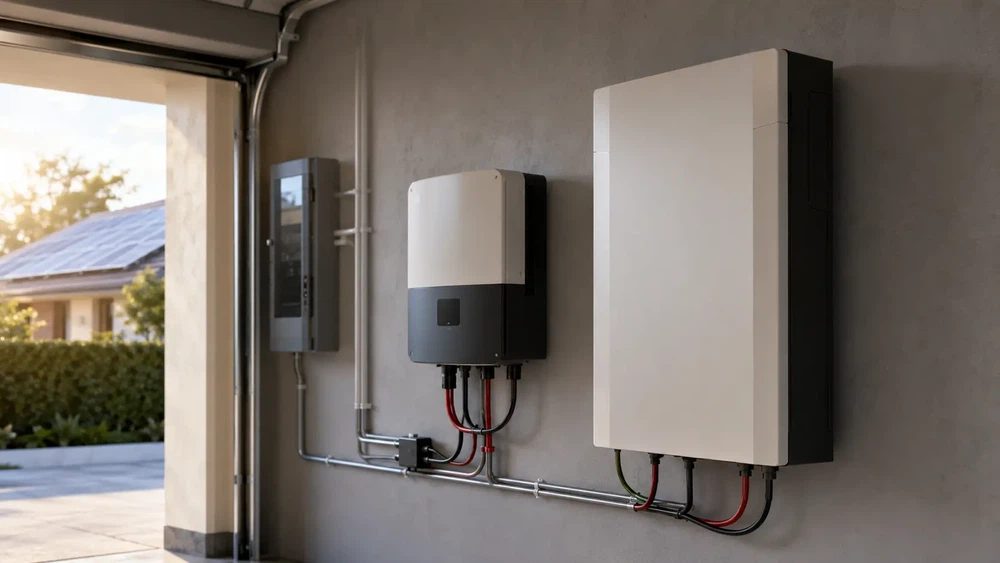
A wall mount battery is a self-contained lithium pack engineered to hang vertically from a structural wall. In residential solar storage, almost all wall mount units are LiFePO4 chemistry packaged as a single enclosed cabinet: cells, BMS, contactors, DC breaker, and communication interface are all integrated behind one cover. Capacity per unit typically falls in the 5–15 kWh range, and several units can be paralleled if the model and inverter both allow it.
Because the entire pack is one IP-rated enclosure, the installer wires a few cables - DC to the inverter, communication to the BMS, ground - and the visible footprint is essentially flat against the wall. That is why wall mount units dominate residential rooftop solar installations where the inverter and battery live side by side in a garage or utility closet.
Wall Mount Battery Advantages for Home Solar Systems
The real advantage is not just "looks neat." It is that the system is delivered as an engineered unit. The BMS is matched to the cells, the protection is sized to the pack, and the certification covers the assembly. Installation time is shorter because there is no cabinet to assemble, no busbar to torque, no module-level wiring.
For a homeowner running a 5–10 kW hybrid inverter with a moderate backup load list - lights, internet, refrigerator, a couple of circuits - one wall mount LiFePO4 unit covers the use case cleanly.
Wall Mount Limitations Installers Actually Run Into
Three limitations come up repeatedly on real jobs.
First, wall strength. A 50 kg battery on a single-layer drywall partition is not an installation; it is a hazard. The bracket must anchor into structural studs, masonry, or a properly engineered backing. Where the wall is weak, the installer either adds a steel backing plate or moves the battery to a floor stand - both of which erode the "space saving" benefit.
Second, parallel limits. Most residential wall units cap at 4–6 parallel modules, sometimes fewer when communication is daisy-chained across a single CAN/RS485 bus. When a project may grow beyond two or three battery modules, a rack layout usually reduces cabling disorder and service difficulty.
Third, service. Once a wall pack is bolted up and wired, swapping it is a two-person job. Sliding a module out of a rack is not.
What Is a Rack Mount Battery?
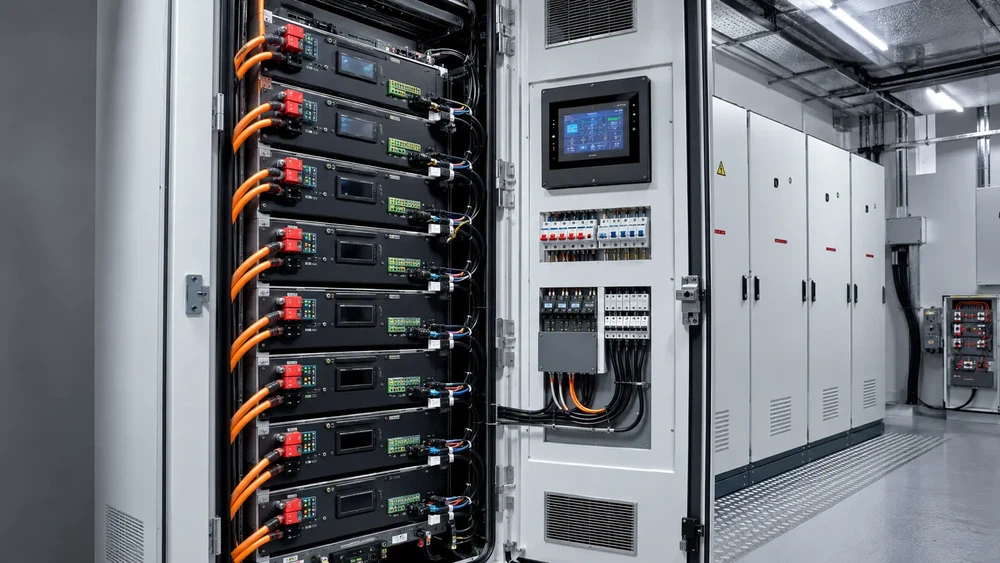
A rack mount battery is a horizontal lithium module sized to fit a 19-inch server-style rack or a purpose-built battery cabinet. Each module is typically 2.5–5 kWh, and a populated rack will hold anywhere from 4 to 12 modules. The rack itself adds a master BMS, communication backplane, busbar, DC breaker, and often a touchscreen monitor.
This is the architecture used in telecom backup, UPS rooms, off-grid base camps, and growing commercial solar storage installations. Server rack battery systems follow the same modular logic as IT equipment: standardized U-height, hot-swappable units, front service access. For larger residential projects that already plan for EV charging or future load growth, modular high-voltage rack battery systems are increasingly common.
Rack Mount Battery Advantages for Off-Grid and Commercial Backup
The single biggest advantage is granular scaling. A rack designed for eight modules can ship populated with three and grow to eight without re-engineering the wiring layout. For an off-grid owner who starts with a base load and later adds a workshop, a heat pump, or extra solar capacity, this matters more than aesthetics.
The second advantage is serviceability. A failed module identifies itself through the BMS, the technician opens the cabinet front, unplugs the comms cable, isolates the module breaker, and slides it out. The rest of the bank keeps running on the remaining modules.
Where Rack Systems Are the Wrong Choice
Rack systems are not free of trade-offs. They consume floor area - a 10-module rack typically needs a footprint of roughly 600 × 600 mm plus front and rear service clearance. They require cabinet, frame, busbar, DC protection, and ventilation planning, which means the upfront installation labor is higher than dropping in a single wall unit. The cost difference is not the cells themselves; it is the supporting infrastructure.
For a small apartment with a 5 kWh backup target, a rack is overengineered.
Wall Mount vs Rack Mount Battery: Side-by-Side Comparison
| Factor | Wall Mount | Rack Mount |
|---|---|---|
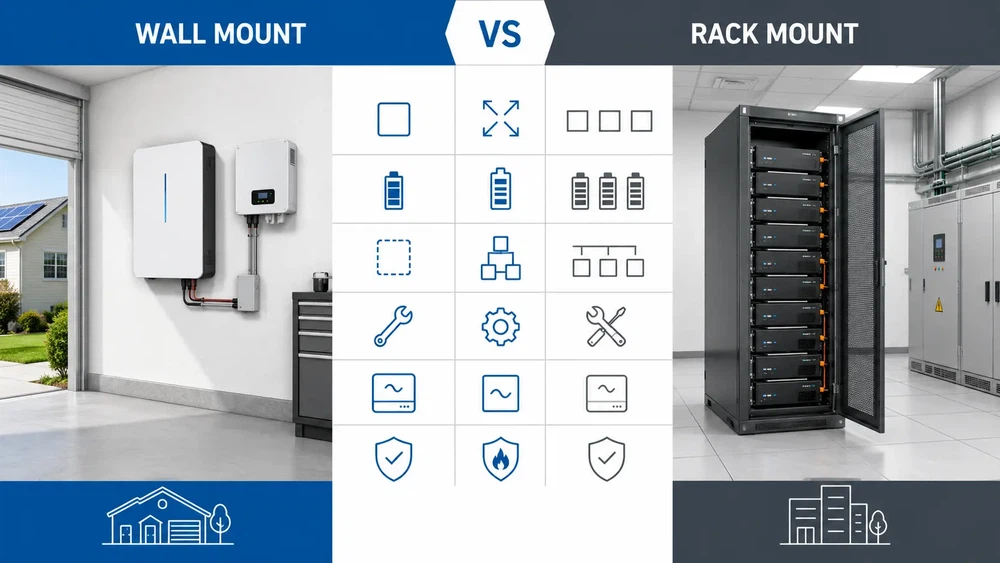
| Typical capacity per unit | 5–15 kWh | 2.5–5 kWh per module; 10–60+ kWh per rack |
| Installation surface | Structural wall | Floor with stable footprint |
| Best system size | Up to roughly 20 kWh | 20 kWh and up; no real ceiling |
| Scalability | Limited by parallel cap (often 4–6 units) | Strong; add modules within rack capacity |
| Service access | Difficult once mounted | Front-access module swap |
| Cabling complexity | Low - pre-integrated | Higher - busbar, DC breakers, comms |
| Cooling | Passive, depends on wall clearance | Cabinet-managed airflow or forced cooling |
| Upfront cost driver | The pack itself | Pack + cabinet + protection + labor |
| Typical buyer | Homeowner, small installer | Commercial integrator, off-grid owner, telecom |
How to Choose
Instead of asking which battery is "better," work through these five questions in order. The answer to the first one that disqualifies a type ends the discussion.
How much capacity does the system actually need now and in three years?
Add up daily backup load in kWh, multiply by hours of autonomy. If the result lands under about 15 kWh and is unlikely to grow much, wall mount fits. If the result is 20 kWh or higher, or if the load is uncertain and growing, build for a rack.
Where will the battery physically live?
A strong masonry or stud-frame wall with 60+ cm of clearance favors wall mount. A utility room, electrical closet, or dedicated battery space with floor area favors rack. Outdoor installation is its own question - covered below.
How likely is expansion?
EV charging, heat pumps, a second solar array, a workshop, a future generator hybrid setup - each of these can double the storage demand. If any of them is on the horizon, design for a rack from day one. Retrofitting a wall mount system into a rack later means relocating the original pack.
Who maintains it, and how often?
Residential users typically inspect once a year. Commercial and off-grid users service more often and need module-level access. Match the installation type to the service model.
What does the inverter require?
Battery selection is locked to the inverter. Voltage range, current rating, BMS communication protocol (CAN or RS485, with vendor-specific framing), and maximum parallel quantity all have to match. Choosing the right inverter–battery pairing for a home system is what makes the rest of the install possible. If the inverter only supports a closed-protocol battery family, the wall-vs-rack choice may already be made for you.
Capacity Planning: Why Big Systems Tend Toward Racks
Capacity is the single strongest predictor of the right installation type. As stored energy grows, three things happen that favor rack architecture.
First, cabling. At 30 kWh and above, parallel cabling between wall units becomes long, awkward, and harder to keep within voltage-drop limits. Busbar-based racks solve this in a few centimeters.
Second, protection coordination. Larger systems usually require dedicated DC breakers per string, surge protection, and clear isolation points. These are designed into rack cabinets; they are bolt-on additions to wall installations.
Third, thermal management. Wall packs rely on passive convection. Above about 20–30 kWh in a single space, that becomes marginal in warm climates, and active airflow or temperature control in a cabinet is more reliable. Understanding how the core components of a battery energy storage system - BMS, PCS, thermal management, protection - interact at scale makes this trade-off clearer.
Inverter Compatibility and BMS Communication
The battery does not work in isolation. Three integration points matter:
- Voltage class. Low-voltage (48 V) batteries pair with most residential hybrid inverters. High-voltage stacks (200–500 V) pair with high-voltage hybrid or three-phase inverters. The two are not interchangeable.
- Communication protocol. The inverter's allowed-battery list is short. A battery whose BMS does not speak the inverter's exact CAN dialect will not be recognized, regardless of how perfect the voltage match is.
- Coupling topology. Whether the system is AC-coupled or DC-coupled changes what the battery has to do and how it integrates with PV. DC-coupled hybrid setups in particular put more weight on BMS handshake quality.
Whether the system is grid-tied, off-grid, or hybrid also influences battery sizing and the role of the BMS in load management, which loops back into the wall-vs-rack choice.
Indoor vs Outdoor Installation
Most wall mount and rack mount LiFePO4 batteries are rated for indoor or sheltered installation. Outdoor installation requires an IP54 or higher enclosure, an operating temperature range that fits the climate (LiFePO4 charging is restricted below 0 °C without internal heating), and protection from direct sun and rain. In humid coastal climates, condensation inside enclosures is the failure most often overlooked.
Garage and utility-room installations sit in between. The space is sheltered but not climate-controlled, and battery datasheets should be checked for the actual operating temperature window, not the wider storage range.
Safety, Certification, and Compliance
In the United States and Canada, residential and commercial energy storage installations are evaluated against a small set of standards. Three to know:
- UL 9540 is the standard for energy storage systems and equipment. A complete BESS, including the battery, inverter, and controls, can be certified to UL 9540.
- UL 9540A is a test method that evaluates thermal runaway fire propagation. It is not a pass/fail certification; it generates data that authorities having jurisdiction use to set installation separation requirements.
- NFPA 855 is the installation standard for stationary energy storage. It governs separation distances, ventilation, fire suppression, and signage. Local fire codes typically reference it.
Why does the user care? Because some jurisdictions require UL 9540A test data before they will permit indoor or attached-garage installation above a certain kWh threshold, and that data shapes which products can be installed in which spaces. UL-certified BESS products short-circuit a lot of permitting friction.
None of this replaces the manufacturer's installation manual, the National Electrical Code, or local building/fire authority approval. The standards are the floor; the installer's documentation chain is what gets the system inspected and signed off.
FAQ
Q: Is A Wall Mount Battery Better Than A Rack Mount Battery?
A: Neither is universally better. For residential systems under roughly 15–20 kWh with a single hybrid inverter, wall mount is usually the cleaner choice. For systems above that capacity, or systems likely to expand, rack mount is usually the better long-term decision.
Q: Can Wall Mount Batteries Be Connected In Parallel?
A: Most can, but each model has a maximum parallel count - commonly four to six units - and the inverter has to support that count on its battery bus. Verify both numbers before assuming a multi-unit wall installation will work.
Q: Are Rack Mount Batteries Only For Commercial Systems?
A: No. Rack mount systems are increasingly used in larger residential installations, especially whole-home backup with future EV charging or off-grid setups. The break-even point is roughly when the project exceeds 20–30 kWh or three modules.
Q: Which Battery Type Is Easier To Expand?
A: Rack mount. Adding a module to an existing rack is a planned operation: slot the module, connect the comms cable, close the breaker, and let the master BMS enroll it. Adding parallel wall units requires more cabling work and is capped by the model's parallel limit.
Q: Can A Wall Mounted Battery Be Installed Outdoors?
A: Only if the unit is rated for outdoor use, which usually means IP54 or higher and a temperature range compatible with the climate. Many wall mount LiFePO4 products are indoor-only. Check the datasheet for the operating temperature range and ingress protection rating, not just the storage rating.
Final Word: Match the Architecture to the Load, the Inverter, and the Future
A wall mount LiFePO4 battery is a single engineered unit that works very well for residential solar storage up to about 15–20 kWh, where the wall is sound, the inverter is matched, and growth is bounded. A rack mount battery is a modular architecture that earns its complexity when capacity, expansion, or serviceability matter - typically commercial backup, off-grid sites, and larger whole-home systems.
Before placing the order, collect the eight items in the installer checklist above. A supplier can then size the inverter, recommend wall or rack, and confirm the certification path for your jurisdiction. If you'd like that review on a specific project, share your load list and site notes with our engineering team and we'll come back with a configuration you can quote against.