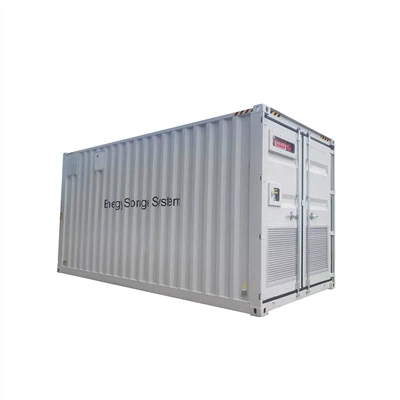
PCS Turnkey Station with MV Transformer
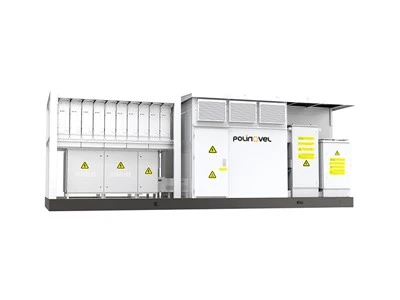
The PCS Turnkey Station with MV Transformer is designed for utility-scale BESS projects that need faster medium-voltage grid connection and easier station-level integration. Instead of matching PCS, transformer, protection, communication, and control equipment separately, it brings key electrical functions together in one project-ready MV station.
With string PCS architecture and integrated grid-support control, the system helps improve project delivery efficiency, battery availability, dispatch response, and long-term operating reliability for large energy storage plants, grid-side BESS, and renewable energy storage projects.

Key Advantages of Our PCS Container
Project-Ready MV Turnkey Station
The station integrates PCS conversion, MV transformer connection, protection, communication, and control functions in one solution. This helps reduce separate equipment matching and simplifies electrical coordination for utility-scale BESS projects.
High-Efficiency Power Conversion
Built with a three-level topology, the system supports high-quality power conversion and up to 99% conversion efficiency. It helps improve energy transfer performance and power quality in large-scale energy storage applications.
Cluster-Level Battery Management
The string PCS design supports cluster-level battery management, helping improve battery availability across multiple battery groups. This is useful for large BESS systems where battery operation consistency and utilization matter.
Fast Grid Dispatch Response
With IEC61850 communication and millisecond-level response capability, the station can react quickly to grid dispatch signals. It supports fast control for grid-side energy storage and renewable energy smoothing applications.
Advanced Grid-Support Functions
The system supports constant power, constant current, and constant voltage control, as well as primary frequency regulation, VSG, and black start. These functions help the BESS participate in more demanding grid-support scenarios.
Reliable Outdoor Deployment
With IP66 protection for the PCS, intelligent multi-stage cooling, 50°C non-derating operation, and flexible outdoor installation, the station is designed for stable operation in utility-scale energy storage sites.
Specification
| DC Parameters | |
| Max. DC Voltage | 1500V |
| Max. DC Current | 483A×16 |
| Battery Group Voltage Range | 1000–1500V |
| Number of Connectable Battery Groups | 8 / 16 |
| AC Parameters (Grid-connected) | |
| Rated Output Power | 6250kVA |
| Rated AC Voltage | 10–35kV |
| Rated Grid Frequency | 50Hz / 60Hz |
| AC Current THD | <3% (Rated Power) |
| Power Factor Adjustable Range | -1~+1 |
| AC Parameters (Off-grid) | |
| Rated AC Voltage | 10–35kV |
| Rated Frequency | 50Hz / 60Hz |
| Voltage THD | <3% (Rated Power) |
| DC Component | <0.5%Un (Linear Balanced Load) |
| Unbalanced Load Capability | 100% |
| System Features | |
| Isolation Method | Dry-type / Oil-immersed Transformer |
| Max. System Efficiency | 98% |
| Protection Rating | IP66 (Converter) / IP54 (Others) |
| Operating Temperature Range | -40~+60℃ (+50℃ Derating) |
| Allowable Humidity Range | 0–100% (Non-condensing) |
| Max. Operating Altitude | 5000m (>4000m Derating) |
| Cooling Method | Liquid Cooling (Converter) |
| Communication Interface | RS485 / CAN / Ethernet |
| HMI Interface | Bluetooth + APP |
| Mechanical Parameters | |
| Dimensions | 7700×3200×3050mm (Dry-type) |
| Weight | 30000kg |
What Is a PCS Turnkey Station with MV Transformer?
The electrical interface between your battery containers and the medium-voltage grid - conversion, step-up
and protection in one pre-assembled unit.
A PCS turnkey station with MV transformer integrated performs three jobs inside one enclosure: bidirectional DC/AC conversion by the power conversion system (PCS), voltage step-up through the MV transformer, and protection, metering and control through the MV switchgear section.
In a conventional separated design, the PCS, the step-up transformer and the MV switchgear come from different vendors and are matched on site. That enlarges the footprint, lengthens commissioning, and pushes electrical coordination onto the EPC contractor.
A turnkey station with MV transformer integrated moves that coordination into the factory, so the site receives one pre-assembled unit needing only DC cables in and MV cables out.
Within the battery energy storage system architecture, this station sits between the DC block and the point of common coupling. It accepts 1000–1500V DC from the battery groups and delivers 10–35kV to the grid.
Architecture and Power Flow
From battery container to utility grid in five stages - only DC cables in, only MV cables out.
1000–1500V DC
483A × 16
Convergence
Dry / Oil
RMU
10–35kV
Each of the 8 or 16 battery groups connects to its own DC input, so the string PCS modules manage clusters independently rather than paralleling every cluster onto one DC bus. A single underperforming cluster therefore does not drag down the rest of the block, and a faulted cluster can be isolated while the station keeps operating at reduced power.
On the AC side, the modules converge onto a low-voltage AC bus feeding the step-up transformer, which raises the voltage to the 10–35kV level required at the point of connection. The principles of power conversion behind the three-level topology determine both the conversion efficiency and the harmonic performance at the transformer primary.
The control path runs in parallel: the BMS reports cluster state to the station controller, which exchanges data with the plant EMS and power plant controller (PPC) over IEC 61850. The whole station appears to SCADA as a single dispatchable asset.
String PCS vs Central PCS
The difference is not efficiency at rated load - both are high. It is what happens at partial load and during faults.
Central PCS Station
- DC Topology
All clusters paralleled onto a shared DC bus ahead of one large converter - Operating Window
The weakest cluster sets the window for the entire block - Fault Impact
A converter fault takes full station capacity offline - Best Fit
Smaller blocks with tight capex limits
String PCS Station
- DC Topology
Each cluster gets its own converter path - 8 or 16 independent DC inputs - Operating Window
Cluster-level SOC balancing raises usable energy across plant lifetime - Fault Impact
A module fault costs a fraction of capacity, not all of it - Best Fit
Utility-scale BESS where availability drives the business case
The trade-off for the string approach is a higher module count and more DC terminations. For utility-scale BESS where availability and lifetime energy throughput drive the business case, the string approach generally wins.
Dry-Type vs Oil-Immersed
The isolation method affects fire strategy, footprint, maintenance and permitting
| Item | Dry-Type | Oil-Immersed |
|---|---|---|
| Fire risk | No liquid dielectric | Requires oil containment |
| Maintenance | Lower, no oil sampling | Periodic oil inspection |
| Footprint | Often larger | Often more compact |
| Outdoor adaptability | Enclosure dependent | Strong |
| Typical application | Fire-sensitive or enclosed sites | Utility-scale outdoor plants |
Communication and EMS Integration
The station controller aggregates data from the string PCS modules, transformer section and MV switchgear,
presenting the station to the plant control layer as a single asset.
| Interface | Availability |
|---|---|
| RS485 | Standard |
| CAN | Standard |
| Ethernet | Standard |
| IEC 61850 | Standard |
| Bluetooth + APP (local HMI) | Standard |
Installation, Transport and Site Requirements
Transport
The dry-type station measures 7700×3200×3050mm and weighs 30,000kg. At 3200mm wide it exceeds standard ISO container width, so road transport is planned as an out-of-gauge load and the route survey should be completed before the delivery date is fixed.
Foundation & Cabling
The station arrives factory-assembled and factory-tested. Only DC cables are routed in and only MV cables are routed out. The foundation must be level and rated for station weight plus the transformer configuration selected, with maintenance clearances preserved on the access sides.
Operating Envelope
-40 to +60°C ambient with derating above +50°C, 0–100% non-condensing humidity, and altitude up to 5000m with derating above 4000m. Sites above 4000m or with corrosive atmospheres should be raised at the enquiry stage.
PCS Turnkey Station Questions
Q: What is the difference between a PCS turnkey station and a PCS MV skid?
A: Nothing substantial - they are two names for the same class of equipment. "PCS turnkey station with MV transformer integrated" is more common among Chinese and European suppliers; "PCS MV skid" is used more often in North America. "Pre-assembled substation" and "energy storage step-up station" describe the same product.
Q: What is the difference between this station and a battery container?
A: A battery container holds cells, racks and the BMS, and produces DC. This station holds no batteries - it converts that DC to AC, steps it up to medium voltage and connects it to the grid. A complete utility-scale block needs both.
Q: What grid voltage does the station support?
A: 10–35kV, on 50Hz or 60Hz. The exact ratio is set by the transformer configuration selected for the project.
Q: Can the transformer be dry-type or oil-immersed?
A: Both are available. See the comparison table above. Published dimensions and weight refer to the dry-type configuration.
Q: Does the station support grid-forming operation and black start?
A: Yes. VSG grid-forming control and black start are both standard, along with primary frequency regulation.
Q: How many battery groups can connect to one station?
A: 8 or 16, each with an independent DC input in the 1000–1500V range, with a maximum DC current of 483A per input.
Q: Why is 99% efficiency listed alongside 98%?
A: They measure different things. 99% is the maximum efficiency of the PCS conversion stage alone. 98% is the maximum efficiency of the complete station, measured from DC input to MV output, and therefore includes transformer and auxiliary losses. The station figure is the one to use for plant energy modelling.
Q: Does the station require on-site assembly?
A: No. It ships factory-assembled and factory-tested. Site work is limited to foundation preparation, DC cable entry, MV cable termination, grounding and commissioning.
Q: What project information is needed for a quotation?
A: Required power in MW or MVA, battery DC voltage range and number of clusters, grid voltage and frequency, transformer preference, whether grid-forming is required, ambient temperature and altitude, installation country and local grid code, and target delivery date.

Configure a PCS MV Station for Your BESS Project
Send your project parameters and our engineering team will return a technical proposal with single-line diagram and scope of supply.
Hot Tags: pcs turnkey station with mv transformer, pcs mv skid, bess mv skid, string pcs turnkey station, energy storage step-up station, integrated pcs and step-up transformer, 1500v dc pcs station, 10-35kv pcs station, utility-scale bess pcs, grid-forming pcs