


What Is a Battery Energy Storage System?
A battery energy storage system is a coordinated set of equipment that stores electrical energy and releases it on demand. A complete system includes battery modules, a power conversion system (PCS) or inverter, a battery management system, an energy management system, thermal management, and electrical protection.
BESS deployments span almost every part of the energy landscape:
- Homes pairing storage with rooftop solar
- Homes that need outage backup with or without solar
- Commercial and industrial facilities managing demand charges and resilience
- Microgrids serving campuses, remote sites, or critical infrastructure
- Utility-scale plants providing frequency regulation, capacity, and renewable firming
- EV charging hubs that need to manage peak power draw
The job is the same in every setting: capture electricity now and deploy it later, where and when it has the most value. Unlike solar panels or generators, a BESS is not a primary source - it must first receive electricity from somewhere else before it can discharge.
How a Battery Energy Storage System Works: Step by Step
The end-to-end flow of a BESS looks like this:
Source → Power Conversion System → Battery Cells (managed by BMS) → Power Conversion System → Loads or Grid, all coordinated by the EMS.
Step 1: Electricity Enters the System
Electricity arrives from solar panels, the utility grid, or a generator. In a solar-plus-storage installation, surplus solar energy at midday - production a household cannot consume in real time - flows into the battery instead of being exported. A typical 8 kW residential solar array can easily produce more than a home uses between roughly 11 a.m. and 3 p.m., and that excess is exactly what the battery captures.
Step 2: Power Is Converted for Storage
Battery cells store energy as direct current (DC). Most homes and buildings run on alternating current (AC). The inverter or PCS bridges the two, converting:
- DC solar power into AC power for the building
- AC grid power into DC power to charge the battery
- DC battery power back into AC power for loads
Whether the system is AC-coupled or DC-coupled changes how the inverter, solar, and battery interact - DC-coupled designs are typically more efficient for new solar-plus-storage projects, while AC-coupled designs are easier to retrofit onto existing PV systems.
Step 3: The Battery Stores Energy Chemically
Inside each cell, electricity is stored through reversible chemical reactions. The U.S. Department of Energy describes electrochemical storage as converting electrical energy into chemical potential energy during charging, then back into electricity during discharge. Lithium iron phosphate (LFP) chemistry now dominates stationary storage thanks to its long cycle life (commonly 6,000+ cycles to 80% capacity) and strong thermal stability, which is why it shows up in everything from high-voltage residential batteries to multi-megawatt-hour container systems.
Two performance metrics matter here:
- Round-trip efficiency - the share of electricity put in that comes back out, typically 85–95% for modern lithium systems.
- Depth of discharge (DoD) - how much of the rated capacity is actually used per cycle. Most LFP systems allow 90–100% DoD without harming cycle life.
Step 4: The Battery Management System Protects the Battery
The BMS is the safety and health layer. It continuously monitors state of charge, voltage, current, cell temperature, cell-to-cell balance, and fault conditions, then communicates with the inverter to throttle or shut down operation when anything drifts out of range. Without a competent BMS, batteries are exposed to overcharging, deep discharge, thermal runaway, and accelerated degradation.
Step 5: Stored Energy Is Converted Back to Usable Power
When loads call for power - at sunset, during a peak-rate window, or during a grid outage - the battery discharges, the inverter converts DC back to AC, and electricity flows to the panel. In a backup configuration, this handoff usually happens within milliseconds via an automatic transfer switch or hybrid inverter, so sensitive equipment like Wi-Fi routers, refrigerators, and CPAP machines stay running.
Step 6: The Energy Management System Decides Strategy
The EMS turns a passive battery into a smart asset. Depending on the operating mode, it may prioritize:
- Self-consumption - store excess solar, discharge in the evening
- Time-of-use arbitrage - charge off-peak, discharge during expensive hours
- Backup reserve - hold a percentage of capacity for outages
- Peak shaving / demand charge management - discharge briefly to clip peak kW
- Grid services - frequency response, capacity, or VPP participation
In commercial systems, the EMS is often where the financial case lives, since utility tariffs and demand charges drive most of the savings.
Core Components of a BESS
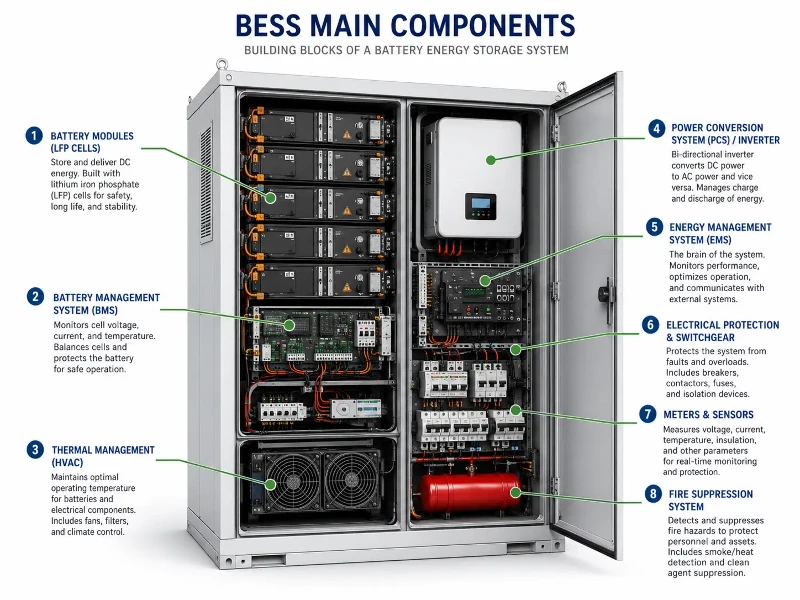
A BESS is more than the battery cabinet. The supporting hardware and software determine performance, safety, and lifespan as much as the cells themselves.
| Component | Function |
|---|---|
| Battery modules | Store energy in cells arranged for the required voltage and capacity |
| Battery management system (BMS) | Monitors and protects cells; manages balancing and faults |
| Power conversion system (PCS) / inverter | Converts between DC battery and AC building or grid power |
| Energy management system (EMS) | Controls charge/discharge logic and operating mode |
| Thermal management | Air or liquid cooling to keep cells within safe temperature ranges |
| Safety equipment | Disconnects, protective relays, sensors, fire detection and suppression |
| Switchgear and metering | Measures energy flow and isolates the system as needed |
| Backup or critical-loads panel | Routes stored energy to selected circuits during an outage |
Form factor matters too. Residential systems are usually wall-mounted indoor cabinets; outdoor cabinet BESS serve commercial sites; and containerized BESS handle utility-scale and large C&I projects, often with integrated liquid cooling and fire suppression. A full breakdown of subsystem responsibilities is covered in the 8 core BESS components reference.
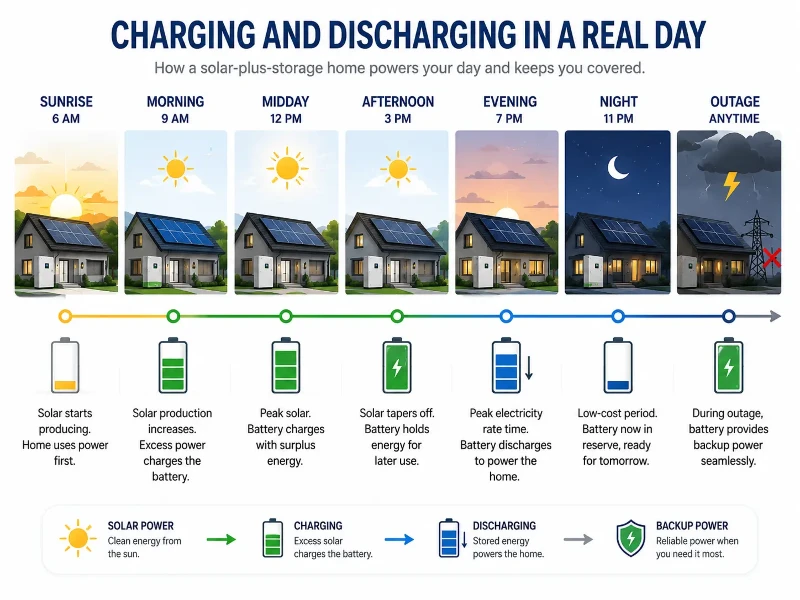
Charging and Discharging in a Real Day
A solar-plus-storage home in a time-of-use territory might run like this:
- Morning - solar starts producing; loads are met directly from PV.
- Midday - solar exceeds household demand; surplus charges the battery.
- Late afternoon - battery typically reaches full charge.
- Evening (peak rates) - battery discharges to cover lighting, cooking, HVAC, and electronics.
- Overnight - system holds reserve capacity for backup; grid fills any gap.
- Outage - the system islands from the grid and powers critical loads.
Actual behavior depends on tariff structure, inverter type, battery sizing, and whether backup is configured for whole-home or critical-loads only.
What Can a BESS Be Used For? Common Applications
Solar Self-Consumption
The most common residential use case. Instead of exporting surplus solar at low feed-in credit, the home stores it for evening use, raising self-consumption from a typical 25–35% to 70%+.
Backup Power During Outages
Backup time is a function of usable capacity, average load, and whether solar can recharge during the day. A 13 kWh battery powering a refrigerator (~150 W average), Wi-Fi, lights, and a few outlets - about 0.6 kW continuous - can run roughly 18–20 hours from a full charge. Add HVAC or a well pump with high starting current, and that drops sharply. This is why a critical-load list, not battery size alone, drives a sound design.
Time-of-Use Energy Arbitrage
Charging during cheap or solar-rich hours and discharging during peak-rate hours is one of the grid services the EIA identifies as a primary value stream for battery storage.
Commercial Peak Shaving and Demand Charge Management
For many commercial customers, demand charges - billed on the highest 15-minute kW spike of the month - represent 30–70% of the electric bill. A BESS sized to discharge during those spikes can clip peaks without changing operations. Several mechanisms contribute to the commercial business case, including load shifting, demand response revenue, and resilience savings.
Microgrids and Grid Support
Battery storage is the enabling technology behind most modern microgrids, allowing solar, generators, and loads to operate as a coordinated island when the main grid is unavailable. At grid scale, batteries balance supply and demand on second-to-hour timescales and store renewable output that would otherwise be curtailed.
EV Charging Hubs
High-power DC fast charging can overwhelm a site's grid connection. A BESS reduces the demand drawn from the utility by buffering charge sessions, often making a project viable without a costly service upgrade.
Residential vs Commercial BESS
| Feature | Residential BESS | Commercial BESS |
|---|---|---|
| Typical capacity | 5–40 kWh | 100 kWh – several MWh |
| Primary goals | Backup, solar self-use, bill savings | Demand charges, resilience, sustainability |
| Loads supported | Critical circuits or whole-home | HVAC, refrigeration, production lines, EV charging |
| Design driver | Outage tolerance and PV size | Load profile, tariff structure, operational risk |
| Controls | Simple presets and app | Advanced EMS, often integrated with BMS/SCADA |
The principle is identical; the engineering, controls, and economics differ.

kW vs kWh: The Two Numbers That Define a Battery
Specifying a BESS comes down to two specs:
- kW (kilowatts) - power. How much load the system can serve at one moment.
- kWh (kilowatt-hours) - energy. How much the battery can store and discharge over time.
A 5 kW / 15 kWh battery can deliver up to 5 kW instantaneously, or sustain about 1.5 kW for 10 hours. Mismatch between the two is a common design error: high capacity with low power can hold lots of energy but cannot start a heat pump; high power with low capacity can start big loads but runs out quickly. The kW vs kWh guide walks through the sizing math in more detail.
Benefits and Limitations of a Battery Energy Storage System
Benefits
- Stores solar energy for evening or overnight use
- Provides outage backup for critical or whole-home loads
- Reduces exposure to time-of-use and demand charges
- Improves resilience for homes, businesses, and microgrids
- Supports higher renewable penetration on the grid
- Can stack revenues in markets that allow grid services
Limitations
- Significant upfront cost
- Finite usable capacity per cycle
- Gradual degradation; capacity warranties typically guarantee ≥70% at year 10
- Site requirements: ventilation, clearance, code compliance
- Possible electrical panel or service upgrades
- Permitting and AHJ review
- End-of-life recycling responsibilities
The best system is rarely the largest one. It is the system matched to the load profile, tariff, site, and budget.
Safety Standards You Should Know
BESS safety is governed by a small set of standards that any reputable installer will work to:
- NFPA 855 - Standard for the Installation of Stationary Energy Storage Systems. Covers spacing, ventilation, fire detection, and emergency response.
- UL 9540 - Safety certification for energy storage systems and equipment.
- UL 9540A - A test method for evaluating thermal runaway fire propagation in BESS.
- NEC Article 706 - National Electrical Code requirements for energy storage systems.
For a deeper look at why these certifications matter when comparing equipment, see why your BESS needs UL certification.
FAQ
Q: Does A Battery Energy Storage System Create Electricity?
A: No. A BESS only stores electricity that has already been produced by solar, the grid, or a generator, and releases it later. It is a storage device, not a generator.
Q: Can A BESS Power A Whole Home?
A: Sometimes - it depends on the home's loads and the battery's power and capacity ratings. Many homeowners choose critical-load backup (refrigerator, internet, lights, medical devices, well pump) because it is far cheaper than backing up HVAC, electric ovens, and EV charging simultaneously.
Q: How Long Can A BESS Provide Backup Power?
A: Backup duration depends on usable capacity (kWh), average load (kW), and whether solar can recharge during daylight. A 13.5 kWh battery powering 0.6 kW of essentials runs about 20 hours from full; the same battery running a 4 kW air conditioner runs about 3 hours.
Q: Do Solar Batteries Work During Outages?
A: Only if the system is specifically configured for backup. Standard grid-tied solar without storage shuts down during outages for safety. Solar-plus-storage with a hybrid inverter and an islanding-capable design will keep critical loads running and, in many cases, recharge from the sun the next day.
Q: How Long Does A BESS Last?
A: Most modern LFP residential and commercial batteries are warranted for 10 years and 6,000+ cycles to a guaranteed minimum capacity (typically 70%). Real-world life depends on temperature, depth of discharge, charge rate, and usage patterns.
Q: Does A BESS Need Solar To Be Useful?
A: No. Battery storage delivers value on its own through outage backup, time-of-use arbitrage, and demand charge management. Solar simply expands the financial case and allows for off-grid recharging during extended outages.
The Bottom Line
A battery energy storage system works by converting incoming AC or DC electricity into stored chemical energy, holding it under the watch of a battery management system, and releasing it through an inverter when the energy management system determines it is most valuable. The technology is mature, the standards are well established, and the use cases - from a 10 kWh home backup unit to a multi-megawatt grid asset - all rest on the same core principles.
The deciding factor in a successful project is not the battery brand. It is matching the system's power, capacity, and controls to a real load profile, a real tariff, and a real site. Get those right, and a BESS earns its keep for a decade or more.