


For European BESS projects, the EU Battery Passport handover is a manufacturer-data delivery exercise: define the finished battery boundary, identify the responsible economic operator, collect the mandatory Annex XIII data, and make the passport accessible through the required QR-code-linked unique identifier or a passport portal. From 18 February 2027, each industrial battery with capacity greater than 2 kWh placed on the EU market or put into service must have a battery passport; BESS suppliers, EPC contractors, importers, integrators, and procurement teams should therefore contract the data package before equipment ships. (eur-lex.europa.eu)

What must a BESS supplier hand over first?
A BESS supplier should first hand over the evidence needed to prove what the "finished battery" is, who is responsible for the passport, which mandatory data points apply to the industrial battery, and how authorised users will access the passport. The Battery Passport is not a cell-counting exercise; it attaches to the finished, safely functioning battery that can deliver electrical energy, which may be a cabinet, a rack group, or a containerised battery system depending on how the BMS and essential components are supplied. The Commission FAQ also clarifies that where another party creates or updates the passport under written authorisation, ultimate responsibility remains with the economic operator placing the battery on the EU market. (single-market-economy.ec.europa.eu)
For procurement, the practical output is a controlled data room plus a passport access plan. Link this work with your BESS compliance documentation and supplier quality documentation so regulatory data, commercial documents, and restricted technical files do not get mixed.
Finished battery boundary for BESS supply architectures
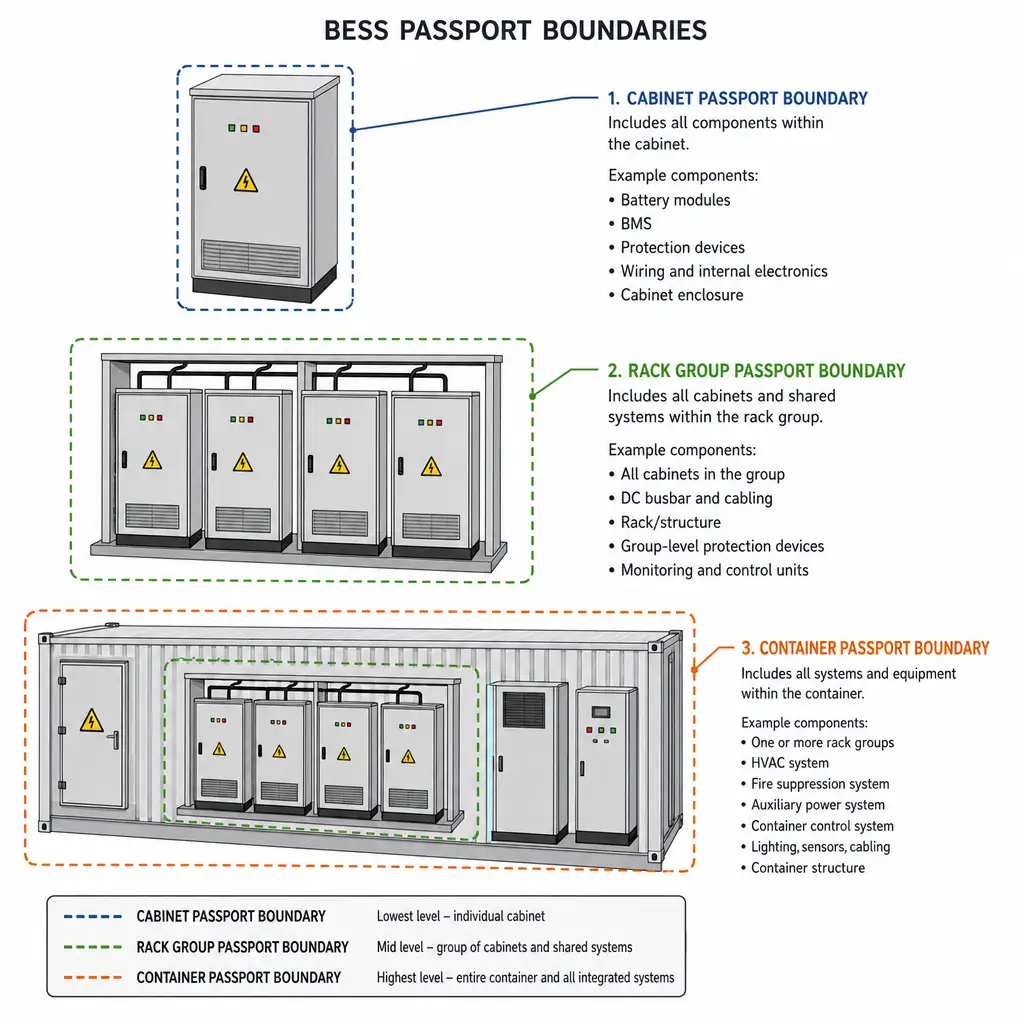
The boundary is determined by functional completeness, not by the number of modules, racks, or shipping units. If imported packs and a BMS are assembled in the EU before a completed battery is placed on the market, the EU entity completing and placing that battery on the market is responsible for the Battery Passport; if components are not yet a finished, safely functioning battery, the passport obligation arises for the completed battery. (single-market-economy.ec.europa.eu)
For BESS projects, use these boundary checks:
- Outdoor cabinet BESS: if each cabinet contains the battery packs, BMS, protection, and essential controls needed to operate as a complete battery, treat each cabinet as the likely finished battery boundary.
- Multi-rack BESS: if racks depend on a common BMS or shared essential systems and cannot operate independently, assess the rack group as one finished battery rather than issuing passports per rack.
- Containerised BESS: if the container integrates multiple battery strings under common safety and control architecture, the container or defined battery subsystem may be the finished battery; if independently functioning cabinets are simply installed inside a container, each complete cabinet may need separate treatment.
- EU final integration: if modules, packs, or racks are supplied unfinished and the integrator adds the BMS or essential components, the integrator may become the responsible manufacturer for the finished battery.
Document the boundary decision in the technical file. It should identify serialised passport units, excluded components, shared systems, and the evidence used to decide whether the supply is finished or unfinished.
Mandatory 2027 data and planned future fields
Regulation (EU) 2023/1542 Article 77 requires the passport to contain battery-model information and individual-battery information, with public, restricted, and authority-only access categories defined through Annex XIII. The Commission's 2026 guidance organises the passport into 71 data points and identifies which are mandatory, optional, conditional, or not required to be filled/displayed as of February 2027; it does not make all 71 points mandatory for every industrial BESS battery from day one. (eur-lex.europa.eu)
For BESS data handover, separate three groups:
- Mandatory or conditional 2027 industrial battery data: unique identifier, responsible party identity, manufacturer details, battery category, model/serial identifiers, manufacturing place and date, weight, capacity, chemistry, hazardous substances, usable extinguishing agent, critical raw materials, voltage range, power capability, marking information, EU declaration of conformity, waste-battery information, detailed composition, spare-parts sources, dismantling information, safety measures, test-report results, applicable dynamic performance/status data, and state-of-health fields where applicable. (single-market-economy.ec.europa.eu)
- Not required in February 2027: carbon footprint declaration/label, recycled-content shares, and responsible-sourcing information are linked to separate application dates or implementing/delegated acts and should be managed as upcoming requirements, not represented as currently mandatory passport fields. (single-market-economy.ec.europa.eu)
- Recommended contractual files: design drawings, data dictionaries, BMS register maps, supplier declarations, version logs, and evidence packs may not all be passport fields, but they help the responsible operator defend completeness, accuracy, and updates.
This distinction is central to battery lifecycle management: collect future-facing evidence early, but label it contractually as preparatory unless the regulation or applicable act makes it required.
Manufacturer Data Handover Matrix
Use the following matrix in RFQs and supply agreements. "Mandatory" means required by Regulation (EU) 2023/1542 or the 2026 data-point guidance for industrial batteries where applicable; "recommended" means useful contractual documentation that supports the passport but is not itself a universal passport field.
| Data category | Original data source | Responsible delivery party | Required evidence | Project phase | Access permissions |
|---|---|---|---|---|---|
| Finished battery boundary | System architecture, BMS topology, scope of supply | Manufacturer or integrator completing the battery | Boundary memo, serialisation plan, shared-system diagram | RFQ / engineering verification | Internal, authority on request |
| Responsible economic operator | Importer/manufacturer records, mandate letters | EU importer, manufacturer, or party placing into service | Legal entity details, written authorisation if delegated | RFQ / pre-delivery | Public identity plus controlled admin access |
| Public model data | Nameplate, technical file, manufacturing records | Manufacturer, validated by importer/integrator | Model, serial/batch, capacity, chemistry, weight, voltage, power, manufacturing date/place | Engineering verification | Public passport access |
| Composition and hazardous substances | Cell, module, pack, and material suppliers | Manufacturer with upstream supplier inputs | Chemistry, hazardous substances, critical raw materials, detailed composition | Engineering verification | Public or restricted depending field |
| Conformity and test evidence | Technical documentation and compliance file | Manufacturer; importer verifies availability | EU declaration of conformity, applicable test-report results | Pre-delivery / handover | Public for DoC; authority-only for some test results |
| Dismantling and safety data | Product engineering, service engineering | Manufacturer | Exploded diagrams, disassembly sequence, fastening methods, tools, warnings, safety measures | Project handover | Restricted legitimate-interest access |
| BMS static data | BMS specification and firmware baseline | Manufacturer / BMS supplier | Parameter list, measurement definitions, firmware/version references | Engineering verification | Controlled project access |
| BMS dynamic data | BMS logs after use begins | Operator or authorised service party | SOH where applicable, status, cycles, negative events, environmental and SOC records where applicable | Handover / operation | Restricted legitimate-interest access |
| Future sustainability evidence | Supply-chain declarations and calculation files | Manufacturer with upstream suppliers | Carbon footprint, recycled content, due-diligence evidence when applicable | Contract option / future update | To be defined by field and access rules |
RFQ to handover milestone checklist
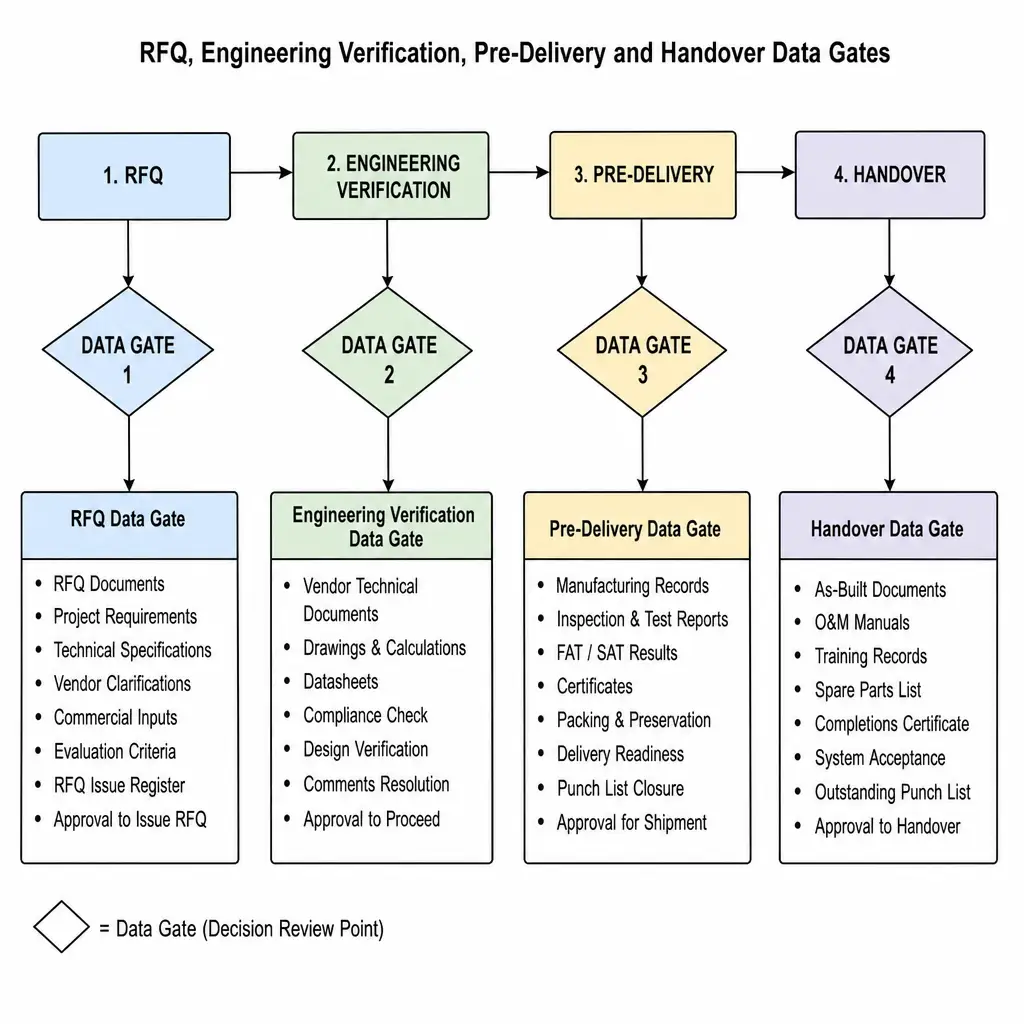
Data obligations should be written into the project schedule, not chased during commissioning. The responsible economic operator must ensure passport data is accurate, complete, and up to date, while authorised suppliers may perform practical data tasks under written mandate; that contractual delegation does not automatically transfer statutory liability. (eur-lex.europa.eu)
RFQ
Ask bidders to state the finished battery boundary, passport unit count, intended responsible economic operator, data owner for each Annex XIII category, and whether the passport will be hosted by the operator or an authorised service provider. Include a requirement for a draft data-point register mapped to the Commission's 2026 guidance. This is also the right time to align with your battery lifecycle management process so future repair, repurposing, and recycling access needs are not ignored.
Engineering verification
Verify that model data, composition data, conformity documents, dismantling data, and BMS data definitions are technically consistent. For example, the passport serialisation plan should match cabinet or container labels, the BMS boundary should match the finished battery decision, and restricted data should be separated from public data. Any non-applicable field should have a reason, not an empty cell without explanation.
Pre-delivery checks
Before shipment or EU import, confirm that the QR code, unique identifier, registry workflow, and passport portal responsibilities are defined. The regulation requires access through a QR code linked to a unique identifier, and the Commission FAQ explains that the full Battery Passport is hosted by the economic operator or an authorised operator, while the DPP Registry primarily records registration and metadata. (eur-lex.europa.eu)
Project handover
At handover, obtain the final data pack, access credentials or role process, proof of registration if available, and a change-control procedure. Connect the handover to your BESS commissioning documentation and BMS data integration workflows so operational data does not become detached from the passport.
How should BMS data be provisioned?
BMS data should be split into static definitions and dynamic records. Static data explains what the battery is and how values are defined: battery model, BMS hardware/software baseline, measurement definitions, parameter names, units, limits, and the relationship between BMS signals and passport fields. Dynamic data results from use, including applicable performance and durability values, state-of-health information, battery status, cycle count, negative events, operating environmental conditions, and state of charge records. (eur-lex.europa.eu)
Do not require unsupported real-time uploads unless your contract separately defines them. For the EU Battery Passport for BESS: Supplier Data Handover Checklist, the safer requirement is evidence-based provisioning: define the data field, source register, timestamp logic, validation owner, access tier, and update trigger. If dynamic data is unavailable for a new imported finished battery because it has not yet been used, the Commission FAQ states that this does not prevent passport registration. (single-market-economy.ec.europa.eu)
Access, permissions, and portal controls
Passport access must reflect Annex XIII. Public users can see public model information; authorities and notified bodies have access to authority-only data; persons with a legitimate interest may access restricted dismantling, composition, and individual-battery information as defined by the applicable access rules. The Commission FAQ notes that the implementing act on restricted access was still pending final adoption as of the FAQ text, so contracts should reserve a mechanism to update access roles when the binding act is final. (single-market-economy.ec.europa.eu)
Procurement teams should require:
- QR code placement and identifier management plan.
- Passport hosting responsibility and continuity plan.
- Role-based access for public, authority, owner, service, and end-of-life users.
- Download/export rules for EPC records and owner handover.
- Audit trail for corrections, updates, and authorised changes.
- Language handling for non-language-neutral information in target Member States.
This is where BESS recycling and end-of-life documentation becomes relevant: dismantling and safety data must be available to the right actors without exposing more commercial information than the access tier permits.
Contract wording priorities for EPCs and importers
The contract should make data delivery enforceable without overstating legal responsibility. State that the supplier must provide complete, accurate, and update-ready data for the defined finished battery, but also identify the statutory responsible economic operator separately. Add a written-authorisation clause if a manufacturer, non-EU supplier, data platform, or integrator will create or maintain the passport on behalf of that operator.
Include these deliverables:
- Data-point register mapped to Annex XIII and the 2026 guidance.
- Finished battery boundary report for each supplied BESS architecture.
- Evidence pack for mandatory and conditional industrial-battery fields.
- BMS static data dictionary and dynamic data provisioning method.
- QR code, unique identifier, registry, and portal access plan.
- Restricted-data handling procedure.
- Update procedure for corrections, repairs, status changes, and future legal requirements.
Handled this way, passport requirements eu compliance becomes a structured manufacturer data handover-not a last-minute documentation chase at energisation.