


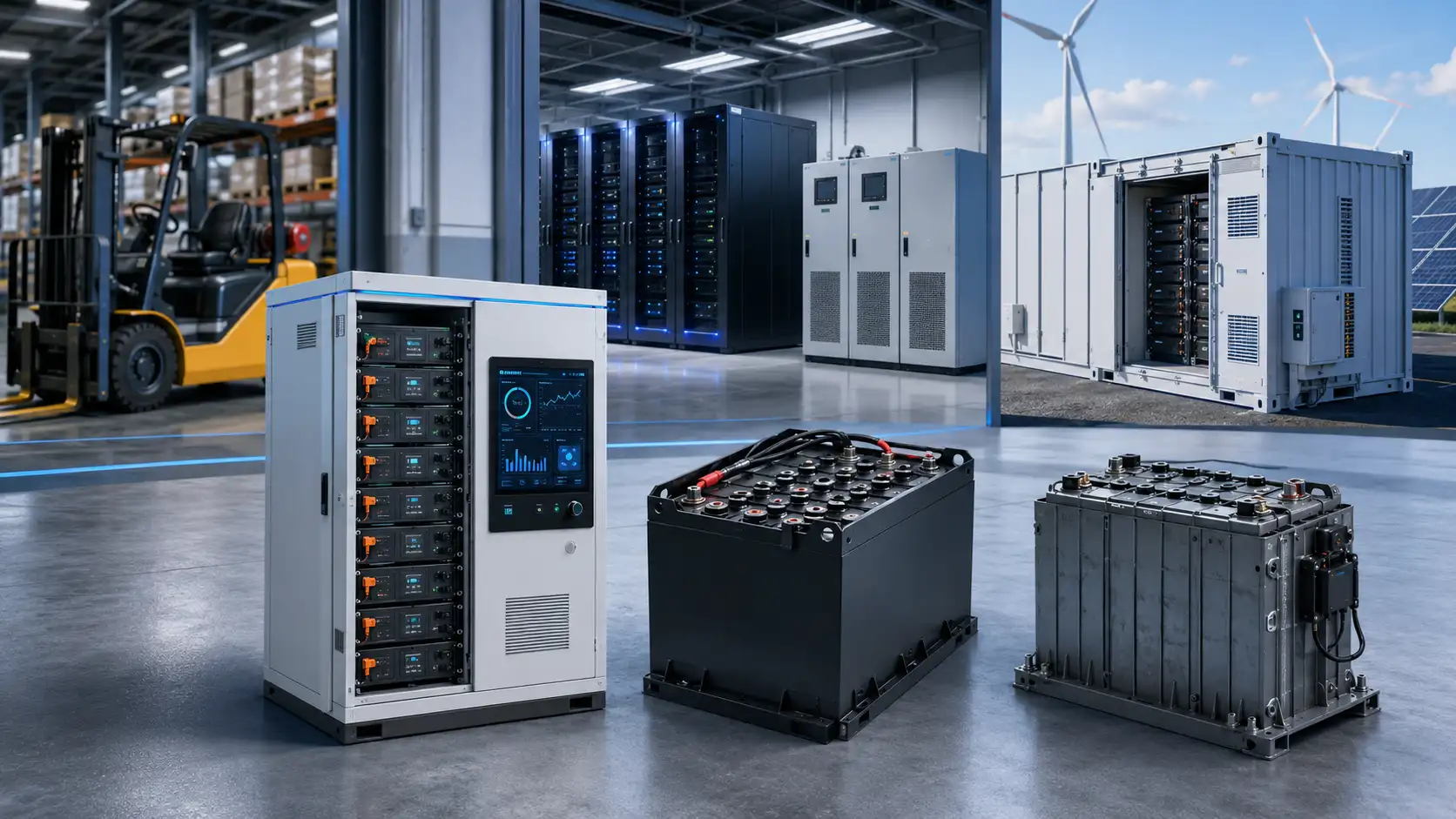
Choosing an industrial battery system comes down to matching one of three proven chemistries to how you actually run your operation. Lithium-ion (especially LFP) fits high-utilization, multi-shift, and weight-sensitive work; lead-acid still wins on upfront cost for single-shift and stationary backup; and nickel-cadmium remains the specialist for extreme temperatures. There is no universal "best" industrial battery system. The right choice depends on duty cycle, charging windows, operating temperature, total cost of ownership, footprint, and safety certification. This guide compares each chemistry, gives a side-by-side reference table, walks through a five-step selection process, and matches batteries to common industrial applications.
For most high-utilization industrial applications, lithium-ion (particularly LFP chemistry) offers the best total value through roughly 3–5× longer cycle life, about 90–95% round-trip efficiency, and 2–4 hour fast charging. Lead-acid still wins on upfront cost for single-shift stationary backup, while nickel-cadmium is hard to beat in extreme temperatures from roughly −40°C to +60°C.
What Is an Industrial Battery System?
An industrial battery system is engineered for sustained high current, thousands of deep-discharge cycles, and reliable operation in conditions that would quickly destroy consumer cells. Three demands shape the design. First, the system must handle heavy continuous loads. A forklift battery may discharge at over 100 amps for hours, while a data center UPS must deliver thousands of amps the instant the grid fails. Second, it must tolerate environmental extremes, from cold-storage warehouses near −40°C to plant floors above 50°C. Third, the cost of failure is high, because downtime in critical infrastructure can run into thousands of dollars per minute.
Those demands explain why industrial buyers compare chemistries so carefully. Demand for industrial and grid storage continues to grow, driven mainly by renewable energy adoption and industrial automation, which has widened the range of products on offer and made it worth understanding the major battery types used for energy storage before committing to one.
Lithium-Ion vs Lead-Acid vs NiCd: Key Differences
The three mainstream industrial chemistries each earn their place. Below is what separates them in practice, followed by a reference table.
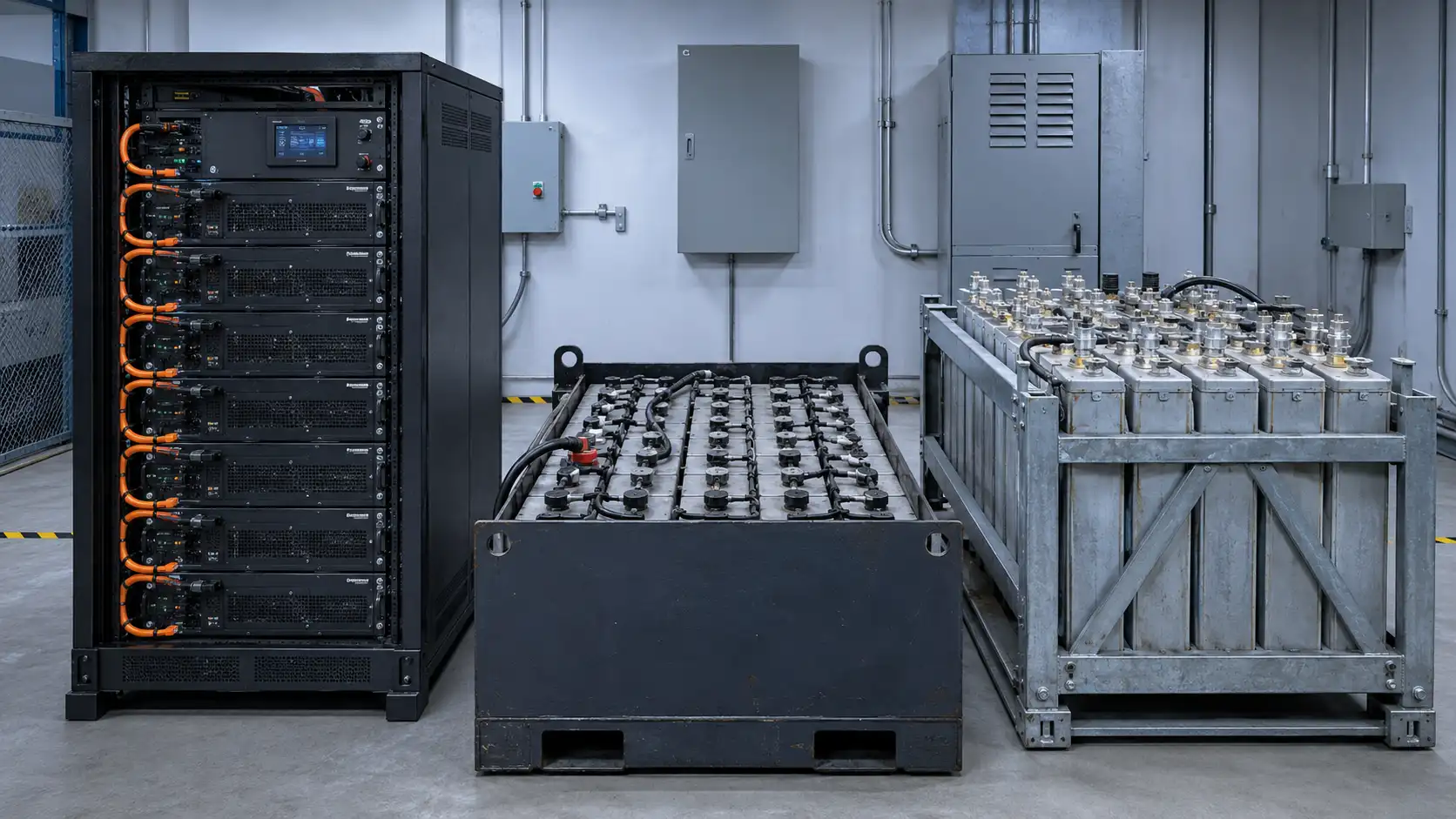
Lithium-Ion Battery Systems
Lithium-ion has become the default for demanding applications. It holds voltage steady through most of the discharge, so equipment performs consistently from full charge down to about 20%, whereas lead-acid power tapers off as it drains. The practical gains are clear. A lithium forklift battery charges in 2–4 hours versus 8–16 hours for lead-acid, and it can safely discharge to 80–90% depth where lead-acid tolerates only 30–50%. Because you use more of the rated capacity, a smaller, lighter lithium pack can replace a larger lead-acid unit for the same runtime.
Cycle life is the bigger differentiator. Lithium-ion delivers roughly 1,000–5,000 cycles depending on chemistry and use, against 300–1,000 for lead-acid. Within lithium, LFP (lithium iron phosphate) has become the preferred chemistry for stationary industrial storage, offering very long cycle life and strong thermal stability compared with NMC. Even with a higher purchase price, the cost per cycle often favors lithium in high-use settings.
Every industrial lithium pack ships with a Battery Management System (BMS) that monitors cell health, balances charge, and intervenes before overcurrent or thermal faults develop. That intelligence enables predictive maintenance and remote oversight that traditional batteries cannot match. Safety concerns are legitimate but manageable: modern systems layer thermal management, pressure relief, and BMS shutdown logic. For mission-critical UPS duty needing 5–15 minutes of runtime, a well-designed lithium system from a reputable supplier is at least as safe as the alternatives, provided it meets recognized certification.
Lead-Acid Battery Systems
Lead-acid stays dominant for straightforward economic reasons. It still powers the large majority of material-handling and motive-power fleets, reflecting a technology refined over more than 150 years with well-understood failure modes and a mature recycling chain. Upfront cost is the draw: lead-acid typically runs 30–50% cheaper than equivalent lithium capacity, which suits budget-constrained projects and duty cycles that do not justify premium technology.
Two variants serve industry. Flooded lead-acid is cheapest but needs routine maintenance, including water top-ups, equalization charges, and ventilation for hydrogen gas. Valve-regulated (VRLA) types, such as AGM and gel, remove most maintenance but cost more and often have shorter lives than a well-kept flooded battery. The trade-offs are real. Lead-acid usually needs an 8-hour charge plus cool-down before reuse, self-discharges at 5–10% per month, loses capacity below 0°C, and ages faster above 25°C. It also weighs three to four times more than equivalent lithium, although in forklifts that mass usefully doubles as counterweight.
Recycling is a genuine strength. According to the U.S. Environmental Protection Agency, the United States recycles about 99% of lead-acid batteries, the highest rate of any product, supported by deposit-style core charges and an established collection network. Lead-acid makes the most sense for stationary backup where weight is irrelevant, single-shift operations with overnight charging, and projects where lower capital cost outweighs operating limits.
Nickel-Based Battery Systems: NiCd and NiMH
Nickel-cadmium (NiCd) and nickel-metal hydride (NiMH) hold specialized niches. NiCd's headline strength is temperature: it functions from about −40°C to +60°C with little capacity loss, well beyond lithium's typical −20°C to +45°C window. That makes it valuable for cold storage, Arctic sites, and outdoor telecom gear. It is also abuse-tolerant, recovering from overcharge and over-discharge that would permanently damage other chemistries.
The drawbacks are significant. NiCd contains cadmium, a toxic heavy metal that demands controlled disposal and triggers tightening regulation. The European Union's Batteries Regulation (2023/1542) caps cadmium in portable batteries and, under the rules replacing the old battery directive, bars nickel-cadmium from portable applications from August 2025; industrial use remains permitted but faces growing scrutiny. NiCd also costs more than lead-acid while offering lower energy density than lithium, and its memory effect requires periodic full discharges to preserve capacity.
NiMH removes the cadmium and can store more capacity than NiCd of the same size, but it self-discharges quickly (around 30% per month) and offers lower cycle life. Aviation, rail, and military applications keep using nickel batteries where a proven reliability record under extreme conditions justifies the premium, though lithium is gradually displacing NiCd even in telecom backup as management systems improve.
Industrial Battery Chemistry Comparison
Use the table as a quick reference when weighing which technology fits your operational priorities. Figures are typical ranges, not absolute specifications.
| Parameter | Lithium-Ion (LFP/NMC) | Lead-Acid (Flooded/VRLA) | Nickel-Cadmium (NiCd) |
|---|---|---|---|
| Energy density | 150–260 Wh/kg | 30–50 Wh/kg | 45–80 Wh/kg |
| Cycle life | 1,000–5,000+ cycles | 300–1,000 cycles | 1,500–3,000 cycles |
| Depth of discharge | 80–90% | 30–50% | 80–100% |
| Round-trip efficiency | ~90–95% | ~75–80% | ~70–75% |
| Charging time | 2–4 hours | 8–16 hours (+ cool-down) | 4–8 hours |
| Operating temperature | −20°C to +45°C | −20°C to +50°C (optimal ~25°C) | −40°C to +60°C |
| Self-discharge | 1–2% per month | 5–10% per month | 10–20% per month |
| Relative upfront cost | High (roughly 2–3× lead-acid) | Low (baseline) | Medium–high |
| Maintenance | Minimal (BMS-monitored) | Regular (water, equalization, ventilation) | Moderate (periodic full discharge) |
| Relative weight | 1× (lightest) | 3–4× | 2–3× |
| Typical lifespan | 8–12 years | 3–8 years | 15–20 years |
| End-of-life recycling | Low today (under ~15%); infrastructure still developing | ~99% (mature infrastructure) | Regulated due to cadmium toxicity |
| Best fit | Multi-shift, renewable storage, weight-sensitive uses | Single-shift backup, stationary UPS, budget-driven projects | Extreme temperatures, aviation, rail, military |
One correction worth flagging: lithium-ion recycling is sometimes quoted at very high rates, but published data shows recovery today sits well below 15%, with material-recovery processes still scaling. Lead-acid's ~99% figure is the genuine benchmark.
How to Choose the Right Industrial Battery System
The most common mistake is starting with chemistry. Start with how the battery will be used, and the chemistry usually selects itself. Work through these five steps in order.
- Identify your duty cycle. Count shifts and cycles. Single-shift operations with idle overnight hours rarely need lithium's cycle life, while three-shift fleets running 16–24 hours a day reward it quickly. The real question for a busy fleet is not battery price, but whether you can eliminate battery swapping and charging downtime.
- Map your charging window. If equipment sits idle for 8+ hours, lead-acid's long charge is no obstacle. If you only have short breaks, lithium's opportunity charging keeps equipment moving and removes the need for a battery room and spare packs.
- Define the temperature range. Cold storage and outdoor sites narrow the field fast, since standard lithium cannot charge below 0°C without damage and lead-acid loses capacity in the cold. Confirm the operating temperature range of lithium batteries against your environment, and consider NiCd or purpose-built low-temperature lithium where conditions are extreme.
- Compare total cost of ownership, not just purchase price. Factor in efficiency losses, maintenance, downtime, floor space, and replacement cycles. A cheaper battery often costs more over five years once swapping, labor, and energy waste are counted.
- Verify safety certifications and supplier support. Insist on the right certifications for your sector and confirm the supplier's financial stability and service network. A low price from an unstable supplier is expensive if support disappears mid-life.
Best Battery System by Industrial Application
Matching technology to the job is where the decision becomes concrete. The strongest fit changes with the application.

Material Handling and Forklifts
Material handling is one of the largest single uses of industrial batteries. Multi-shift forklift fleets strongly favor lithium-ion despite the higher price, because fast opportunity charging during breaks removes the need for battery rooms and spare fleets. Single- or two-shift operations can run lead-acid effectively, accepting overnight charging in exchange for meaningful upfront savings. Cold storage is the exception: standard lithium cannot charge below 0°C, so sites either move trucks to warm rooms or pay 25–40% more for low-temperature lithium, while NiCd charges reliably at −20°C and runs at −40°C.
Backup Power and Data Center UPS
Backup power demand is rising sharply alongside data center buildout. For short ride-through (5–15 minutes), any chemistry works, and the choice turns on cost and space. Lithium's smaller footprint-several times denser than lead-acid-matters where floor space is expensive. For longer runtimes or budget-led projects, VRLA lead-acid remains common thanks to lower capital cost and a long stationary track record. Where space and rapid deployment are tight, operators increasingly look at how mobile BESS units support data center power as a flexible bridging or supplemental source.
Renewable Energy and Grid-Scale Storage
Grid-scale and renewable storage increasingly deploys lithium-ion for its efficiency and cycle life. Modern containerized battery energy storage systems built on LFP chemistry deliver multi-megawatt-hour capacity per unit at round-trip efficiency up to around 95%, which suits daily-sometimes twice-daily-deep cycling over a decade-plus life. Flow batteries are an emerging alternative for very large stationary projects, separating power and energy scaling with very long cycle life, but they remain specialized and costly next to lithium for most industrial uses.
The table below maps chemistries to common scenarios. As a rule, there is no universal best battery system; the best choice depends on utilization rate, charging availability, environment, and lifecycle cost.
| Application scenario | Recommended chemistry | Key reason |
|---|---|---|
| Multi-shift forklift fleet (16–24 hrs/day) | Lithium-ion | Opportunity charging removes spare batteries and battery rooms |
| Single-shift warehouse forklift | Lead-acid | Lower upfront cost; overnight charging is sufficient |
| Cold storage facility (−20°C to −40°C) | NiCd or low-temp lithium | Reliable operation and charging in extreme cold |
| Data center UPS (short runtime, 5–15 min) | Lithium-ion | Smaller footprint; BMS health monitoring |
| Data center UPS (long runtime, budget priority) | Lead-acid (VRLA) | Lower capital cost; proven stationary performance |
| Grid-scale renewable storage | Lithium-ion (LFP) | High cycle life and efficiency for daily deep cycling |
| Telecom tower backup (remote/harsh climate) | NiCd | Wide temperature tolerance; survives electrical abuse |
| Aviation / rail emergency power | NiCd | Proven reliability; meets stringent certification |
| Commercial peak shaving / demand management | Lithium-ion (LFP) | Fast response and daily cycling over a long life |
Total Cost of Ownership: Beyond the Purchase Price
Purchase price is only a fraction of the lifetime cost of a battery system. A proper analysis adds direct costs-charging equipment and installation, spare batteries for swap-out, electricity (including efficiency losses), maintenance, room infrastructure, and replacement based on cycle life-to indirect costs such as charging downtime, lost productivity, floor space, climate control, safety equipment, and disposal. For a structured walk-through, see this cost analysis of a battery energy storage system.
The figures below are an illustrative example, not a quote, intended to show how the gap opens up. Assumptions: one 48V/1000Ah forklift battery in three-shift use; lead-acid requiring rotation and a mid-life replacement; lithium running on opportunity charging with no swapping; downtime valued at $100/hour; a five-year window.
Lead-acid (illustrative):
- Batteries (3 units for rotation): $24,000
- Charging equipment: $5,000
- Battery room and ventilation: $15,000
- Maintenance over 5 years: $4,000
- Mid-life replacement: $24,000
- Charging and swap downtime (~480 hrs): $48,000
- Approximate 5-year total: $120,000
Lithium-ion / LFP (illustrative):
- Single battery (no rotation needed): $22,000
- Charging equipment: $4,000
- Minimal infrastructure: $2,000
- Maintenance over 5 years: $500
- Replacement within 5 years: $0
- Minimal opportunity-charge downtime: $2,000
- Approximate 5-year total: $30,500
In this heavy-use case, lithium's longer life, near-zero maintenance, and higher efficiency more than offset its higher purchase price. The calculation shifts for single-shift operations with ample overnight charging: lead-acid drops to a single-battery cost, downtime largely disappears, and its TCO position improves sharply while lithium's advantages shrink. That is exactly why duty cycle, not chemistry, should lead the decision.
Emerging Industrial Battery Technologies
A few next-generation chemistries are worth watching, though most remain in development or early commercialization. Solid-state batteries replace liquid electrolyte with solid material, promising higher energy density and improved safety, but manufacturing cost still limits them. Sodium-ion uses abundant, inexpensive sodium to ease supply-chain pressure; its lower energy density rules out weight-sensitive uses but suits stationary storage where cost matters more than density. Nickel-zinc, using no heavy toxic metals and recycling easily, is appearing in some UPS designs as electrolyte improvements reduce earlier dendrite problems. The practical takeaway for buyers is to favor modular, upgradeable designs so future chemistries can be adopted without replacing an entire system.
Maintenance and Management Best Practices
Whatever the chemistry, operating practice drives lifespan. Lead-acid needs routine water checks on flooded types, terminal cleaning, periodic equalization, and good ventilation, since charging generates explosive hydrogen in confined spaces. Keep records of cycles and readings to support warranty claims and predict replacement.
Lithium-ion needs little physical upkeep but rewards attention to BMS data: watch for cell-voltage imbalance, track temperature trends, and review charge patterns for anomalies. Integrate packs into facility management systems over CAN bus or similar, and keep firmware current, since updates can extend life or add features. Across all chemistries, hold battery rooms near 20–25°C where possible-each 8°C above 25°C roughly halves lead-acid life-and provide the ventilation, eye-wash, and emergency equipment that local codes require.
FAQ
Q: How long do industrial battery systems typically last?
A: It depends on chemistry and how hard the system is worked. Lead-acid usually lasts 3–8 years, lithium-ion (especially LFP) commonly 8–12 years, and nickel-cadmium can run 15–20 years in stationary use. Calendar age matters less than cycle count and conditions. A battery cycled deeply every day at high temperature ages far faster than one shallow-cycled in a climate-controlled room. Always read warranty terms, which typically cap coverage at a number of years or cycles-whichever comes first-and exclude abuse such as over-temperature operation or improper charging. Treat published lifespans as ranges, then adjust for your own duty cycle and environment.
Q: Can I replace lead-acid batteries with lithium-ion in existing equipment?
A: Often yes, but not as a simple drop-in. Lithium and lead-acid use different charge profiles, so an existing lead-acid charger usually cannot safely charge lithium without a controller upgrade or replacement. In forklifts, lead-acid often doubles as counterweight, so a lighter lithium pack may need added ballast to keep lift capacity and stability. Voltage windows, compartment dimensions, and the equipment's communication requirements also need checking. For multi-shift fleets the switch usually pays off, but plan it as a system change-battery, charger, and sometimes the equipment itself-rather than a like-for-like swap, and confirm compatibility with the manufacturer first.
Q: What safety certifications should I require for industrial lithium batteries?
A: For stationary and energy storage uses in North America, look for UL 1973 at the battery level and UL 9540 at the system level, with UL 9540A fire-propagation test data to support permitting. UL 1973 covers electrical, mechanical, and thermal abuse testing of the battery; UL 9540 certifies the complete system including power conversion and controls. Internationally, IEC 62619 is the closest equivalent to UL 1973, and fire codes such as NFPA 855 reference these standards directly. A practical primer on why UL certification matters for energy storage is worth reviewing before procurement. Aviation, marine, and hazardous-location uses carry additional sector-specific certifications.
Q: How do extreme temperatures affect battery performance?
A: Temperature affects every chemistry, but differently. Cold reduces available capacity and slows reactions; standard lithium cells should not be charged below 0°C without damage, which is why cold-storage sites either warm batteries before charging or use purpose-built low-temperature lithium. Heat is the bigger long-term enemy: lead-acid life roughly halves for every 8°C above 25°C, and high temperatures raise thermal-runaway risk in lithium systems. Nickel-cadmium tolerates the widest band, working from about −40°C to +60°C with little capacity loss. Whatever the chemistry, thermal management and ventilation are central to both safety and lifespan, so size your climate control to the worst case, not the average.
Q: What is the best battery type for data center backup power?
A: It depends on runtime and priorities. For short ride-through to generator start (5–15 minutes), lithium-ion is increasingly preferred because it occupies far less floor space, integrates real-time health monitoring through its BMS, and lasts longer in service. For longer runtimes or budget-driven projects, valve-regulated lead-acid (VRLA) remains common thanks to lower upfront cost and a long stationary track record. Many operators now weigh lithium's higher capital cost against reclaimed floor space and reduced maintenance. The right answer also factors in your facility's fire-code requirements and how much downtime the business can tolerate during a transfer.
Q: How does a battery management system (BMS) improve industrial battery performance?
A: A BMS is the electronic brain of a lithium system. It continuously monitors cell voltages, temperature, and current, balances charge across cells, and shuts the pack down before conditions become dangerous, protecting against overcharge, over-discharge, short circuit, and thermal events. Beyond safety, it enables predictive maintenance: by tracking trends and flagging imbalances early, it helps you catch failing cells before they cause an outage. Most industrial BMS units communicate over CAN bus or similar protocols, so they can feed data into facility management systems for centralized oversight. Keeping BMS firmware up to date can extend battery life and unlock new features over time.
Q: Are lithium-ion batteries safe for industrial use?
A: Yes, when properly engineered, certified, and maintained. The concerns are real but manageable. Modern industrial lithium systems layer protection: thermal management, pressure relief, and BMS controls that isolate the pack before a fault escalates. LFP chemistry in particular offers strong thermal stability compared with NMC. Risk rises with damaged cells, poor-quality manufacturing, or charging outside specified limits, so sourcing from reputable suppliers and insisting on UL 1973 and UL 9540 certification matters. For many mission-critical UPS and multi-shift applications, a well-designed lithium system is at least as safe as the alternatives, provided installation and ventilation follow local code.
Q: What is the difference between LFP and NMC lithium batteries for industrial storage?
A: Both are lithium-ion, but they trade off differently. LFP (lithium iron phosphate) offers longer cycle life, greater thermal stability, and lower fire risk, which makes it the usual choice for stationary and grid-scale storage where safety and longevity outweigh size. NMC (nickel manganese cobalt) packs more energy into less weight and volume, favoring weight- or space-constrained mobile uses. In short, LFP delivers more cycles and tolerates abuse better, while NMC delivers higher energy density. For most stationary industrial and commercial storage, LFP has become the default; NMC still appears where every kilogram counts. Cost and supply-chain factors increasingly favor LFP as well.
Key Takeaways: Matching the Battery to the Job
No single chemistry wins everywhere, so let the application decide. High-utilization, multi-shift duty cycles reward lithium-ion's faster charging, longer life, and operational flexibility, which typically return their cost premium within a few years. Lighter-duty and budget-led projects, especially stationary backup where weight is irrelevant, often still favor lead-acid's lower upfront cost and proven reliability. Extreme environments-cold storage, aviation, rail-may justify nickel-based batteries despite higher cost and regulatory constraints.
Before you buy, run the five-step check: confirm duty cycle, charging window, temperature range, total cost of ownership, and certification plus supplier support. For commercial and grid-connected projects, scoping options against commercial and industrial energy storage solutions early helps you size, certify, and budget the system correctly. Because the market keeps moving, favor modular designs that leave room to adopt new chemistries without replacing everything you have installed.