

If you're sourcing a lithium ion battery for a solar storage project in 2026, the chemistry question is already settled - LiFePO4 dominates new installations for good reason: 3,000–6,000+ cycle life, 90–95% round-trip efficiency, 95–100% usable depth of discharge, and a safety profile that no other lithium chemistry matches in stationary applications.
The harder question - the one that actually determines whether your system performs as expected three, five, ten years down the line - is everything that comes after chemistry. What form factor fits the site? How does the battery integrate with the solar array and the grid? Can the system scale when loads grow? We've seen projects spec the right cells but get the system architecture wrong, and the result is always the same: underperformance that shows up too late to fix cheaply. This guide is built around avoiding that outcome.

LFP Is the Baseline - Here's What Matters Beyond Chemistry
The industry's shift to LiFePO4 is complete. Tesla's Powerwall 3, Enphase IQ, Panasonic EverVolt - every major residential battery launched since 2022 runs on iron phosphate cathodes. At the C&I and utility scale, the picture is even more uniform. LFP's olivine crystal structure handles the daily deep cycling inherent to solar storage with minimal degradation, and its thermal stability eliminates the runaway risks that plagued earlier NMC deployments.
But here's what we've learned from thousands of actual deployments: the single-cell specs on a datasheet - cycle life, energy density, C-rate - tell you surprisingly little about how a system will perform in the field. What actually separates a solar battery that delivers its rated performance for 15 years from one that starts disappointing in year three is system-level engineering: how the thermal management keeps cells within optimal temperature bands during summer peak cycling, how the BMS balances modules over thousands of charge-discharge cycles, and whether the PCS integration was designed for the specific inverter and grid configuration on site.
That's the lens we apply to selection criteria below - not just what the cells can do in isolation, but what the complete system delivers under real operating conditions.

Selection Criteria That Actually Drive Long-Term Performance
Usable capacity (kWh) - the energy available after depth of discharge limits, not nameplate. A 10 kWh battery with 95% DoD gives you 9.5 kWh. Sounds obvious, but we still see projects sized on nameplate numbers.
Round-trip efficiency - LFP systems typically achieve 90–95%. Advanced containerized systems with optimized PCS design reach up to 97%. The difference seems small until you multiply it across 6,000 cycles.
Cycle life at rated DoD - at one cycle per day, 6,000 cycles means roughly 16 years. This is where LFP's advantage over NMC becomes a financial argument, not just a technical one.
Continuous and peak power rating (kW) - capacity tells you how much energy is stored; power rating tells you how fast it can be delivered. Undersizing the power rating remains one of the most common mistakes in residential and small commercial installations. An air conditioner, electric range, and EV charger running simultaneously will expose an undersized inverter within the first week.
Thermal management - this is where system-level design matters most. Batteries perform best between 15–35°C. In hot climates, an air-cooled cabinet will derate during the exact hours when solar generation peaks and you need maximum charge acceptance. Liquid-cooled containerized systems and climate-controlled outdoor cabinets solve this at the system level. If your site sees temperature extremes, this single factor should weigh heavily in your selection - it's the difference between a battery storage system that performs under real-world conditions and one that only hits its specs in a controlled environment.
Warranty terms - read past the headline number. Capacity retention guarantee (typically 60–70% at end of warranty), cycle count caps, and total throughput coverage are where the real commitment lives.
Matching System Form Factor to Your Solar Project
This is where most selection guides fall short. They talk chemistry and capacity but skip the question that drives actual procurement decisions: what physical system fits the site, the budget, and the growth plan? The right battery energy storage system configuration depends less on cell specifications and more on project scale, installation constraints, and how the system needs to evolve over time.
High-Voltage Modular Battery Systems (20 kWh – 209 kWh)
Stackable LiFePO4 modules on high-voltage platforms - typically 204V to 512V - are the most flexible option for commercial buildings, light industrial facilities, and larger residential solar installations. The higher voltage reduces current at any given power level, which means lower losses and smaller cable runs.
The real value proposition here is growth flexibility. A commercial tenant might start with 30 kWh for solar self-consumption today. Next year they add EV charging. The year after, they install a heat pump. Modular stacking handles all of that without system replacement - just add modules.
For solar integration, inverter compatibility is a practical bottleneck that's easy to overlook. Systems pre-certified with major inverter brands (Growatt, Deye, Goodwe, SMA, Sol-Ark, Victron) via RS485 and CAN protocols eliminate weeks of integration troubleshooting. We've seen projects delayed by months because the battery and inverter hadn't been tested as a combined system - individual certifications don't guarantee they'll work together.
Best suited for: commercial building peak shaving, industrial parks reducing demand charges, data center backup alongside solar, and residential whole-home systems above 20 kWh.
Outdoor Cabinet BESS (60 kWh – 261 kWh)
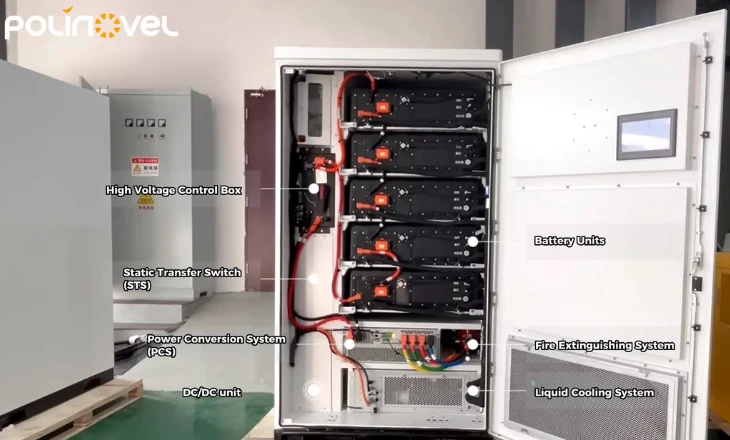
When the project needs a self-contained outdoor system but a shipping container is overkill, outdoor cabinet BESS hit the sweet spot. These all-in-one units integrate LiFePO4 batteries, PCS, BMS, thermal management, and fire suppression inside a single IP55-rated enclosure - dust-tight and protected against water jets.
What makes cabinets particularly practical for distributed C&I solar projects is deployment speed. They arrive ready to connect, with an integrated EMS that handles solar array input, grid connection, and generator fallback through a single management platform. No separate thermal management installation, no field-wiring the fire suppression, no coordinating five different subcontractors.
We've found these work especially well for retail locations, small manufacturing facilities, and agricultural operations - sites where there's outdoor space available but no foundation for a container, and where the facility manager needs remote monitoring and diagnostics without a dedicated energy team on staff.
Containerized BESS (1.2 MWh – 5 MWh+)
At the MWh scale, containerized battery energy storage systems are the standard deployment format for utility-scale solar farms, large industrial facilities, and microgrid projects. Standard 20-foot containers pack 1.2 to 5+ MWh of LFP storage with liquid cooling, multi-layer fire suppression, and integrated power conversion - engineered for rapid commissioning.
The liquid cooling systems in these containers aren't optional extras - they're what keep cell temperatures within optimal bands during aggressive summer cycling when ambient heat is already pushing 40°C+. Air-cooled systems derate under exactly these conditions, which means reduced charge acceptance during peak solar generation hours. That's a direct hit to project economics.
For facilities with demand charges exceeding $15/kW or time-of-use spreads above $0.10/kWh, containerized solar-plus-storage consistently delivers the strongest ROI. Microgrid battery storage designs for industrial complexes add grid services revenue and demand response participation on top of peak shaving savings. Parallel connection architectures support scaling beyond initial capacity as solar generation expands - protecting the original investment rather than stranding it.
Mobile BESS
Mobile battery energy storage fills a specific niche: temporary or remote solar-hybrid power without diesel. Construction sites, agricultural operations, emergency response, live events - anywhere you need clean, quiet power that can be redeployed when the job moves.
These units integrate PCS, EMS, high-voltage control, DC/DC converters, and fire suppression into a single transportable package. Paired with portable solar arrays, they provide fully off-grid power without fuel logistics. Fast electrical connections enable rapid deployment and teardown as project needs shift.
DC-Coupled vs. AC-Coupled: Architecture Matters for Efficiency
In a DC-coupled system, solar panels feed directly into the battery through a charge controller, with a single inverter handling the DC-to-AC conversion. One fewer conversion step means 90–95% round-trip efficiency and typically $500–$1,000 less hardware cost. For new solar-plus-storage installations designed from scratch, DC coupling is the default recommendation.
AC-coupled systems give the battery its own inverter, independent of the solar inverter. The tradeoff is efficiency - multiple conversions drop round-trip performance to 85–90%. The benefit is flexibility: you can add storage to an existing solar array without touching the panels or their inverter. For retrofit projects, or when future expansion needs to remain open, AC coupling is usually the pragmatic choice.
Form factor influences this decision. High-voltage modular batteries and outdoor cabinet BESS support both architectures. Containerized systems at utility scale typically implement DC-coupled designs to maximize efficiency at the volumes where every percentage point matters.

Sizing: Start from Load Data, Not Rules of Thumb
Pull 12 months of utility bills. Identify average daily consumption (kWh), peak demand (kW), and the time-of-use rate spread. Everything else follows from these three numbers.
A typical U.S. household consumes about 30 kWh per day. For overnight backup at reduced load - refrigeration, lighting, Wi-Fi - a 10–15 kWh high-voltage modular system covers the essentials. Whole-home backup including HVAC pushes into the 20–40 kWh range, achievable with stacked battery modules.
For backup applications, this formula keeps projects out of trouble: Usable Capacity (kWh) = Peak Load (kW) × Backup Duration (hours) ÷ Depth of Discharge ÷ Round-Trip Efficiency. It consistently produces numbers 20–30% higher than a simple "load times hours" calculation. That margin is the difference between a system that delivers during an actual outage and one that falls short at 2 AM.
At the C&I scale, sizing shifts toward demand charge reduction. Outdoor cabinet BESS in the 60–261 kWh range serve smaller commercial facilities. For peak loads above 500 kW, containerized MWh-class systems become the cost-effective choice, with parallel architectures that scale alongside solar generation growth.
Cost and Return on Investment
Residential: a 10 kWh LFP system runs approximately $10,000–$13,000 installed in the U.S. as of 2025–2026 (battery, inverter, labor, permitting). The 30% federal Investment Tax Credit brings net cost to roughly $7,000–$9,100.
The more meaningful number is total cost of ownership over the system's life. An LFP system lasting 15 years without replacement versus an NMC system needing replacement at year 8–10 isn't a small difference - it roughly halves the effective cost per kWh delivered. Over a 15-year horizon, homeowners in areas with high time-of-use rate spreads or frequent outages typically recover $25,000–$40,000 in electricity costs, well above the net investment.
At the commercial scale, the payback math strengthens. Facilities paying $15+/kW in demand charges can see system payback within 3–5 years, even before accounting for grid services revenue. The full benefits of battery energy storage only become visible when you model the complete picture: avoided demand charges, TOU arbitrage, backup value, and - for systems participating in grid programs - ancillary services income.
Certifications: What Your Insurer and AHJ Will Require
In North America, three UL standards stack on each other for BESS installations: UL 1973 (battery module safety), UL 9540 (complete integrated system), and UL 9540A (thermal runaway propagation testing). All three are needed for a compliant deployment - having one or two doesn't satisfy the full requirement.
Since July 2022, UL 9540 requires metallic enclosures for ESS. Standard shipping containers qualify for containerized systems, but some cabinet-style products that used composite enclosures had to redesign. Always confirm which edition of UL 9540 your supplier's listing covers.
Insurance underwriters now commonly require monitored fire detection, automatic suppression, 24/7 remote monitoring, and minimum separation distances from occupied structures. These requirements effectively mandate integrated safety systems - not aftermarket add-ons. For international deployments, IEC 62619 and UN 38.3 certifications alongside UL listings simplify cross-border procurement and satisfy lender due diligence.
One practical lesson worth sharing: get the full documentation package - UL test reports, certificates, compliance records - into the hands of your AHJ and EPC during the design review phase, not after construction starts. We've watched that single timing decision save projects weeks of back-and-forth.
Decision Framework: Matching Scale to System
Residential solar self-consumption and backup (10–60 kWh): High-voltage modular LFP battery systems. Start with what you need, expand later. Verify inverter compatibility before committing.
Small to mid-size C&I solar-plus-storage (60–261 kWh): Outdoor cabinet BESS with integrated thermal management and safety. Best for retail, light manufacturing, and agricultural sites where outdoor placement and fast deployment are priorities.
Large C&I and utility-scale solar (1 MWh+): Containerized BESS with liquid cooling and fire suppression. Pre-engineered for rapid commissioning at the capacity large solar projects demand.
Remote or temporary solar installations: Mobile BESS paired with portable solar arrays. Clean, transportable power that eliminates diesel dependency.
Across all scales, prioritize modular architectures that support parallel expansion - it protects the initial investment as loads evolve. For commercial energy storage deployments, this is almost always the right call.
Frequently Asked Questions
Q: Is LiFePO4 Always The Right Choice For Solar Storage?
A: For stationary solar storage, almost always yes. At this point, the real comparison is no longer LFP versus lead-acid for serious projects, and in most cases it is no longer LFP versus NMC either. LiFePO4 gives solar applications what they actually need: long cycle life under daily charge-discharge use, high usable depth of discharge, and a much stronger safety profile in fixed installations. The only time energy density becomes the deciding factor is when space or weight is unusually constrained. For most residential, commercial, and utility-scale solar projects, that is not the limiting variable. System design, thermal control, and integration quality matter far more.
Q: How Do I Choose Between Modular Batteries, Outdoor Cabinets, And Containerized BESS?
A: Start with project scale, site conditions, and future expansion plans. High-voltage modular batteries make the most sense when flexibility is the priority - larger homes, commercial buildings, or light industrial sites that may add load later. Outdoor cabinet BESS are a better fit when the project needs an all-in-one outdoor system with faster deployment and less field integration work. Containerized BESS become the practical choice once the project moves into MWh-scale storage, utility integration, or large industrial peak shaving. In other words: if the site is small and may grow, go modular; if the site is mid-size and needs a packaged outdoor system, go cabinet; if the project is already large enough that thermal control, commissioning speed, and parallel scaling become central, go containerized.
Q: Can An Existing Solar System Be Upgraded With Battery Storage Without Replacing Everything?
A: Usually yes, but the answer depends on the current inverter architecture and the performance target. AC-coupled storage is the standard retrofit path because it allows the battery system to be added without replacing the existing PV inverter. That makes it the most practical option for many existing rooftop and commercial solar systems. But "can be added" does not automatically mean "will perform well." Before procurement, verify inverter compatibility, communication protocol support, interconnection requirements, breaker space, and whether the backup loads are actually matched to the battery's power rating. A retrofit that looks simple on paper can become expensive if those checks happen too late.
Q: What Usually Causes A Solar Battery System To Underperform After Installation?
A: In most cases, the battery chemistry is not the reason. The more common problems are system-level: the battery was sized on nameplate capacity instead of usable capacity, the inverter and battery were technically compatible but not well integrated, the PCS was undersized for the actual load profile, or the thermal management was not sufficient for the climate. We also see issues when buyers focus heavily on cycle-life claims but pay too little attention to charge acceptance under summer temperatures, module balancing over time, or the site's real demand pattern. A battery can have strong cell-level specs and still disappoint in the field if the full system architecture was not matched to the project.
Q: What Documents Should I Ask For Before Choosing A Solar Battery Supplier?
A: Ask for the full compliance and integration package before the design is finalized, not after the purchase order is placed. For North America, that usually means UL 1973, UL 9540, and UL 9540A documentation, plus UN 38.3 for transport and any relevant inverter compatibility records. For international projects, IEC 62619, CE, and related market-specific certifications may also be necessary. Beyond certificates, request datasheets for the complete system, thermal management details, fire suppression configuration, communication protocol information, warranty terms, and installation references for similar project types. Good suppliers can provide these quickly. If the answers are vague or incomplete during procurement, the installation phase usually becomes more difficult than it needs to be.
Q: When Does Solar-Plus-Storage Usually Make Financial Sense?
A: The answer depends less on battery price alone and more on how the system will be used. For residential projects, the economics improve when the site has high time-of-use spreads, frequent outages, or a strong self-consumption case. For commercial projects, the financial case is often much clearer because demand charges, peak shaving, and operational resilience create multiple value streams at once. That is why some C&I systems can justify storage much faster than residential ones, even when the upfront investment is much larger. If the project only looks at battery cost per kWh, it will miss the bigger picture. The right question is how much value the system creates across tariff reduction, backup capability, solar utilization, and future expansion.