

A lithium iron phosphate (LiFePO4) battery in a well-designed energy storage system typically lasts 10 to 15 years of daily cycling. But that number assumes a lot of things go right-proper thermal management, conservative depth of discharge, a BMS that actually does its job, and a dispatch profile that does not treat the battery like it is disposable. Get any of those wrong, and you could be looking at a replacement conversation five or six years in.
This is something we see regularly in the BESS space. Two projects use the same cell supplier, the same nameplate cycle rating, and still end up with wildly different real-world lifespans. The difference almost always comes down to system-level decisions, not cell-level specs. That is what this guide focuses on-what actually determines how long lithium batteries last when the application is energy storage, not a phone in your pocket.

Lithium Battery Lifespan by Application
| Application | Typical Chemistry | Typical Years | Typical Cycle Range |
|---|---|---|---|
| Consumer electronics (phones, laptops) | LiCoO₂ / LiPo | 2–4 | 300–500 |
| Electric vehicles | NMC | 8–12 | 1,000–2,000 |
| Residential solar storage | LiFePO4 | 10–15 | 3,000–6,000+ |
| Commercial & industrial BESS | LiFePO4 | 10–20 | 4,000–10,000 |
The gap between residential and C&I comes down to system design rigor-active cooling, tighter BMS tolerances, and dispatch optimization that smaller installations rarely justify.
For the rest of this article, we are going to spend most of our time on that last category, because it is where the lifespan question gets genuinely complicated-and where getting it wrong costs real money.
Why BESS Lifespan Is Not the Same as Cell Lifespan
Cell manufacturers publish cycle life numbers. Those numbers come from lab conditions-controlled temperature, fixed C-rate, consistent depth of discharge. A datasheet that says "6,000 cycles at 80% DoD, 25°C" is telling you what the cell can do in a best-case scenario. It is not telling you what your system will deliver in a shipping container sitting in Arizona, cycling twice a day for frequency regulation.
The real service life of a battery energy storage system depends on the entire package: cells, thermal management, power conversion, BMS/EMS strategy, and the operating profile imposed by the application. We have seen LiFePO4 systems rated for 6,000 cycles degrade to 80% capacity in under four years because the integrator skimped on cooling. We have also seen systems with modest 4,000-cycle cells exceed 12 years because every other design decision was made to protect battery health.
That distinction-between nameplate cycle life and deliverable service life-is the single most important concept for anyone evaluating lithium battery longevity in a storage context.
Chemistry Still Matters, but Less Than You Think
LiFePO4 dominates stationary storage for reasons that go beyond cycle count. Its thermal runaway threshold sits around 270°C, compared to roughly 160°C for NMC chemistries. That margin changes the entire safety and thermal design conversation. It also means LFP cells tolerate higher ambient temperatures without accelerated degradation, which directly translates to longer life in outdoor installations where cooling budgets are finite.
NMC batteries offer higher energy density-150 to 260 Wh/kg versus 90 to 160 Wh/kg for LFP-which still matters in space-constrained applications. But for most ground-mounted or containerized deployments, footprint is not the binding constraint. Cost per cycle and total cost of ownership over a 10- to 15-year horizon are. And on those metrics, LFP has pulled ahead decisively. Testing at national laboratories has shown LFP cells reaching 4,000 to 10,000 cycles to 80% capacity retention, compared to 1,000 to 2,000 for NMC under similar conditions.
Other lithium chemistries-LiPo, lithium manganese oxide, lithium cobalt oxide-serve consumer electronics and specialty applications well, but they rarely appear in stationary storage. Their cycle life (typically 300–1,500 cycles) and thermal characteristics simply do not support the 10-plus-year project horizons that storage economics require.
Temperature: The Factor That Quietly Kills Batteries
There is a widely cited engineering heuristic: every 10°C rise in sustained operating temperature roughly doubles the rate of chemical degradation. Whether the exact multiplier is 1.8x or 2.2x depends on the chemistry and the study, but the direction is not debated. Heat accelerates electrolyte decomposition and builds up resistive layers on electrode surfaces. The damage is cumulative and irreversible.
What does this look like in practice? A solar-plus-storage project in a hot climate that relies on passive air cooling might see internal cell temperatures regularly exceed 40°C during afternoon discharge. Over 18 months, that kind of sustained thermal stress can produce double-digit capacity loss-well outside warranty expectations. Retrofit the same system with active liquid cooling that holds cells between 20°C and 30°C, and degradation returns to normal rates.

Cold temperatures create a different problem. Below 0°C, charging a lithium battery risks lithium plating on the anode-a form of permanent, safety-relevant damage. Most quality BMS platforms block charging below a safe threshold, but not all do. For installations in northern climates, self-heating capability or pre-conditioning routines are not optional features. They are lifespan insurance. Understanding lithium battery operating temperature limits before specifying a system avoids the kind of field failures that erode both capacity and project returns.
Depth of Discharge and Dispatch Profile
A battery discharged to 50% DoD on every cycle will typically deliver two to three times the total cycle count of one discharged to 100%. This is well-established electrochemistry. What gets less attention is how the dispatch profile-meaning the pattern of charging and discharging over days, weeks, and seasons-shapes degradation in ways that a simple DoD number does not capture.
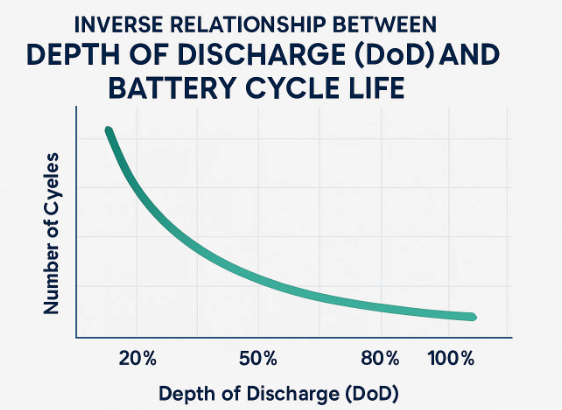
Consider two commercial BESS installations, both using the same LiFePO4 cells rated at 6,000 cycles. Installation A performs one deep cycle per day for peak shaving. Installation B handles frequency regulation, cycling shallowly hundreds of times daily. Both are technically operating within spec. But the cumulative energy throughput, thermal loading, and micro-stress on electrode materials differ significantly. Installation B may hit its capacity warranty threshold years before Installation A, even though its average DoD per cycle is much lower.
This is why experienced integrators size systems with headroom-typically 15 to 20% above calculated requirements. That margin lets the system operate at moderate DoD rather than being pushed to its rated limits on every cycle. It is also why the relationship between charge-discharge cycles and real-world BESS performance is more nuanced than most datasheets suggest.
BMS and EMS: Where System Design Meets Battery Life
The battery management system monitors cell-level voltage, temperature, and current. It prevents overcharge, over-discharge, and thermal events. In multi-cell packs, it handles cell balancing so that no single cell degrades faster than its neighbors. All of this is table stakes.
What separates a mediocre BMS from a good one is state-of-charge estimation accuracy and adaptive control. In LiFePO4 systems specifically, SoC estimation is notoriously difficult because the voltage curve is nearly flat across most of the usable range. Basic systems can be off significantly. That means operators either leave capacity stranded as a safety buffer, or they inadvertently over-discharge cells and shorten cycle life. More sophisticated platforms bring that error down substantially, preserving both usable capacity and long-term health.
Above the BMS sits the energy management system, which decides when and how hard to charge and discharge based on electricity prices, grid signals, solar generation forecasts, and contractual obligations. A well-tuned EMS does not just maximize revenue-it also protects the battery by avoiding unnecessary high-rate cycling and by scheduling maintenance charges that keep cells balanced over time.
In our experience, the combination of a competent BMS and a thoughtful EMS strategy adds more to real-world battery life than choosing between two LFP cell suppliers with slightly different datasheet specs.
LiFePO4 vs. Lead-Acid: The Lifespan Gap
Lead-acid batteries still show up in legacy backup systems and some off-grid applications. Their cycle life tells the story: 500 to 1,000 cycles at 50% DoD for a quality deep-cycle lead-acid, compared to 3,000 to 6,000+ cycles at 80% DoD for LiFePO4. In calendar terms, lead-acid typically lasts 3 to 5 years in active cycling applications. LiFePO4 systems routinely reach three to four times that.
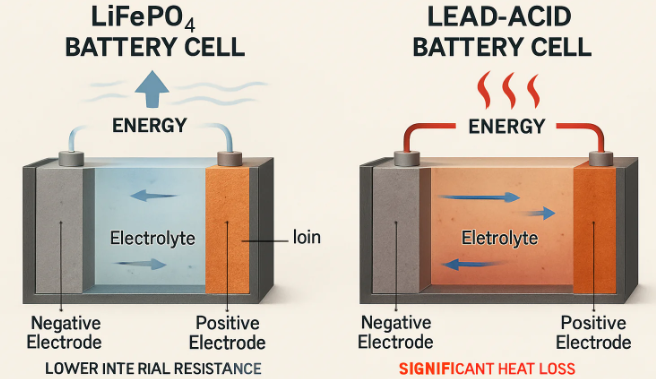
The upfront cost difference has also narrowed considerably. When you calculate total cost of ownership across a 10- to 15-year project life, factoring in replacement frequency, maintenance, and round-trip efficiency losses, LiFePO4 delivers a meaningful advantage. This is a key reason high voltage LiFePO4 systems have displaced lead-acid in virtually every new stationary storage project.
What You Can Do to Maximize Battery Life in Storage Projects
Keep cells within 15°C to 35°C during operation. For outdoor deployments, this means specifying active thermal management-liquid cooling for high-density containerized BESS installations, forced-air for smaller cabinet systems. Passive cooling is rarely sufficient in climates with sustained highs above 35°C or lows below freezing.
Operate at moderate depth of discharge. Running the battery at 70–80% DoD instead of 100% costs you some usable capacity per cycle but can add years to total service life. Size your system so that everyday operation stays comfortably within rated limits rather than pressing against them.
Match your charger and inverter to the battery spec. Charging voltage profiles, current limits, and cutoff thresholds are tuned to specific cell chemistries. Mismatched equipment does not just void warranties-it actively degrades cells through voltage stress or incomplete balancing.
Do not let stored batteries sit fully charged or fully depleted for extended periods. For seasonal or standby storage, maintain 40–60% SoC in a temperature-controlled environment. Calendar aging accelerates at both extremes of the charge range.
Invest in BMS and EMS quality over marginal cell-level savings. Basic monitoring electronics may provide minimum protection, but a properly engineered BMS/EMS architecture does far more to preserve long-term battery health and usable capacity. A properly engineered system will keep it performing near rated capacity for a decade or longer.
Frequently Asked Questions
Q: How Long Does A LiFePO4 Battery Last In A BESS Application?
A: Under proper operating conditions-controlled temperature, moderate DoD, competent BMS-a LiFePO4 BESS typically delivers 10 to 15 years of daily cycling before capacity drops to 80% of its original rating. Some well-managed installations exceed this range. The key variable is not the cell itself but the system around it: thermal management, dispatch profile, and maintenance practices determine where you land within that window.
Q: Does A Lithium Battery Degrade When It Is Not Being Used?
A: Yes. Calendar aging is a separate degradation mechanism from cycling. Internal side reactions proceed slowly even when the battery is idle, consuming active lithium and increasing internal resistance. The rate depends on temperature and state of charge during storage-batteries stored at high temperature and full charge degrade fastest. For long-term storage, 40–60% SoC in a cool, dry environment slows this process significantly.
Q: What Is The Difference Between Cycle Life And Calendar Life?
A: Cycle life counts the number of charge-discharge cycles before capacity falls to a defined threshold, usually 80% of original. Calendar life measures how many years a battery remains functional regardless of how much it cycles. Both clocks run simultaneously, and whichever limit hits first determines when the battery reaches end of useful life. In daily-cycling BESS applications, cycle life is usually the binding constraint. In standby or low-use backup systems, calendar life may matter more.
Q: Why Do Two BESS Projects With The Same Cells Get Different Lifespans?
A: Because cell specs are only one input. Thermal management quality, depth of discharge settings, C-rate during operation, BMS sophistication, and dispatch patterns all vary between projects. A well-integrated battery energy storage system that manages all of these factors will outlast a system with identical cells but weaker design-sometimes by several years.
Q: When Should I Plan For Battery Replacement In An ESS Project?
A: Most project finance models assume battery replacement or augmentation at year 10 to 12 for LiFePO4 systems cycling daily. If your system operates under conservative conditions-lower DoD, moderate climate, quality thermal management-you may push replacement to year 15 or beyond. Budget for it early, but design the system so that the replacement happens as late as possible. On a commercial-scale project, the difference between a 10-year and a 15-year replacement cycle can mean hundreds of thousands of dollars in avoided capital expenditure.
Q: Is 6,000 Cycles Really Equal To 15 Years?
A: Only if the system averages roughly one full cycle per day and every other operating condition stays within spec. At one cycle per day, 6,000 cycles works out to about 16.4 calendar years. But most real-world systems do not cycle at a perfectly consistent rate. Seasonal demand shifts, grid dispatch variability, and occasional high-rate events mean some days see more than one equivalent full cycle and some see less. Factor in calendar aging-which proceeds regardless of cycling-and a 6,000-cycle cell in a daily-cycling application more realistically maps to 10 to 15 years of useful service. The gap between the math and the field result comes down to thermal stress, BMS accuracy, and how aggressively the system is dispatched.
Q: How Much Does Temperature Reduce BESS Battery Life?
A: The commonly referenced rule of thumb is that every sustained 10°C increase above optimal operating temperature roughly doubles the rate of chemical degradation. A system running consistently at 35°C will age noticeably faster than one held at 25°C, and a system regularly hitting 45°C can lose usable capacity at several times the expected rate. On the cold side, charging below 0°C risks lithium plating-an irreversible form of damage that reduces both capacity and safety margins. In practical terms, a BESS installed in a hot climate without active cooling can lose years of service life compared to an identical system in a temperate environment or one equipped with liquid thermal management. The exact impact depends on exposure duration and cycling intensity, but poorly managed thermal conditions are the single most common reason BESS projects underperform their rated lifespan.
Q: When Does LiFePO4 Battery Augmentation Become Necessary?
A: Augmentation-adding new cell modules alongside aging ones to restore total system capacity-typically enters the conversation when a BESS has degraded to around 70–80% of its original nameplate capacity. For a well-operated daily-cycling LiFePO4 system, that point usually arrives between year 8 and year 12. The decision depends on contractual capacity obligations, revenue impact of reduced throughput, and the cost of new modules relative to full replacement. Some operators augment proactively at 80% to maintain guaranteed capacity for offtake agreements, while others ride the degradation curve further if their dispatch needs allow it. Augmentation is generally more cost-effective than full replacement when the existing BMS and power conversion equipment remain functional, but it requires careful cell matching to avoid accelerating degradation in the new modules due to voltage imbalances with the older ones.