

A portable battery energy storage system stores electricity in a compact, movable unit and delivers it through AC, DC, or USB outputs when grid power is unavailable. It fills a practical gap between small power banks and permanently installed residential energy storage systems-offering more output and flexibility than a phone charger, without the wiring, permits, or cost of a fixed home battery.
The product category has grown fast, and many buyers end up with the wrong unit. Some overspend on capacity they never use; others discover too late that their system cannot start a refrigerator or recharge fast enough between outages. This guide covers how portable battery energy storage systems work, which type fits which scenario, and how to evaluate one before buying.
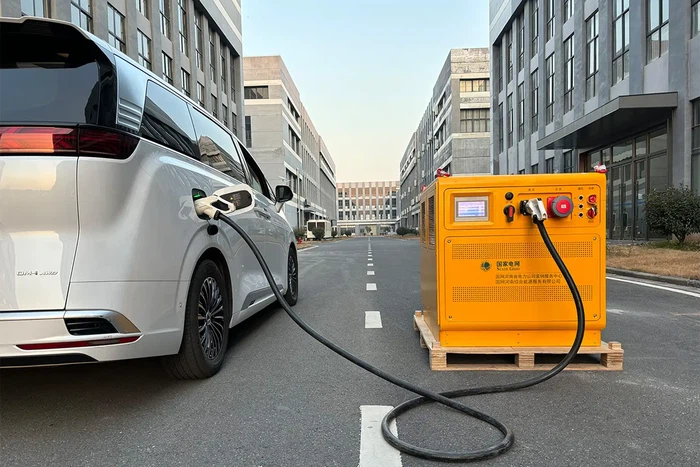
What Is a Portable Battery Energy Storage System?
A portable battery energy storage system is a self-contained unit with a built-in battery pack, an inverter, a charge controller, and multiple output ports. You charge it from the wall, a solar panel, a vehicle outlet, or another compatible source. The stored energy is then converted and delivered to your devices on demand.
If you have seen the term "portable power station" in retail listings, it refers to essentially the same product. Portable power station is the more common consumer label, while portable battery energy storage system appears more often in technical, B2B, and broader energy industry discussions. This guide uses both terms because buyers search for both depending on their background. To understand the core components of a battery energy storage system-including the battery management system, inverter, and thermal controls-it helps to see how these parts work together at every scale.
When Does a Portable Battery Energy Storage System Make Sense?
A portable system works best when you need flexible, temporary power without permanent installation. Here are the core scenarios where it earns its value.
Home Backup During Power Outages
For apartment renters, tenants who cannot modify their electrical panel, or homeowners who want a simple backup without hiring an electrician, a portable battery system keeps essential devices running during a blackout: Wi-Fi router, LED lighting, phone and laptop charging, a CPAP machine, or a small 12 V compressor fridge.
Consider a renter preparing for storm-season outages. Their priorities are communication, light, and keeping medications cool. A system in the 500–1,000 Wh range with a 500 W continuous inverter covers that load for roughly 6–10 hours. The key advantage over a generator: it runs indoors with zero emissions, zero noise, and no fuel storage.
What a portable system cannot do well is whole-home backup. Central air conditioning, electric ovens, and large pumps draw far more power than most portable units deliver. For full-circuit backup with automatic switchover, a fixed home battery system is the more appropriate solution.
Camping, RV, and Off-Grid Travel
Charging devices, running LED lighting and a portable fridge, powering a small electric cooker-all without generator noise or fuel handling. For RV users, recharge flexibility often matters more than raw capacity. A unit that accepts both shore power and foldable solar panels lets you top up during the day and run loads through the evening. Pairing a portable system with a solar battery energy storage setup extends off-grid runtime significantly.
Outdoor Work, Events, and Mobile Operations
Field crews, content creators, pop-up market vendors, and mobile event teams use portable battery systems to run displays, power tools, PA systems, lighting rigs, and charging stations. For these users, output port diversity and fast recharge between shifts matter more than headline capacity-especially when the unit goes back to a vehicle for charging overnight.
Emergency Preparedness and Medical Device Backup
Some buyers choose a portable battery system as a resilience tool: keeping communication devices online, powering emergency lighting, or backing up medically important devices within supported power limits. If you rely on a medical device, always check its power requirements against the system's continuous output and waveform type (pure sine wave is usually required). Consult the device manufacturer's guidance for backup power recommendations, and treat the portable battery as one layer of your backup plan rather than the only one.
How to Choose the Right Type and Size
Not every portable battery system targets the same use case. The right choice depends on what you need to power, for how long, and in what setting. Below is a practical framework that moves from identifying your size category to calculating exact capacity needs.
Size Categories and Typical Applications
Small units (under 500 Wh) are best for phones, tablets, cameras, drones, laptops, routers, and LED lights. Compact and usually under 7 kg, they are not designed for household appliances or any device with a compressor motor.
Mid-size systems (500 Wh–2 kWh) handle laptops, portable fridges, some TVs, routers and lighting during outages, and moderate RV use. If you want a single unit for both home backup and weekend travel, this is the range to start with.
Larger mobile systems (2 kWh and above) serve field operations, mobile clinics, larger event setups, and heavier tool loads. At this scale, the line between consumer portable power station and mobile battery energy storage system starts to blur. Wheels, modular expansion ports, and charging logistics all become critical. Some professional-grade mobile systems exceed 100 kWh and are trailer-mounted.
Calculating Your Actual Energy Need
Battery capacity is measured in watt-hours (Wh) or kilowatt-hours (kWh). One kWh equals 1,000 Wh. To understand the difference between power and energy in practical terms, see this explanation of kW vs kWh.
Here is a general sizing reference by scenario:
Phone and laptop charging only: 200–400 Wh
Camping (lights, devices, small fan): 500–800 Wh
Home outage backup (router, lights, phone, laptop, CPAP): 800–1,500 Wh
RV weekend (fridge, lights, devices, fan, TV): 1,000–2,000 Wh
Extended off-grid or field work: 2,000 Wh+
Professional mobile operations: 5,000 Wh+ or modular systems

Why Inverter Output Matters as Much as Battery Size
Capacity tells you how much energy is stored. But if the inverter's continuous output rating is too low, the system cannot deliver enough instantaneous power to run your device-even if the battery is full. A 2,000 Wh battery with a 300 W inverter cannot run a 400 W appliance.
Pay attention to two ratings: continuous output (watts the inverter can sustain) and surge output (short-term peak for startup loads). Refrigerators, pumps, power tools, and some compressors draw 2–3× their running wattage during startup. If your system's surge rating does not cover that spike, the unit will shut down or fail to start the device. Always check both ratings against your heaviest load before purchasing.
Output Ports and Recharge Sources
Verify that the unit offers the right combination of AC outlets, USB-A, USB-C (with sufficient PD wattage for laptops), 12 V DC outputs, and car socket ports. If you need to run a fridge and a CPAP simultaneously through AC, a single-outlet unit is a problem regardless of its capacity.
Equally important is how and how fast the system recharges. For home backup, fast wall charging (under 2 hours to 80%) matters most during multi-day outage events. For camping and off-grid use, solar input capacity and panel compatibility are key. For mobile work, vehicle charging keeps the unit topped up between shifts. A system that takes 10+ hours to recharge may be acceptable for rare use but creates a real bottleneck during repeated demand.
Key Features to Evaluate Before Buying
Battery Chemistry: Why LiFePO4 Has Become the Standard
Most mid-range and premium portable battery systems now use lithium iron phosphate (LiFePO4 or LFP) cells. Compared to other lithium-ion chemistries like NMC (nickel manganese cobalt), LFP offers stronger thermal stability, longer cycle life, and a lower risk of thermal runaway. The trade-off is lower energy density-LFP units tend to be heavier for the same capacity.
According to data compiled in the Wikipedia entry on LiFePO4 batteries (citing multiple peer-reviewed sources and a 2020 U.S. Department of Energy report), LFP cycle life ranges from 2,500 to over 9,000 cycles depending on conditions, and LFP cells were projected to last approximately 67% longer than NMC cells in large-scale storage applications. For a deeper comparison of different battery types used in energy storage, it is worth understanding the specific trade-offs of each chemistry.
If you plan to use the system frequently-daily cycling for off-grid living, regular job-site use, or recurring outage backup-LFP chemistry is worth prioritizing. For occasional emergency-only use, the chemistry difference matters less, but LFP still provides a meaningful safety and longevity margin.
Safety Systems and Certifications
A reliable portable battery energy storage system should include a battery management system (BMS) that monitors cell voltage, temperature, and current, with protections against overcharge, over-discharge, short circuit, and overheating.
For third-party certification, the key standard for portable power packs in North America is UL 2743, which covers the entire system-battery, electronics, wiring, and enclosure-through electrical, mechanical, and flammability testing. For larger stationary energy storage systems, UL 9540 applies. Products shipped internationally may also carry CE marking (Europe) or comply with UN 38.3 for lithium battery transport safety. If a seller cannot clearly state which certifications their product holds, that is a meaningful warning sign.
Weight, Portability, and Everyday Usability
A unit that technically qualifies as portable but weighs 30 kg without wheels is impractical for anyone who needs to move it regularly. Beyond weight, check handle ergonomics, wheel quality (if present), display readability in direct sunlight, cable management, and storage footprint. These details rarely appear in comparison charts but strongly affect day-to-day satisfaction.
App Monitoring and Expansion Options
Some users want simple plug-and-play operation. Others benefit from mobile app control with real-time state-of-charge monitoring, input/output tracking, remote shutdown, and firmware updates. If you anticipate growing your system over time, check whether the unit supports expansion batteries that add capacity without replacing the base unit.
Portable Battery System vs Home Battery vs Generator
These three categories solve different problems. Choosing the wrong one usually means either overspending or underperforming.
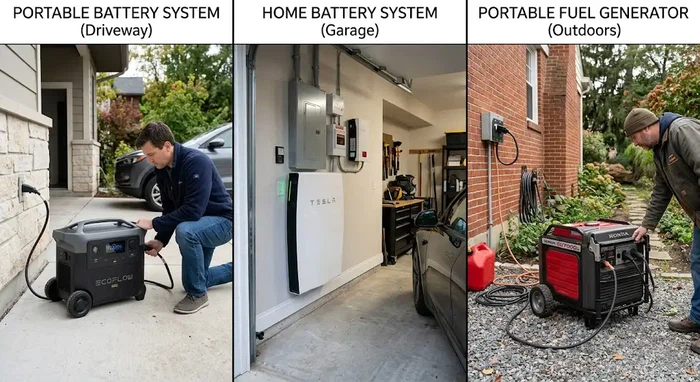
Portable battery energy storage system - No installation required. Moves with you. Best for selected-device backup, camping, RV, outdoor work, and temporary off-grid use. Limited by battery capacity and inverter output. Silent, zero-emission, indoor-safe.
Home battery system - Permanently installed and wired into your electrical panel for automatic switchover during outages. Integrates with rooftop solar. Supports broader circuit backup and higher daily cycling. Higher upfront cost and requires professional installation. For a detailed look at how fixed systems differ, see this guide on what BESS really means beyond just a big battery.
Generator (fuel-based) - Long runtime with fuel refills. Supports heavier loads. Works in remote areas without any charging infrastructure. But generators produce carbon monoxide, require outdoor-only operation at least 20 feet from any structure, need fuel storage, generate significant noise, and demand regular maintenance. The U.S. Consumer Product Safety Commission warns that portable generators are among the leading causes of non-fire CO poisoning deaths, making indoor or enclosed-space use extremely dangerous.
For most users who want quiet, clean backup for essentials, a portable battery system is the safer and more practical choice. Generators still make sense for sustained heavy-load scenarios in remote locations where recharging a battery is impractical. And if your needs scale toward whole-home backup or deeper solar integration, a permanently installed home battery-or for commercial and industrial applications, an LFP stacked battery system-is the smarter long-term investment.
Frequently Asked Questions
Can a portable battery energy storage system power a CPAP machine?
Most CPAP machines draw 30–60 W without a heated humidifier (50–100 W with one). A 500 Wh system can typically power a standard CPAP for one full night. Verify that the unit outputs a pure sine wave-some CPAP machines do not operate correctly on modified sine wave inverters. Always consult your CPAP manufacturer's documentation for backup power specifications.
Can I charge a portable battery system with solar panels?
Yes, most mid-range and premium systems accept solar input through an MPPT or PWM charge controller. Recharge speed depends on the system's maximum solar input rating and the panel wattage connected. A 200 W panel in good sunlight can add roughly 150–170 Wh per hour to a compatible system. For extended off-grid use, solar recharging is one of the most practical strategies to extend effective runtime.
How many years does a portable battery system last?
With LiFePO4 chemistry and moderate use (daily cycling at 80% depth of discharge), most quality units are rated for 2,500–6,000 cycles before capacity drops to 80% of original. For a user cycling once per day, that translates to roughly 7–16 years. Occasional-use buyers (emergency backup a few times per year) can expect the unit to remain functional for well over a decade with proper storage.
What is the difference between continuous output and surge output?
Continuous output is the sustained power the inverter can deliver indefinitely-it determines what the system can run during normal operation. Surge output is a brief peak (usually 1–3 seconds) that handles startup spikes from motors and compressors. A unit rated at 1,500 W continuous / 3,000 W surge can run a 1,200 W appliance steadily and handle a refrigerator's startup spike, but it cannot sustain 2,500 W continuously.
Does the system work while charging?
Most modern portable battery systems support pass-through charging, meaning you can draw power from the outputs while the unit is being charged from the wall, solar, or a vehicle. However, simultaneous high-draw input and output may generate more heat and reduce charging efficiency. Check the manufacturer's specifications for any limitations on pass-through use.
Final Recommendation
The right portable battery energy storage system is not the one with the biggest number on the box. It is the one where the capacity covers your actual daily watt-hours, the inverter handles your heaviest device, the ports match your setup, and the recharge method fits your routine. Start with a real device list and a real usage estimate. That single step eliminates most buying mistakes before they happen.