

Purchasing an Outdoor Battery Storage Cabinet is not a simple hardware procurement. It is a 15-year financial commitment. You are not just buying a metal box filled with batteries. You are investing in a power plant that must perform every single day, regardless of the weather.
In a market flooded with new suppliers, the "price-per-kWh" trap is real. We have seen it many times. A buyer chooses the cheapest quote to save 10% upfront. Two years later, the cooling fails. The cells degrade. The ROI evaporates. What looked like a bargain becomes a costly liability.
At Polinovel, we believe transparency is the foundation of a successful energy project. Our goal is not just to sell a product, but to ensure your project's long-term viability.
Based on our global deployment experience, we have identified 7 critical evaluation factors. Whether you are an EPC contractor, a warehouse manager, or a utility-scale developer, these insights can help you avoid the "hidden costs" of low-quality storage.
Factor 1: Thermal Management – The Foundation of Longevity
The lifecycle of your outdoor battery storage cabinet begins with how it breathes. While the enclosure protects the system from the outside, the thermal management system dictates what happens on the inside.
If a battery cabinet gets too hot, the cells degrade. If the cooling is uneven, the system becomes unbalanced. Consequently, for a BESS meant to last 15 years, thermal management is not a luxury-it is a survival requirement.
Many entry-level suppliers rely on air cooling because it is simple and cost-effective. However, as system size and power density increase, thermal management becomes more critical.
Air cooling can struggle with uneven airflow inside large outdoor cabinets, which may lead to localized "hot spots" that are difficult to detect.
According to a DNV GL technical review on stationary battery systems, a temperature gap of just 5℃ between cells can reduce total system life by up to 20%. This is why more high-performance systems are shifting toward liquid cooling solutions.
To illustrate the difference, consider the following comparison between air cooling and liquid cooling:
| Feature | Air Cooling (Standard) | Liquid Cooling |
| Temperature Uniformity | ±5°Cto ±8°C | ±3°C (Strict Control) |
| Energy Efficiency | High Fan Consumption | Low Auxiliary Power |
| Response Speed | Slow | Instant/Precise |
| Noise Level | High (Loud Fans) | Silent / Low Vibration |
| Lifespan Impact | Moderate Degradation | Maximum Cycle Life |
👉Choosing the Right Cooling - and How We Deliver It
In practice, there is no one-size-fits-all solution when it comes to thermal management.
- Air cooling is suitable for moderate climates and cost-sensitive energy storage projects
- Liquid cooling is preferred for high-temperature, high-load, or high-cycling applications where thermal consistency directly impacts lifespan and performance
That's why our 261kWh All-in-One Cabinet is designed with both air-cooled and liquid-cooled configurations on the same platform, allowing you to match the system to your real operating conditions-without redesigning your system architecture. Same platform, same electrical performance-only the cooling strategy changes.
For higher-demand scenarios, our liquid-cooled version uses a high-efficiency closed-loop system to maintain tighter temperature control. Even during 125kW high-power operation, cell temperature variation is kept within <2℃, significantly reducing thermal stress across the system.
Real-world proof
In a recent deployment for a commercial warehouse in Texas, our liquid cooling system maintained stable cell temperatures across 45℃ outdoor conditions, reducing cooling-related auxiliary power consumption by 15% compared to air-cooled alternatives on the same site.
Of course, cooling is only half the battle. A well-cooled system is useless if it cannot withstand the external elements. That is why our systems feature IP54-rated protection, keeping the internal electronics bone-dry in humid coastal regions or dusty deserts.
Factor 2: Battery Cell Grade & Cycle Life – The Engine of Your Investment
If the thermal management is the "climate control," then the battery cells are the "engine" of your BESS. Not all lithium cells are created equal. In the industrial energy storage market, the difference between Grade-A and Grade-B cells is the difference between a 15-year asset and a 5-year failure.
The "Grade-B" Trap: Why Cheap is Expensive
Many low-cost suppliers offer incredibly low quotes. However, they often achieve these prices by using Grade-B or retired EV (Electric Vehicle) cells. These cells may look identical on the outside, but they suffer from internal chemical impurities and high self-discharge rates.
👉Industry Reality: A Grade-B cell might fail after only 2,000 cycles. For a commercial energy storage project, this means your system could become useless before it even pays for itself. This is why savvy investors look beyond the initial price tag.
The Industrial Gold Standard: Grade-A 314Ah LFP
Building on the need for reliability, the current benchmark for utility-scale and industrial storage is the Grade-A 314Ah LFP (Lithium Iron Phosphate) cell.
At Polinovel, we exclusively use these high-capacity, high-density cells. Compared to older 280Ah versions, the 314Ah cell offers higher energy density and better thermal stability-while also reducing the number of cells required per system, simplifying system architecture, and lowering potential failure points.
More importantly, our cells are rated for 6,000+ cycles at 80% Depth of Discharge (DoD), supporting long-term operation with predictable performance and helping improve overall project ROI.
What 6,000 Cycles Means for Your ROI
To put this into perspective, let's look at the operational math:
| Metric | Budget Grade-B System | Grade-A System |
| Cycle Life (80% DoD) | -2,000 to 2,500 Cycles | 6,000+ Cycles |
| Operational Years | 5 -7Years | 15+ Years |
| Capacity Retention | Rapid Decline | Stable (>80% After 15 yrs) |
| Replacement Cost | High (Every 6 Years) | Minimal (Long-term Asset) |
Consequently, choosing a Grade-A 314Ah system isn't just a technical preference; it's a financial strategy. It ensures that your energy storage remains a revenue-generating asset long after the payback period has ended.
Of course, even the best cells in the world are dangerous without proper supervision. That is why the next critical factor is the "brain" and "bodyguard" of the system: Safety Protocols and Fire Suppression.
Factor 3: Safety Protocols & Fire Suppression – The Bodyguard of Your Asset
👉Why it matters: A single thermal runaway can destroy your entire investment in minutes.
In the energy storage world, safety is the non-negotiable foundation.
If a thermal management system is the "climate control" and the cells are the "engine," then the safety protocols are the "bodyguards." A single thermal runaway event can destroy your entire investment in minutes. Consequently, evaluating a supplier's safety architecture is more important than checking their price list.
Active Protection: The Multi-Layer BMS
A standard Battery Management System (BMS) is not enough. To ensure 10-15 years of stable operation, you need a multi-level protection hierarchy.

How Polinovel Delivers
Our outdoor battery cabinet systems utilize a three-tier BMS architecture, monitoring voltage, current, and temperature at the cell, module, and rack levels.
This layered approach enables early detection of abnormalities at the smallest unit level-before they escalate. If a single cell behaves outside safe parameters, the system can trigger alarms, limit operation, or isolate the affected section, preventing fault propagation across the entire system.
In practice, this means moving from passive protection to proactive risk control-reducing the likelihood of thermal runaway events and ensuring safer, more predictable long-term operation
Passive Defense: Automated Fire Suppression
Of course, electronic monitoring is only the first line of defense. True industrial-grade cabinets must have physical fire suppression built-in.
Many budget suppliers skip this to save costs. Polinovel integrates automated fire suppression-such as Aerosol or Novec 1230-directly into each cabinet. These systems are triggered by dedicated smoke and heat sensors, allowing them to extinguish a flame long before it becomes a disaster.
Safety is not a cost; it is insurance for your ROI. A certified, multi-layer safety system ensures that your "strategic asset" doesn't become a "headline-making liability."
Factor 4: Integration Efficiency – The Power of All-in-One Design
👉Why it matters: Component mismatch can delay commissioning by 4–6 weeks.
If the safety system is the "bodyguard," then the system architecture is the "blueprint" for your operational efficiency.
In the traditional BESS market, project delays are common. Why? Because many suppliers ship components separately. When you buy individual parts from different vendors, you face the "integration nightmare." Communication protocols between the BMS and the PCS might not sync. Cables may be missing. More importantly, troubleshooting a fragmented system can take weeks of on-site labor. Consequently, you are forced to hire expensive engineers to assemble the battery racks, PCS, BMS, and HVAC on-site. This is exactly where hidden costs begin to spiral out of control.
Polinovel's Solution
We don't treat integration as a final step-we build it into the system from the start.
All Polinovel outdoor cabinet BESS systems-such as our 125kW / 261kWh configurations are engineered as fully integrated, all-in-one solutions. Battery, PCS, thermal management, fire suppression, and EMS are designed, installed, and validated together at the factory.
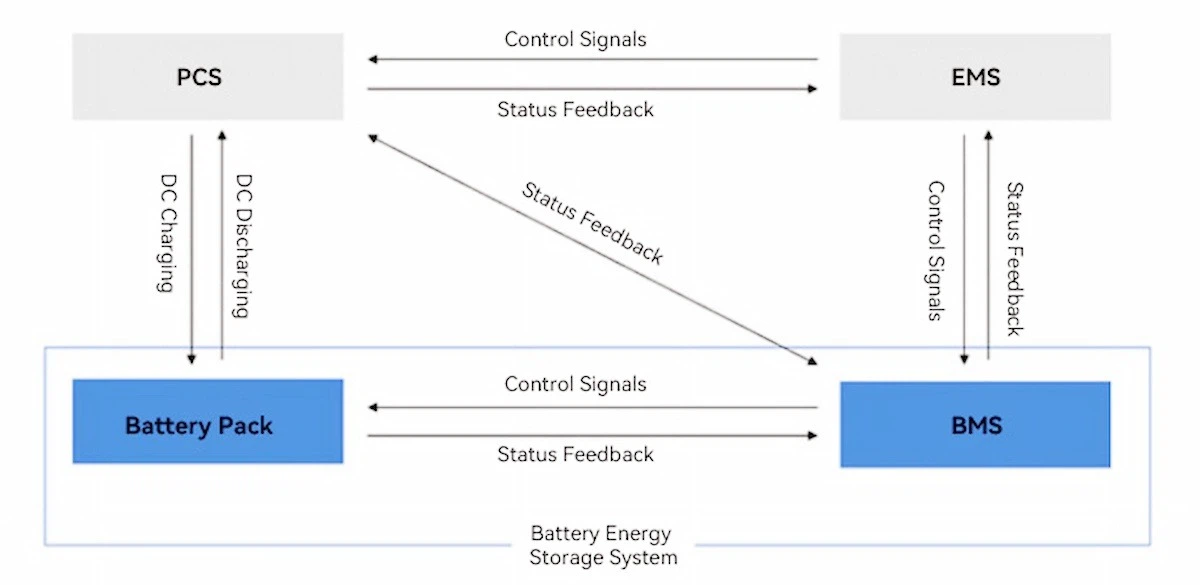
This is fundamentally different from assembling components from multiple vendors on-site.
Because every subsystem is pre-matched and tested as a single architecture, communication between the BMS, PCS, and EMS is already synchronized. There are no compatibility gaps, no missing interfaces, and no trial-and-error during commissioning.
Because of this pre-integrated approach, our clients reduce their on-site commissioning time by over 50%. You simply place the cabinet on its pad, connect the AC cables, and power it up.
| Installation Phase | Traditional Modular System | All-in-One Cabinet |
| On-site Assembly | 5 - 10 Days (Labor Intensive) | < 1 Day (Positioning Only) |
| Commissioning | Complex (Manual Setup) | Simple (Plug-and-Play) |
| Risk of Error | High (Wiring/Software) | Minimal (Pre-tested) |
| Total Labor Cost | Expensive Engineering | Minimal Local Labor |
Of course, a fast setup is only half the battle. A smart system also needs to be easy to manage long-term. This leads us to the "brain" behind the daily savings:Intelligent Energy Management and software-driven ROI.
Factor 5: Compliance & Global Logistics – Your Passport to Execution
👉Why it matters: Incorrect documentation can strand your shipment at customs for months.
If the All-in-One Integration Design is the "blueprint" for speed, then compliance is the "passport" that gets your project across the finish line.
Many buyers focus entirely on the hardware. However, lithium batteries are strictly classified as Class 9 Dangerous Goods. This means that without the correct paperwork and logistical expertise, your shipment could be seized at customs or stranded at a port for months. Consequently, a supplier's shipping track record is just as important as their battery specs.
The Hidden Barrier: Documentation Scrutiny
International shipping regulations (like IMDG or IATA) are becoming stricter every year. This is exactly where inexperienced suppliers fail. If a single MSDS (Material Safety Data Sheet) is outdated, or if the UN38.3 test report doesn't match the specific cell model, your project timeline is effectively dead.
Proven Experience
Building on years of global delivery, Polinovel has mastered the complexity of hazardous goods transport. We don't just "book a ship"; we manage the entire compliance chain.
- Verified Certifications:We maintain a library of up-to-date UN38.3, CE, and UL certifications to ensure zero friction at customs.
-
Specialized Packaging:Every cabinet is crated and secured according to international maritime standards to prevent vibration damage during transit.
-
Regional Expertise:Whether you are in the USA, Europe, or Australia, we understand the local grid requirements and import duties.
| Standard | Purpose | Compliance |
| UL 9540/9540A | System-Level Safety & Fire | Certified & Tested |
| UL 1973 | Battery Pack Safety | Standard Requirement |
| IEC 62619 | Industrial Application Saf ety | Fully Compliant |
| UN38.3/MSDS | Safe Global Transport | Global Shipping Ready |
Factor 6: Intelligent EMS – Transforming Hardware into Revenue
👉Why it matters: Smart peak shaving can shorten payback by 2–3 years.
If the hardware is the "body" of your BESS, the Energy Management System (EMS) is its "brain."
Many buyers make the mistake of focusing only on battery specs. However, once the system is installed, its ability to save-or make-money depends entirely on its intelligence. A high-quality cabinet without smart software is like a powerful car without a GPS; it has the potential, but it doesn't know where it's going. Consequently, the EMS is what ultimately dictates your ROI.
The "Passive" System Problem
A basic system simply charges and discharges. This is exactly where you lose money. If your system cannot predict peak demand or react to real-time utility pricing, you are missing out on the most lucrative benefits of energy storage.
Modern EMS platforms use forecasting algorithms to optimize for time-of-use rates and demand charges. According to a 2024 NREL report on commercial storage, intelligent peak shaving alone can improve payback by 2-3 years compared to passive charge/discharge logic.

Our integrated EMS is designed for automated profit-making.
- Peak Shaving:The system automatically discharges during expensive "peak" hours to lower your demand charges.
- Load Shifting:It charges when electricity is cheapest (off-peak) and powers your facility when rates spike.
- Remote Monitoring:You don't need to be on-site. Our cloud-based dashboard gives you real-time visibility into your savings, SOC (State of Charge), and system health from any device.
| Financial Benefit | Standard Manual System | Intelligent EMS |
| Demand Charge Reduction | Low /Inconsistent | Maximum (Automated Peak Shaving) |
| Grid Interaction | Limited | Full (Ready for Virtual Power Plants) |
| System Maintenance | Reactive (Fix after break) | Predictive (Al-driven alerts) |
| Payback Period | 7-9 Years | 4 - 6 Years (Optimized) |
A BESS is a financial tool. A smart EMS shortens your payback period by years. It turns a "cost center" into a "profit center" by making intelligent decisions every second of the day.
Of course, your business needs might grow tomorrow. This brings us to the final factor: Scalability and ensuring your 2026 investment is still relevant in 2030.
Factor 7: Scalability & Future-Proofing – Growing with Your Business
👉Why it matters: Modular design protects your initial capital as energy needs grow.
If the EMS is the "brain" that optimizes today's savings, then scalability is the "insurance policy" for your facility's growth.
Many business owners buy an outdoor battery storage cabinet based only on today's energy bills. This is a strategic trap. Your energy needs will grow. You might add a new production line. You might install 20 new EV chargers. If your system is "fixed," it becomes a stranded asset the day you outgrow it. Consequently, modularity is the only way to protect your initial capital.

The Polinovel Solution: Smart Master-Slave Logic
Our 241kWh - 964kWh Scalable Series is designed for true parallel connection.
- Automatic Balancing: Our "Master" EMS treats all connected cabinets as one single unit. It automatically balances the voltage and SOC (State of Charge) across every cell.
- Daisy-Chain Wiring: You don't need a complex new control room or massive rewiring. We use a "daisy-chain" setup, where one cabinet plugs into the next in a simple series. This creates a single, unified communication loop that the Master EMS manages automatically.
- Plug-and-Play: The system detects the new capacity instantly. No manual software coding. No system downtime.
A "Pay-as-You-Grow" Financial Strategy
Don't over-invest on day one. Why pay for a 1MWh system today if you only need 261kWh?
With Polinovel, you can install one outdoor battery storage cabinet now. When your production capacity doubles in three years, you simply add another unit. We help you prepare your site from the start so future expansion is "plug-and-play."
- The Concrete Pad: This is the heavy-duty foundation for your cabinets. We help you design a pad that is already sized for your future units. This prevents the high cost of secondary excavation or pouring new concrete later.
- AC Busbars: These are the high-conductivity copper bars that connect your cabinets to the main power grid. We ensure your initial busbars are rated for your maximum future load. You won't have to rip out and replace expensive wiring when you add your second or third cabinet.
| Scalability Factor | Traditional Fixed System | Scalable Series |
| Expansion Method | Full System Replacement | Plug-in Parallel Cabinets |
| Max Capacity | Fixed at Purchase | Expandable to 1MWh+ |
| Commissioning | Start from Scratch | Auto-Sync via Master EMS |
| Footprint | Double the Space | Compact, Side-by-Side Array |
Don't let your hardware limit your business trajectory. A modular outdoor battery storage cabinet allows you to "Pay-as-you-grow." You save cash today while staying ready for the opportunities of 2030.
Choosing an outdoor battery storage cabinet is a long-term financial decision.
The initial price is only one part of the equation. As we have explored, a "cheap" quote often hides long-term risks. Low-quality cooling kills batteries. Grade-B cells lead to early failure. Poor integration increases labor costs.
At Polinovel, we bridge the gap between technology and ROI. We focus on the 7 critical pillars: from Liquid Cooling precision to Modular Scalability. Our goal is simple. We ensure your system remains safe, efficient, and profitable for its entire lifespan.
Ready to Secure Your Energy Future? Don't navigate this complexity alone.
Our engineering team is ready to help. We can calculate your specific payback period. We can design a system that fits your facility perfectly.
[Contact Polinovel Today] for a technical consultation. Let's build an energy strategy that works as hard as you do.
FAQ About Outdoor Energy Storage Cabinets
Q: Are battery storage systems worth it?
A: Yes. Outdoor battery storage cabinets help businesses cut energy costs, reduce peak demand charges, and provide backup power. With pre-integrated design and no need for indoor space, they usually deliver clear ROI over time.
Q: How safe are battery energy storage systems?
A: Very safe when properly designed. Outdoor cabinets use LFP batteries, BMS protection, thermal management, and fire suppression systems to prevent and control risks. Safety is built into every layer.
Q: How long can BESS store energy?
A: Typically 1–4 hours, depending on system size. For example, a higher-capacity cabinet can extend runtime to 4–6+ hours for backup or peak shaving.
Q: What is the lifespan of a battery energy storage system?
A: About 10–15 years. Most systems deliver 4,000–6,000 cycles, with around 70–80% capacity remaining at end of life.