


Single phase vs three phase power is an important consideration when selecting a battery energy storage system (BESS). Even if a system has sufficient battery capacity and rated power, its AC output must still match the site's electrical supply and load requirements. Otherwise, grid integration and load support may become challenging.
So, what sets single-phase and three-phase BESS apart? And which configuration is more suitable for different energy storage applications?
What Do Single-Phase and Three-Phase Configurations Mean in a BESS?
The terms single-phase and three-phase describe the AC side of a BESS. Batteries store energy in chemical form and deliver direct current (DC). It is the Power Conversion System (PCS) that converts this DC power into the required AC configuration.
Single-Phase BESS Configuration
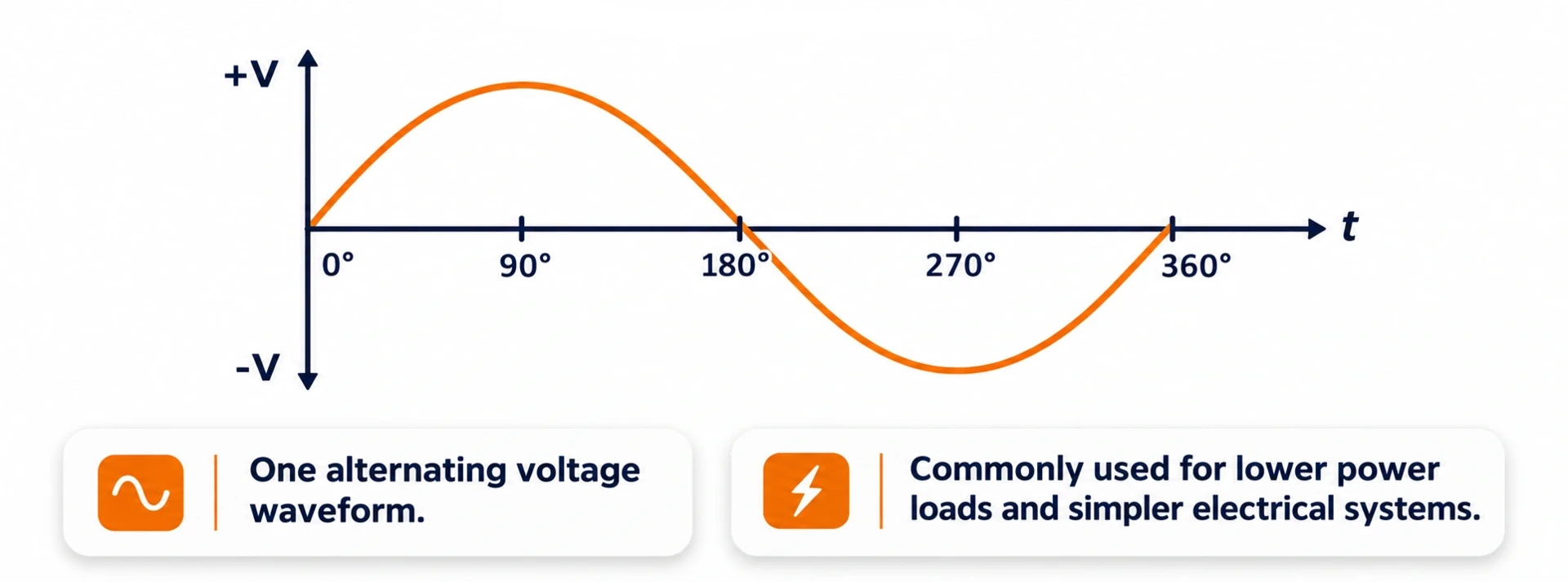
A single-phase BESS delivers alternating current through a single AC phase. The voltage follows one sinusoidal waveform, periodically changing in magnitude and direction.
The electrical connection typically consists of a line conductor and a neutral conductor, although wiring arrangements vary according to regional power supply standards.
Three-Phase BESS Configuration
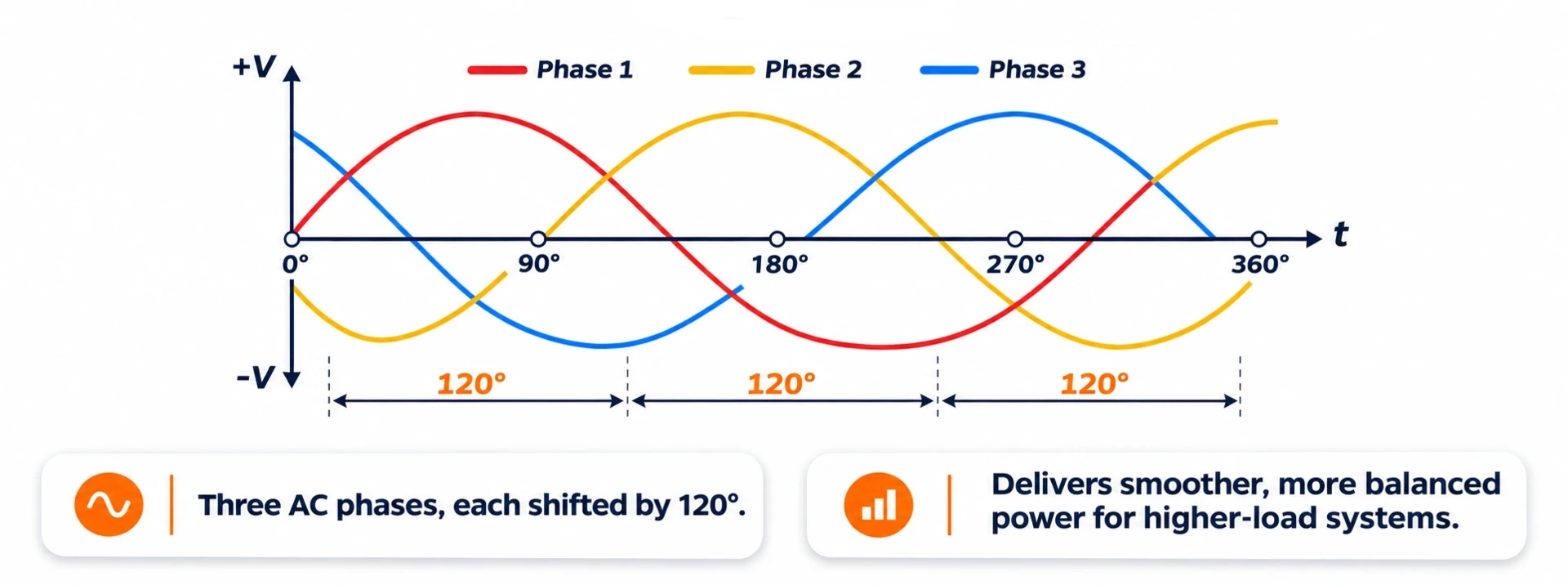
Rather than using one AC phase, a three-phase PCS delivers three AC voltage waveforms of the same frequency, separated by 120° in a balanced system. The U.S. Department of Energy's Electrical Science Fundamentals Handbook explains this phase relationship and the basic wye and delta connection arrangements.
Two common AC connection arrangements are:
- Three-phase, three-wire (3P3W): Uses three phase conductors (L1, L2, and L3).
- Three-phase, four-wire (3P4W): Includes a neutral conductor (N) in addition to the three phase conductors.
Both configurations require a compatible PCS and electrical distribution design. A three-phase AC output does not necessarily require three separate battery banks.
Single-Phase vs. Three-Phase Power in BESS: Key Differences
When comparing single-phase vs. three-phase power in battery energy storage systems, the practical differences become clearer at the point of use. Grid compatibility, power distribution, and backup requirements all influence how a BESS performs on site.
| Comparison Factor | Single-Phase BESS | Three-Phase BESS |
| Grid Connection | Single-phase supply or one phase of a compatible three-phase supply | Three-phase supply |
| Load Compatibility | Single-phase loads | Three-phase and compatible single-phase loads |
| Power Distribution | One AC phase | Three AC phases |
| Typical Power Range | Generally lower | Generally higher |
| Load Balancing | Limited to the connected phase | Subject to per-phase limits and imbalance capability |
| Backup Power | Single-phase loads, where supported | Three-phase and compatible single-phase loads, where supported |
| System Integration | Relatively simple AC architecture | Additional phase coordination and protection requirements |
Power distribution is an important difference. A single-phase BESS delivers its output through one phase, while a three-phase BESS distributes AC power across three phases.
However, the total rated power of a three-phase PCS does not tell the whole story. Its maximum output on each phase and ability to handle uneven loads also matter. These limits vary by model, so the total rated power should not be assumed to divide equally into fixed per-phase output limits.
Consider a hypothetical 30 kW three-phase PCS with an assumed maximum output of 10 kW per phase:
- L1: Maximum output of 10 kW
- L2: Maximum output of 10 kW
- L3: Maximum output of 10 kW
If the connected loads require 14 kW on L1, 5 kW on L2, and 5 kW on L3, the total demand is only 24 kW. However, L1 exceeds its assumed 10 kW output limit.
In this example, the PCS may not support the full load, even though the total demand is below its 30 kW rating. However, other 30 kW PCS models may have different per-phase output limits or support higher levels of unbalanced loading. The actual load capacity depends on the manufacturer's specifications, including per-phase output limits and unbalanced-load capability.
How Does PCS Configuration Affect the AC Output of a BESS?
Once the site's phase and wiring requirements are known, the PCS datasheet becomes the main reference for confirming the BESS AC output configuration.
It provides key information about the output phase, wiring arrangement, rated AC voltage, frequency, and power rating. These specifications help determine whether the system's electrical interface is compatible with the project requirements.
Key PCS Specifications for AC Output
When evaluating a BESS, several PCS specifications deserve attention:
| PCS Specification | What to Check | Why It Matters |
| AC Phase | Single-phase or three-phase | Identifies the AC output configuration |
| AC Wiring | 1P2W, 3P3W, 3P4W, etc. | Identifies the supported connection arrangement |
| Rated AC Voltage | Phase-to-phase and phase-to-neutral voltage, where applicable | Checks electrical compatibility |
| Frequency | 50 Hz or 60 Hz | Matches local electrical standards |
| Rated Output Power | kW/kVA | Indicates the PCS power delivery capability |
A Polinovel Product Example: 225 kWh Outdoor Cabinet BESS
The PCS specifications discussed above can also be identified in real BESS products. Polinovel's 225 kWh outdoor cabinet BESS provides a practical example.
Its published technical specifications include:
- Battery Capacity: 225 kWh
- Rated PCS Power: 60 kW
- AC Voltage: 220/380 Vac or 230/400 Vac
- AC Connection: 3L+N+PE
- Frequency: 50/60 Hz
These specifications identify a three-phase, four-wire AC connection. The 3L+N+PE configuration includes three phase conductors, a neutral conductor, and protective earth.

The battery capacity and PCS rated power describe different aspects of the system. The 225 kWh capacity indicates how much energy the battery can store, while the 60 kW PCS rating indicates its rated power output. Neither figure alone identifies the number of AC phases.
When Is a Step-Up Transformer Needed?
For larger BESS projects, the PCS output voltage may not be high enough for direct connection to a medium-voltage grid.
A step-up transformer increases the AC voltage before grid connection.
A typical system arrangement is: Battery Container → PCS → Step-Up Transformer → MV Switchgear → Medium-Voltage Grid
The transformer changes the voltage level, not the phase configuration. The PCS remains responsible for the AC output architecture.
Can a Single-Phase BESS Connect to a Three-Phase Grid?
A single-phase BESS may be connected to one phase of a three-phase grid, provided the inverter supports this arrangement and the connection meets local utility requirements. However, its operation depends partly on how power is regulated across the three phases.
Before connecting the system, project developers should check the local utility's interconnection rules. Depending on the jurisdiction and service configuration, these rules may specify limits on single-phase DER capacity, phase-current imbalance, voltage imbalance, and power export at the point of common coupling (PCC). Inverter protection and metering requirements may also affect the permitted connection arrangement.
In jurisdictions that adopt it, IEEE Std 1547-2018 provides a technical framework for DER interconnection and interoperability. It covers performance requirements, responses to abnormal grid conditions, power quality, anti-islanding, and equipment testing.
Two regulation methods are worth understanding:
- Total-Phase Regulation: The system adjusts its output according to the combined power demand of L1, L2, and L3.
- Individual-Phase Regulation: The system compensates for the power demand on the phase to which it is connected.
A single-phase BESS connected to one phase can increase power flow on that phase, particularly when exporting electricity to the grid. The utility may assess the resulting phase loading and voltage conditions to determine whether the connection complies with its imbalance limits.
Consider a facility with three-phase loads of 100 W on L1, 400 W on L2, and 200 W on L3, for a total demand of 700 W. Under a three-phase total-power control strategy, a single-phase BESS connected to L1 could inject 700 W into that phase, provided the inverter supports this operating mode and the grid connection allows the resulting power export.
In this example, 100 W of the BESS output supplies the local load on L1, while the remaining 600 W flows back to the grid. Meanwhile, L2 and L3 continue drawing 400 W and 200 W from the grid, respectively. If the meter and control system calculate net power by summing the power across all three phases, the combined grid exchange is zero, assuming other power flows and losses are excluded.
This does not mean the BESS physically supplies all three phases. Instead, it balances the aggregate power exchange at the grid connection. Whether this arrangement works as expected depends on the inverter's control capabilities, meter configuration, permitted phase-level export, and local utility interconnection rules. Some metering arrangements may measure power imports and exports separately on each phase rather than offsetting them across all three phases.
A similar operating principle is illustrated in Victron Energy's ESS Design and Installation Manual. It demonstrates how a single-phase ESS connected to L1 can regulate the combined power of L1, L2, and L3 under its "Total of all phases" setting. This is a manufacturer-specific implementation example, and the same capability should not be assumed for every BESS.
For backup applications, the distinction is even more important. A single-phase BESS cannot independently provide three-phase AC power to equipment during a grid outage.
Where Are Single-Phase and Three-Phase BESS Configurations Used?
The choice between single-phase and three-phase BESS depends largely on the site's electrical infrastructure and power requirements. Both configurations can serve different energy storage applications, but their suitability varies with the type of power supply and connected loads.
Single-Phase BESS Applications
Single-phase BESS is commonly considered for residential properties and smaller facilities with single-phase electrical supplies.
Typical applications include:
- Residential Solar Storage: Stores excess electricity generated by rooftop solar panels for use when solar production is low.
- Home Backup Power: Supplies essential household loads during grid outages, depending on the inverter's backup capabilities.
- Small Commercial Facilities: Supports energy storage needs in shops, offices, and other sites with single-phase electrical connections.
For these projects, the main considerations are the available AC supply, inverter compatibility, and the power requirements of connected loads.
Three-Phase BESS Applications
Three-phase BESS is widely used in projects where the electrical infrastructure and connected equipment require three-phase power.
Typical applications include:
- Three-Phase Residential Storage: Supports homes with three-phase electricity supplies, particularly where three-phase household equipment needs to be accommodated.
- Commercial and Industrial Storage: Integrates with factory equipment, industrial motors, HVAC systems, and other three-phase loads. Common applications include peak shaving and backup power.
- Utility-Scale Energy Storage: Connects large battery storage installations to the power grid through three-phase PCS equipment and, where required, step-up transformers.
These projects require careful consideration of PCS output ratings, phase loading, and grid connection requirements.
Single-Phase vs. Three-Phase BESS Applications
| Application | Single-Phase BESS | Three-Phase BESS |
| Residential Solar Storage | Common for homes with single-phase supplies | Suitable for homes with three-phase supplies |
| Home Backup Power | Supports compatible single-phase essential loads | Can support three-phase backup loads when the PCS supports islanded operation |
| Small Commercial | Suitable for sites with single-phase supplies and loads | Suitable for sites with three-phase supplies or equipment |
|
C&I Energy Storage |
Possible for specific single-phase loads or smaller configurations | Common for facilities with three-phase distribution and industrial loads |
| Utility-Scale Storage | Less typical for large grid-connected projects | Common for large-scale BESS with three-phase PCS equipment |
The application alone does not determine the phase configuration. The existing electrical supply, load requirements, and PCS capabilities should all be considered before selecting a BESS.
How to Choose the Right Phase Configuration for a BESS Project
Choosing between single-phase and three-phase BESS requires more than checking the site's electrical supply. The key is to understand what the system needs to power and how it will operate.
Four factors can help determine the right configuration.
1. Check the Existing Electrical Supply
Start by identifying the site's existing AC power supply. This establishes the electrical conditions that the BESS must work with.
Check the following:
- Phase Configuration: Is the site connected to a single-phase or three-phase supply?
- Voltage and Frequency: What are the site's nominal AC voltage and operating frequency?
- Single-Phase Connection Limits: Does the local utility permit the proposed single-phase BESS capacity on one phase of a three-phase supply?
- Grid Connection and Imbalance Limits: Are there restrictions on power export, phase-current imbalance, or voltage imbalance at the point of common coupling (PCC)?
- Connection Arrangement: Does the existing system use a three-wire or four-wire configuration?
- Protection and Metering Requirements: What inverter protection functions and metering arrangements are required for grid connection?
A single-phase BESS may also be connected to one phase of a three-phase supply in certain applications. However, local grid regulations and metering arrangements must be considered.
2. Identify the Loads the BESS Needs to Support
The site's electrical supply does not always tell the whole story. The types of equipment connected to the system are equally important.
For example:
- Single-Phase Loads: Lighting, office equipment, and many household appliances.
- Three-Phase Loads: Industrial motors, pumps, compressors, and production machinery.
If the BESS only needs to supply single-phase loads, a single-phase configuration may be sufficient.
However, if the project requires backup power for three-phase equipment, a PCS capable of three-phase islanded output is necessary.
3. Evaluate PCS Output and Power Distribution
A PCS must deliver enough power to support the connected loads. For three-phase systems, checking the total rated output is not enough.
Pay attention to three specifications:
- Rated Output Power: Can the PCS meet the facility's total power demand?
- Per-Phase Output: Can each phase handle its individual load?
- Unbalanced Load Capability: Can the PCS accommodate uneven power demand across L1, L2, and L3?
A three-phase PCS rated at 30 kW, for example, may have model-specific output limits for each phase.
Do not assume that its total rated power is always divided into three equal 10 kW limits. Check the manufacturer's datasheet for the permitted output on each phase and the supported level of load imbalance.
Battery capacity also needs separate consideration. The PCS determines the available output power, while usable battery capacity determines how long the system can supply that power.
4. Consider Backup Requirements and Future Needs
A BESS designed for grid-connected operation may not provide the same capabilities during a power outage.
Before finalizing the configuration, consider:
- Does the project require grid-connected operation only, or backup power as well?
- Must the system continue supplying three-phase equipment during an outage?
- Does the PCS support islanded operation and the required backup output?
- Are there plans to add more equipment or increase power demand later?
These requirements affect the PCS configuration, transfer equipment, protection design, and potential system expansion.
Quick Checks Before Selecting a BESS Phase Configuration
| Project Requirements | Key Checks Before Selection |
| Single-phase supply and loads | Confirm PCS voltage, frequency, and rated output power |
| Three-phase supply with mainly single-phase loads | Check neutral availability, phase allocation, and local grid imbalance limits |
| Three-phase equipment requiring backup | Verify three-phase islanded output, load starting requirements, and transfer capabilities |
| Industrial site with mixed and uneven phase loads | Check per-phase output limits and unbalanced-load capability |
The right choice ultimately depends on the relationship between the site's electrical supply, connected loads, and required operating mode. Evaluating these factors together helps ensure that the selected BESS is suitable for both normal operation and backup requirements.
Choosing the right phase configuration is essential for reliable BESS integration. Polinovel provides tailored battery energy storage solutions for commercial, industrial, and utility-scale projects.
Whether you need a single-phase or three-phase system, our team can help evaluate your power requirements, PCS configuration, and battery capacity to identify a suitable solution.
Planning a BESS project? Contact Polinovel today to discuss your requirements and get a solution tailored to your application.