


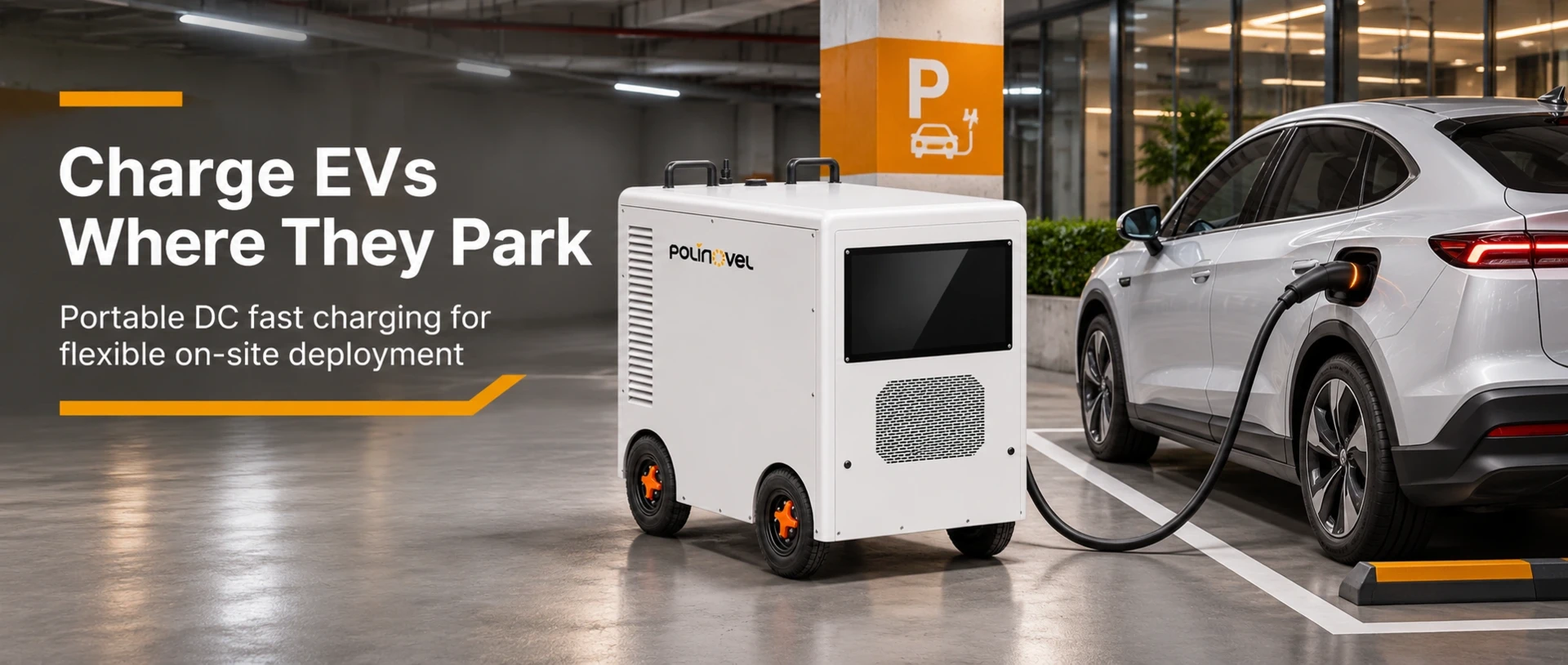
A mobile DC fast charger brings charging power directly to parked EVs when fixed charging stations are unavailable or insufficient. For fleet operators, moving vehicles to distant charging points wastes time and disrupts daily operations. Battery-powered mobile charging offers a more flexible option.
But where does it make the most sense, and what challenges can it address? Let's look at the key applications and considerations.
Why Do Businesses Need More Flexible EV Charging Solutions?
Fixed charging stations work well for vehicles that return to the same location every day. However, commercial EV operations often face changing parking arrangements, limited charging points, and increasing power demands. These challenges can affect daily operations in several ways.
1. Limited Charging Access
Not every parking facility has enough charging points for its EVs. Vehicles may need to move to another location or wait for an available charger, adding extra time to daily operations.
2. Peak-Hour Charging Demand
When multiple fleet vehicles return during the same period, charging demand can rise quickly. Limited charging points may create queues and affect vehicle availability for the next trip or shift.
3. Limited Grid Capacity
Installing additional DC fast chargers requires sufficient electrical capacity. Some commercial sites may need utility upgrades to support higher charging loads, increasing project costs and deployment time.
The U.S. Department of Energy's 2024 report, Impact of Electric Vehicles on the Grid, identifies mobile charging and distributed energy resource-backed charging as potential measures to help manage site peak demand and reduce the need for grid upgrades.
These challenges create a need for more flexible charging options.
How Can Mobile DC Fast Charging Address These Challenges?
A mobile DC fast charger addresses two practical challenges: where charging equipment is available and how much power a site can supply. Its mobile design allows operators to bring charging equipment closer to parked EVs. In battery-powered models, integrated energy storage also provides stored energy for DC charging when the site's grid connection cannot directly meet peak demand.
Bringing Charging Equipment Closer to Parked EVs
A mobile DC charger can be deployed closer to the vehicles that need charging. This offers several practical benefits:
- Less need to move vehicles between parking and charging areas.
- Additional charging access when fixed chargers are occupied.
- More flexibility when parking arrangements or charging locations change.
For example, Polinovel's MBS55 and MBS97–MBS193 mobile chargers feature a mobile installation design and 5-meter charging cables, allowing operators to position the equipment near compatible parked EVs.
Using Battery Storage to Support DC Charging
Some mobile DC fast chargers also integrate battery storage to support charging operations.
The onboard LFP battery stores electricity from an available power source. When an EV needs charging, the system converts the stored energy into DC power for the vehicle. This battery-buffered configuration can help support charging demand at sites where the available grid connection cannot directly meet peak power requirements.
It is worth noting that battery-buffered charging is not limited to mobile equipment. Fixed DC charging stations can also integrate battery storage to manage power demand and support high-power charging.
The U.S. Joint Office of Energy and Transportation also explains this battery-buffered charging principle in its technical guide to battery energy storage for EV charging stations.
Polinovel offers several configurations to match different energy and charging power requirements:
| Model | Battery Capacity | DC Output Power |
| MBS55 | 55.2 kWh | 40 kW |
| MBS97 | 96.4 kWh | 60 kW |
| MBS145 | 144.6 kWh | 80 kW |
| MBS193 | 192.9 kWh | 120 kW |
These two specifications serve different purposes:
- Battery Capacity (kWh): Determines how much energy the unit can store.
- DC Output Power (kW): Determines how much charging power it can deliver at a given time.
A larger battery does not automatically mean faster charging. The right configuration depends on daily energy demand, vehicle charging requirements, and the time available to recharge the mobile unit.
The combination of mobile deployment and integrated energy storage makes these systems useful in more than one type of EV operation. However, their value depends on the site and its charging requirements.
Related Reading: KW Vs KWh Explained: Understanding Power And Energy Units
Where Can Mobile DC Fast Chargers Be Used?
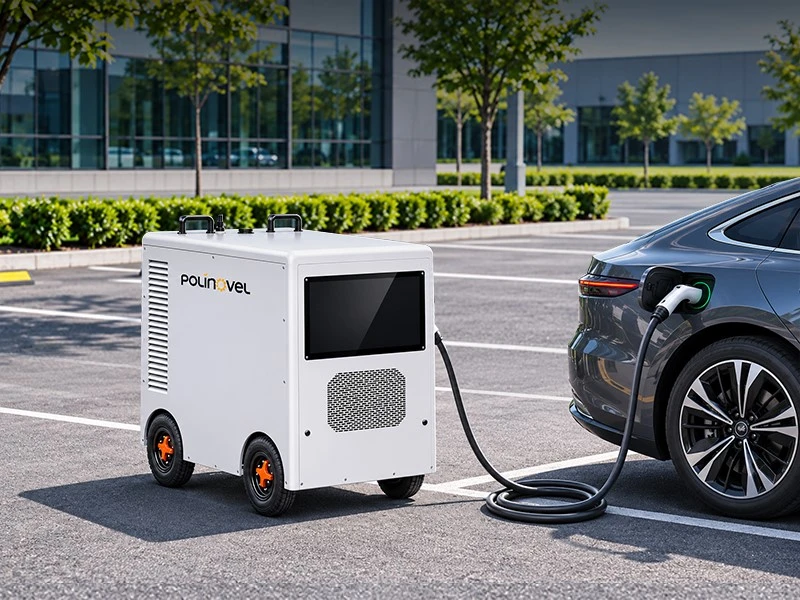
Mobile DC fast chargers can support EV charging across different commercial environments. The following applications show where flexible charging access can make a practical difference.
EV Fleet Depots
Fleet vehicles often return to depots between shifts. During busy periods, fixed charging points may not be enough to serve all vehicles.
Mobile DC fast chargers can provide additional charging support for:
- Peak-hour returns: Supporting vehicles when existing charging points are occupied.
- Multiple parking areas: Bringing charging equipment closer to vehicles parked in different sections of a depot.
- Quick vehicle turnaround: Providing additional DC charging capacity before vehicles return to operation.
Car Rental Companies and Dealerships
Rental companies and dealerships manage large vehicle inventories. EVs may need charging before rental, test drives, or customer delivery.
Mobile charging can help businesses:
- Charge selected vehicles in different inventory areas.
- Support vehicle preparation and delivery schedules.
- Provide additional charging access without installing fixed chargers throughout the parking lot.
Temporary and Overflow Parking Areas
Events, seasonal operations, and temporary parking arrangements can create charging demand beyond the capacity of existing facilities.
In these situations, mobile DC fast chargers can:
- Provide additional charging during periods of increased demand.
- Support EVs parked in temporary or overflow areas.
- Be relocated when the event or parking arrangement changes.
The suitability of each application depends on vehicle charging requirements, parking layout, available power, and daily operating schedules.
Mobile DC Fast Charger vs. Fixed DC Charging Stations
Both mobile and fixed DC charging stations can deliver fast charging to electric vehicles, but they differ in how they are deployed and supplied with energy. The right choice depends on parking arrangements, charging demand, and available site power.
| Comparison | Battery-Integrated Mobile DC Fast Charger | Conventional Grid-Supplied Fixed DC Charging Station |
| Deployment | Can be relocated between different parking areas as needed |
Permanently installed at designated charging locations |
| Charging Access | Can bring charging equipment closer to EVs parked in different areas |
EVs must access the installed charging points |
| Energy Supply | Uses integrated battery storage to supply DC charging power; the unit needs recharging between operations |
Typically draws power directly from the grid; battery storage can also be integrated |
| Grid Requirements | May reduce the need for high-power grid access at the charging point, but requires suitable power for battery recharging |
Requires sufficient site grid capacity to support its rated output |
| Operational Flexibility | Suitable for changing parking arrangements, temporary demand, and additional charging needs; operating cycles depend on stored energy and recharge schedules | Better suited to permanent charging locations and consistent demand, with continuous operation subject to sufficient grid supply |
When Should Businesses Consider Mobile DC Fast Charging?
A mobile solution may be worth considering when:
- Parking locations change: EVs are frequently parked in different areas or temporary facilities.
- Additional charging is needed: Existing fixed chargers cannot meet peak demand.
- Grid capacity is limited: Installing additional high-power chargers would require significant electrical upgrades.
- Charging demand is temporary: Permanent infrastructure may not be justified for short-term requirements.
When Are Fixed DC Charging Stations More Suitable?
Fixed charging stations are generally a better fit for operations with:
- Permanent parking and designated charging spaces.
- Consistent daily charging demand.
- Sufficient electrical infrastructure.
- Frequent, continuous charging requirements.
One important consideration is operating continuity. A battery-powered mobile charger has a finite amount of stored energy and must be recharged before it can support further charging sessions. Fixed chargers, when connected to an adequate power supply, can support repeated charging operations without relying on an onboard energy reserve.
The two solutions do not have to compete. Businesses can use fixed chargers for routine EV charging and mobile DC chargers to provide additional capacity in areas where fixed infrastructure is unavailable or insufficient.
How to Choose the Right Polinovel Mobile DC Fast Charger?
Choosing a mobile DC fast charger requires more than looking at battery capacity or charging power alone. Businesses need to consider daily energy demand, vehicle compatibility, charging schedules, and site conditions. Polinovel offers four configurations, from 55.2 kWh to 192.9 kWh, to support different EV charging requirements.
Match Battery Capacity to Daily Charging Demand
Battery capacity determines how much energy a mobile charger can store. The right capacity depends on how many EVs need charging, how much energy each vehicle requires, and how often the unit can recharge.
Polinovel offers four configurations: MBS55, MBS97, MBS145, and MBS193.
These options cover different energy and power requirements. However, nominal battery capacity does not equal the energy available for EV charging. Actual available energy depends on usable battery capacity, conversion losses, and operating limits.
Businesses should estimate their daily charging demand before selecting a configuration.
Check DC Output Power and Vehicle Charging Requirements
Battery capacity determines how much energy is stored, while DC output power determines how quickly that energy can be delivered.
For example, Polinovel's configurations range from 40 kW to 120 kW DC output. When selecting a model, consider:
- Vehicle charging capability: The EV's maximum DC charging power.
- Charging time: How long the vehicle can remain connected.
- Daily operating schedule: Whether vehicles need to recharge between shifts or during shorter parking periods.
A higher-rated charger does not guarantee that every EV will charge at that power. Actual charging performance also depends on the vehicle's battery condition, state of charge, and charging limits.
The U.S. Department of Energy's Alternative Fuels Data Center explains these factors in its guidance on EV charging equipment.
Verify Connector and Voltage Compatibility
Charging compatibility is another important consideration, particularly for businesses operating different EV models or serving multiple markets.
Polinovel's mobile DC chargers offer several connector options:
- CCS1
- CCS2
- GB/T
- CHAdeMO
- NACS
Both product ranges support a 200–1000 V DC output range, accommodating different EV battery voltage requirements. The selected connector and voltage configuration should still be verified against the target vehicles and local charging standards.
Consider Recharging and Daily Operating Cycles
A mobile DC fast charger needs to replenish its stored energy before it can support further charging sessions. This makes the recharge schedule an important part of equipment selection.
Before choosing a model, evaluate:
- How many charging sessions are expected each day?
- How much time is available to recharge the unit?
- What power supply is available at the equipment's recharge location?
- Does the operating schedule allow enough time between charging cycles?
Polinovel's MBS55 and MBS97–MBS193 configurations include a DCDC recharge port. However, the required recharge time should be confirmed according to the actual input conditions and project configuration.
Check Cooling and Environmental Protection
Mobile charging equipment may operate in outdoor parking areas, vehicle yards, and temporary sites. Cooling and enclosure protection therefore deserve attention.
Polinovel uses different cooling configurations across its product range:
| Feature | MBS55 | MBS97-MBS193 |
| Cooling Method | Fan Cooling | AC Cooling |
| Enclosure Protection | IP54 | IP54 |
| Impact Protection | IK10 | IK10 |
| Operating Temperature | -10°C to +55°C | 10°C to +55°C |
| DC/DC Conversion Efficiency | More than 95% | More than 95% |
Both product ranges also incorporate electrical protection functions, including overcurrent, short-circuit, insulation monitoring, and emergency-stop protection.
The right choice ultimately depends on the project's charging demand, vehicle compatibility, recharge arrangements, and operating environment.
Fixed charging stations cannot meet every EV charging need. A mobile DC fast charger offers another option. It brings charging power closer to parked EVs and gives businesses more flexibility across different operating locations.
Polinovel offers several configurations, from 55.2 kWh / 40 kW to 192.9 kWh / 120 kW. Businesses can choose a suitable model based on their daily charging demand, vehicle compatibility, and site conditions.
Need a mobile DC fast charging solution for your project? Explore Polinovel MBS55 and MBS97–MBS193, or contact our team to discuss your requirements.