

Battery storage for renewable energy captures electricity generated from sources like solar and wind, stores it in rechargeable battery systems, and releases it when needed. This happens through electrochemical processes that convert electrical energy into chemical energy during charging, then reverse the process during discharge. The technology solves the fundamental challenge of renewable energy: matching intermittent power generation with constant electricity demand.
The Core Mechanism: Charging and Discharging
Battery storage for renewable energy operates on a cycle of energy conversion. When solar panels or wind turbines produce more electricity than needed, that surplus flows into the battery system. Inside the battery, this electrical energy converts into chemical energy, which stores until required.
The charging process involves lithium ions moving from the cathode (positive electrode) to the anode (negative electrode) through an electrolyte solution. A separator membrane sits between the electrodes, preventing short circuits while allowing ion movement. During this phase, the battery management system monitors voltage, current, and temperature to prevent overcharging.
When energy demand exceeds renewable generation-such as at night when solar panels are inactive-the process reverses. Lithium ions flow back from the anode to the cathode, releasing electrons that create electrical current. This current passes through an inverter, which converts the battery's direct current (DC) output into alternating current (AC) that the power grid uses.
Modern battery systems use intelligent software and algorithms to coordinate when to store energy and when to release it to the grid. The system continuously evaluates grid conditions, electricity prices, and weather forecasts to optimize storage decisions.
The round-trip efficiency-how much energy you get back compared to what you put in-typically reaches 85% for lithium-ion systems. This means if you store 100 kilowatt-hours, approximately 85 kilowatt-hours become available for use, with 15% lost as heat during conversion processes.
Battery Technologies Powering Storage Systems
Lithium-ion batteries dominate the battery storage for renewable energy market, accounting for over 80% of grid-scale installations globally. These batteries excel due to their high energy density, relatively long lifespan, and declining costs, which have fallen 82% from over $780/kWh in 2013 to $139/kWh in 2023.
Two primary lithium-ion chemistries compete in the storage market. Lithium iron phosphate (LFP) batteries have become the preferred choice for stationary storage since 2022, offering enhanced safety and longer cycle lives. Nickel manganese cobalt (NMC) batteries provide higher energy density but at greater cost and with more stringent thermal management requirements.
The battery cell itself contains an anode typically made from graphite, a cathode constructed from lithium metal oxides, and a liquid electrolyte that facilitates ion transport. When lithium ions move between electrodes, they intercalate-inserting themselves into the electrode material's structure without permanently changing it-which enables thousands of charge-discharge cycles.
Beyond lithium-ion, alternative technologies serve specific niches. Flow batteries use liquid electrolytes stored in external tanks, allowing energy capacity and power output to scale independently. These systems excel in applications requiring 10 or more hours of discharge duration. Compressed air energy storage, pumped hydroelectric systems, and emerging solid-state batteries each offer distinct advantages for particular use cases, though they currently represent smaller market shares.
Physical Components and System Architecture
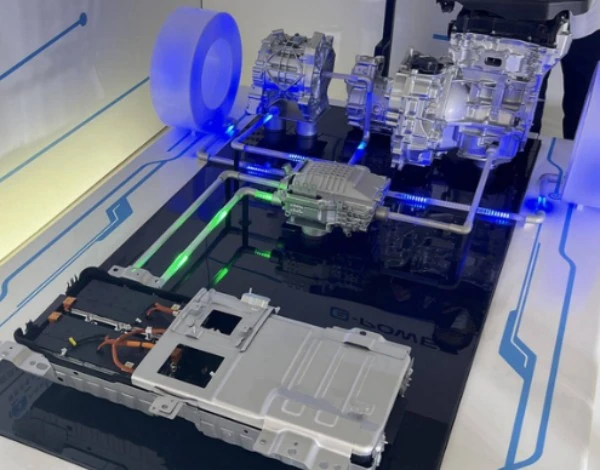
A complete battery storage system for renewable energy extends well beyond the battery cells themselves. The system consists of multiple integrated components working together.
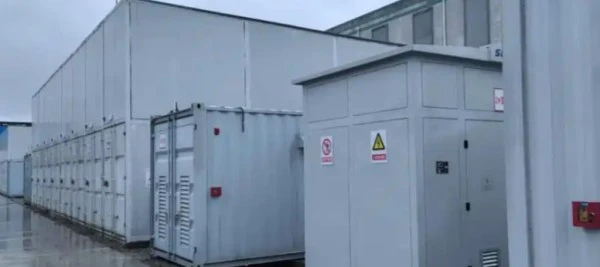
Battery modules stack individual cells into larger assemblies, housed in weatherproof enclosures designed for outdoor installation. These enclosures may take the form of shipping containers, purpose-built structures, or outdoor-rated cabinets, strategically placed along transmission lines where they can efficiently store and dispatch energy.
The battery management system (BMS) serves as the installation's intelligence center. It continuously monitors voltage, current, and temperature across all cells, protecting against overcharging, over-discharging, and overheating while optimizing performance and lifespan. The BMS also performs cell balancing, ensuring all cells within the pack maintain similar charge levels to prevent premature degradation.
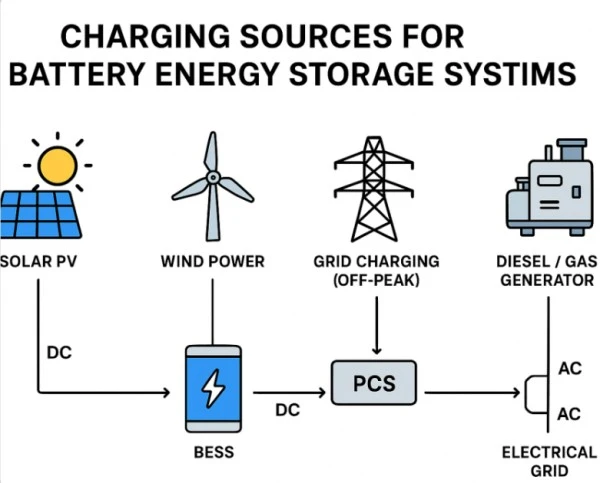
Power conversion systems (PCS) handle the transformation between AC grid power and DC battery storage. During charging, the PCS converts incoming AC electricity to DC for storage. During discharge, it inverts the battery's DC output back to AC at the correct voltage and frequency for grid connection. This bidirectional functionality enables energy to flow seamlessly between the storage system and the grid.
Thermal management systems maintain batteries within optimal temperature ranges, typically 30-35°C for peak performance. These may include liquid cooling systems, air conditioning units, or heating elements for cold climates. Temperature control proves critical because battery chemistry becomes less efficient at temperature extremes and charging cold batteries can damage them permanently.
Energy management software coordinates the entire system, making real-time decisions about charging and discharging based on grid signals, energy prices, renewable generation forecasts, and contractual obligations. This software layer enables battery storage for renewable energy to provide multiple grid services simultaneously.
Grid Integration and Services
Battery storage systems connect to the power grid at various points, from utility-scale installations on transmission networks to smaller systems at distribution substations or behind customer meters. The connection method depends on whether the storage operates as a standalone facility or pairs with renewable generation.
Standalone battery systems charge from the general grid mix and respond to overall grid conditions. These independent systems provide grid-level services such as frequency regulation, voltage support, and reserve capacity for emergencies.
Co-located systems install alongside solar farms or wind plants, creating hybrid facilities that smooth renewable output. These configurations can be DC-coupled or AC-coupled. DC-coupled systems directly charge batteries with power from solar panels before it passes through an inverter, improving efficiency. AC-coupled systems prove easier to retrofit to existing renewable installations, though they incur additional conversion losses.
The services these systems provide extend beyond simple energy storage. Frequency regulation helps maintain the grid's standard 60 Hz frequency by instantly absorbing or releasing power to balance supply and demand. Voltage support stabilizes voltage levels across the network, preventing equipment damage. Peak shaving reduces strain during high-demand periods by discharging stored energy when grid load peaks.
Energy arbitrage represents another key application: batteries charge when electricity prices are low and discharge when prices spike, capturing the price differential. This economic signal helps balance supply and demand while reducing overall energy costs for the system operator.
Capacity firming makes intermittent renewables behave more like dispatchable power plants. When clouds pass over a solar farm or wind speeds drop, battery storage fills the generation gap, maintaining steady output. This capability increases the value of renewable installations and reduces curtailment-the practice of wasting excess renewable generation when the grid can't accept it.
Market Growth and Deployment Statistics
Battery storage for renewable energy has experienced explosive growth in recent years. U.S. utility-scale battery storage capacity exceeded 26 gigawatts (GW) by the end of 2024, representing a 66% increase from the previous year after operators added 10.4 GW of new capacity.
This acceleration shows no signs of slowing. Operators plan to add another 18.2 GW of battery storage to the U.S. grid in 2025, which would set a new annual record and bring total installed capacity to approximately 44 GW. These additions make battery storage the second-largest source of new generating capacity after solar, highlighting its central role in grid modernization.
Geographic concentration remains pronounced. California leads with 12.5 GW of installed battery storage capacity in 2024, while Texas follows with approximately 8 GW, together accounting for the majority of U.S. deployments. This concentration reflects these states' aggressive renewable energy mandates and grid challenges that storage helps solve.
Project economics have improved dramatically. The levelized cost of electricity for utility-scale battery storage fell from $155/MWh in 2023 to $104/MWh in 2024, a 33% decrease driven by manufacturing improvements and supply overcapacity. Over the past decade, battery storage costs have dropped by more than a factor of seven, approaching grid parity with conventional generation sources.
Globally, battery storage capacity likely surpassed pumped hydroelectric storage in 2024, marking a historic shift in energy storage technology. While pumped hydro has provided bulk storage for decades, batteries offer location flexibility, faster response times, and modular scalability that hydroelectric systems cannot match.
Technical Challenges and Solutions
Despite rapid progress, battery storage for renewable energy faces several technical obstacles. Temperature sensitivity affects both performance and safety. Extreme heat accelerates degradation, while freezing temperatures reduce capacity and can damage cells if charging occurs below 5°C. Thermal management systems address this challenge but add cost and complexity.
Cell degradation limits system lifespan. Lithium-ion batteries typically complete 2,000 to 5,000 charge-discharge cycles before capacity drops to 80% of original levels, depending on chemistry and operating conditions. Calendar aging-degradation that occurs even without cycling-further reduces useful life. Operators must plan for eventual replacement, typically after 10-15 years of service.
Grid integration complexity arises from the need to provide multiple services simultaneously while meeting different technical requirements for each. Frequency regulation demands millisecond response times, while energy shifting requires hours of sustained output. Coordinating these functions through sophisticated control algorithms remains an active area of development.
Safety concerns center on thermal runaway-a cascading failure where one overheating cell triggers adjacent cells to overheat. Modern systems use lithium iron phosphate chemistry, which proves far safer than earlier formulations, and incorporate multiple protection layers including cell-level monitoring, physical separation, and automatic fire suppression.
Resource constraints may eventually limit growth. Lithium, nickel, and cobalt supplies must expand substantially to meet projected demand from both vehicles and stationary storage. Recycling programs and alternative chemistries using more abundant materials, such as sodium-ion batteries, aim to address these concerns before supply chains become constrained.

Frequently Asked Questions
How long can battery storage systems power the grid?
Most utility-scale battery installations provide 2-4 hours of discharge at maximum power output. A 240 megawatt-hour system rated at 60 megawatts can deliver full power for four hours, half power for eight hours, or lower power levels for extended periods. The duration depends on the ratio of energy capacity to power capacity, with longer-duration systems serving different market needs than shorter-duration ones.
What happens to batteries when they reach end of life?
Battery systems typically retire from grid service after 10-15 years when capacity drops to about 70-80% of original levels. These batteries often find second-life applications in less demanding roles before eventual recycling. Recycling processes recover lithium, cobalt, nickel, and other valuable materials, though recycling infrastructure continues developing to match the growing volume of retired batteries.
Can battery storage work without renewable energy?
Yes. Standalone battery systems charge from the entire grid mix, including fossil fuel generation, and provide valuable grid services regardless of generation source. However, pairing batteries with renewables creates greater environmental benefits by storing clean energy that might otherwise be curtailed and displacing fossil generation during high-demand periods.
How do battery storage costs compare to building new power plants?
Battery storage costs have declined to the point where they compete favorably with natural gas peaker plants for many applications. The specific comparison depends on how often the facility operates, with batteries proving more economical for facilities that run only occasionally. When combined with renewable generation, the paired system can provide firm capacity at costs competitive with conventional generation.
Most large-scale battery installations now use lithium iron phosphate chemistry rather than the nickel-based formulations common in electric vehicles. This shift reflects the different priorities between transportation and stationary storage-grid batteries optimize for safety, longevity, and cost per kilowatt-hour rather than weight and space efficiency. The technology continues evolving rapidly, with solid-state batteries, flow batteries, and other emerging technologies potentially reshaping the landscape in coming years.
Understanding battery storage mechanics helps explain why this technology has become indispensable for renewable energy integration. The ability to decouple generation timing from consumption timing fundamentally changes how electric grids operate, enabling higher percentages of variable renewables while maintaining reliability. As costs continue declining and technology improves, battery storage for renewable energy will play an increasingly central role in the transition to cleaner electricity systems.