


Liquid cooling is usually the stronger candidate for high-density, frequently cycled or thermally demanding battery energy storage systems because it moves heat through a controlled liquid loop close to the battery modules. Air cooling remains a practical choice when thermal loads are moderate and simpler equipment, familiar maintenance and lower initial complexity are more important.
The better system is not determined by cooling technology alone. A battery energy storage system should be evaluated against its actual duty cycle, ambient conditions, required temperature uniformity, footprint, maintenance capability, fault response and lifecycle economics.
A well-designed air-cooled BESS can outperform a poorly engineered liquid-cooled system. The useful comparison is therefore not "Which cooling method is better?" but "Which thermal architecture can keep this project within its required operating conditions with acceptable cost and service risk?"

Liquid Cooling vs Air Cooling in BESS
| Factor | Air-Cooled BESS | Liquid-Cooled BESS |
|---|---|---|
| Heat-transfer method | Conditioned air circulates around battery modules | Coolant removes heat through cold plates or thermal channels |
| Mechanical complexity | Generally lower | Generally higher |
| Temperature uniformity | Highly dependent on airflow distribution | Often easier to control in dense systems when the liquid loop is well balanced |
| Packing density | Requires space for airflow paths | Can support more compact battery layouts |
| High thermal loads | More difficult as heat flux and rack density increase | Usually better suited to demanding heat-removal conditions |
| Main auxiliary equipment | Fans, ducts, filters and HVAC | Pumps, piping, coolant, heat exchanger or chiller |
| Typical maintenance | Filters, fans, coils, ducts and HVAC | Coolant condition, pumps, seals, piping and chiller |
| Main fault concerns | Restricted airflow, fan failure, dirty filters and HVAC faults | Pump faults, leakage, pressure loss, blocked circuits and chiller faults |
| Typical fit | Moderate thermal load, adequate space, simpler service strategy | High density, frequent cycling, tight thermal control, constrained footprint |
This table is a starting point, not a specification rule. BESS capacity by itself does not determine the cooling method. A smaller system with aggressive cycling in extreme heat can impose a harder thermal problem than a larger system operating gently in a controlled environment.
Why Thermal Management Matters in a BESS
Lithium-ion cells generate heat during charging and discharging. The thermal load varies with current, cell resistance, state of charge, operating duration, chemistry and ambient conditions. If the thermal management system cannot remove heat at the required rate, battery temperature rises and the BMS or PCS may need to reduce charge or discharge power.
Temperature also affects ageing, performance and safety. A peer-reviewed review on temperature, ageing and thermal management of lithium-ion batteries describes elevated temperature as a major ageing accelerator and emphasizes the importance of maintaining a controlled and reasonably uniform thermal environment.
Average Temperature Is Not Enough
A cabinet can report an acceptable average temperature while some cells or modules operate consistently hotter than others. For project evaluation, ask for more than one enclosure temperature.
Useful thermal indicators include:
- maximum cell or module temperature;
- minimum cell or module temperature;
- cell-to-cell temperature difference;
- module-to-module temperature difference;
- temperature distribution during sustained charging and discharging;
- the point at which thermal derating begins.
Persistent thermal imbalance matters because the hottest part of a battery string may age differently from the rest of the system. Over time, that imbalance can become a performance and warranty concern even if the average enclosure temperature appears normal.
Cold-Climate Projects Need Heating Logic Too
Thermal management is not only a hot-weather problem. Low temperatures increase battery impedance and can make charging more difficult. Research reviewing lithium-ion battery operation in low-temperature environments highlights slow electrochemical kinetics, charging limitations and the need for appropriate heating and charging strategies.
For a cold-climate BESS, ask how the system brings cells into the manufacturer's permitted charging range before normal charging begins. Depending on the design, that may involve HVAC heating, dedicated heaters or a liquid thermal loop capable of both heating and cooling.
How Air Cooling Works in a BESS
Air-cooled BESS use moving conditioned air to carry heat away from battery modules. A typical architecture may include fans, internal airflow passages, ducts, filters, HVAC equipment, temperature sensors and control logic.
The simplified thermal path is:
Battery cell → module surface → circulating air → HVAC or heat exchanger → environment
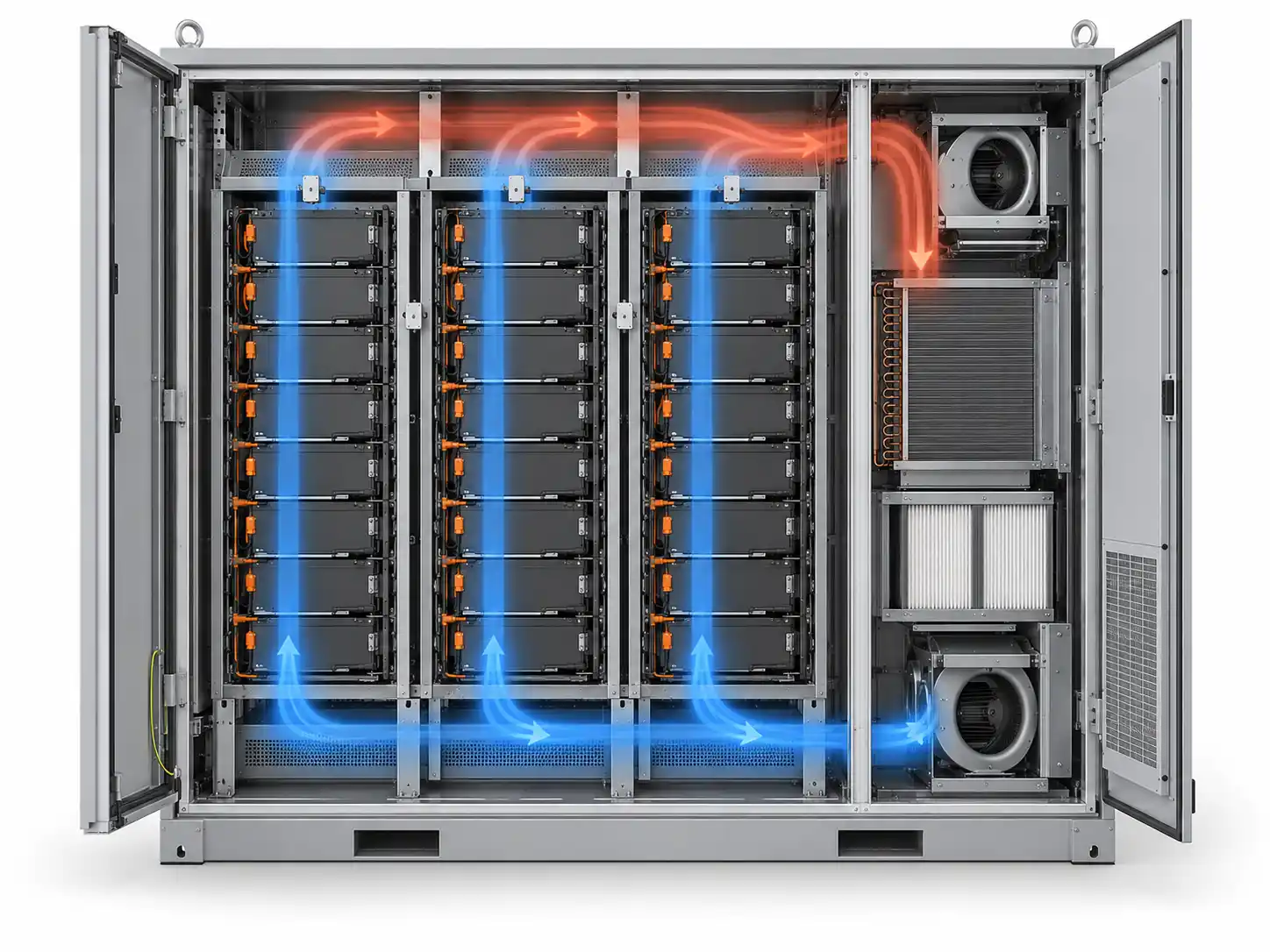
In many systems, the enclosure does not simply pull outside air across the batteries. Conditioned air can circulate inside a closed cabinet or container, so the cooling method should not be confused with the enclosure's ventilation or ingress-protection strategy.
Where Air Cooling Works Well
Air cooling is a strong candidate when the battery packing density is moderate, charge and discharge demands are not extreme, sufficient airflow space is available and local technicians are familiar with conventional HVAC and fan systems.
This can be particularly attractive for lighter-duty C&I systems, backup applications and projects where service simplicity matters more than maximizing energy per square meter. Polinovel's outdoor cabinet BESS range, for example, includes products using both air- and liquid-cooled thermal architectures for different C&I duty profiles.
Where Air Cooling Becomes More Difficult
The main engineering challenge is airflow distribution. As racks become denser, the system must still deliver enough conditioned air to every relevant battery surface and provide a clear return-air path.
Common failure or degradation mechanisms include:
- uneven airflow between racks or modules;
- blocked or poorly designed airflow paths;
- dirty filters and coils;
- fan degradation or failure;
- HVAC faults;
- insufficient heat rejection at high ambient temperature.
More nominal HVAC capacity does not automatically solve poor airflow distribution. Duct geometry, rack placement, recirculation zones and return-air design can be just as important as the cooling equipment rating.
How Liquid Cooling Works in a BESS
Most liquid-cooled BESS use indirect liquid cooling. The battery cells are not normally submerged in coolant. Heat moves through the cell or module structure into a cold plate or another thermal interface, and circulating coolant carries that heat to a heat exchanger or chiller.
The simplified thermal path is:
Battery cell → module or thermal interface → cold plate → coolant → heat exchanger or chiller → environment

A typical system can include cold plates, pumps, coolant, pipes or hoses, valves, heat exchangers, chillers, temperature and pressure sensors, leak detection and control logic.
Why Liquid Cooling Fits High-Density BESS
Liquid cooling places the heat-transfer medium closer to the battery module and does not require the same volume of internal airflow around every rack. This can make heat removal and packaging easier when the project has high energy density, frequent cycling or limited footprint.
That is why liquid cooling is increasingly attractive in utility-scale energy storage projects and other high-density installations. The benefit is not simply that "liquid is better than air"; it is that the thermal design has more flexibility when the heat load and packaging constraints become difficult.
Liquid Cooling Still Depends on Engineering Quality
A liquid-cooled label does not guarantee good temperature uniformity. Cold-plate geometry, coolant flow balance, thermal-interface quality, pump control and chiller performance still have to work together.
Potential failure modes include pump faults, coolant leakage, pressure loss, blocked flow paths, valve faults, chiller faults, sensor problems and degraded coolant condition. Buyers should therefore understand the coolant specification, service interval, leak-detection strategy and system response to pump or chiller failure.
For a concrete same-platform comparison, Polinovel's 261 kWh all-in-one C&I BESS cabinet is offered with air- and liquid-cooled variants. That type of like-for-like comparison is more useful than comparing two completely different products and attributing every performance difference to cooling technology.
Air Cooling vs Liquid Cooling: What Changes at Project Level?
1. Temperature Control and Uniformity
Air cooling depends heavily on airflow geometry. Liquid cooling uses defined coolant circuits and can make thermal distribution easier to control in compact systems, but only when the cold-plate network and flow balance are properly engineered.
Ask suppliers for system-level thermal validation. A useful report should state ambient temperature, battery power, operating duration, state of charge, maximum temperature and temperature spread. A cooling-method label alone is not validation.
2. Energy Density and Footprint
Air-cooled battery racks need space for supply and return airflow. Liquid cooling can reduce some of that internal airflow requirement and support denser packaging.
Do not compare cooling technologies in isolation. Cell format, rack architecture, fire separation, PCS arrangement and enclosure dimensions also affect the final energy density. Compare actual system-level kWh per cabinet, container or usable site area.
For high-capacity projects, review complete containerized BESS configurations rather than assuming that every container uses the same thermal architecture.
3. Auxiliary Power
Both cooling systems consume energy. Air cooling uses fans and HVAC equipment. Liquid cooling uses pumps and may also require chillers, heat exchangers and fans.
Generic claims that one technology always has lower auxiliary consumption are not useful. Ask for auxiliary power under defined conditions such as standby, rated charge or discharge, normal ambient temperature and high ambient temperature.
4. Maintenance
Air cooling and liquid cooling require different maintenance rather than "maintenance" versus "no maintenance."
- Air cooling: inspect filters, fans, ducts, coils, refrigerant systems and condensate handling.
- Liquid cooling: inspect coolant condition, pumps, hoses, fittings, seals, pressure, leak sensors and heat exchangers or chillers.
The better architecture partly depends on the maintenance capability available at the project site. A technically strong design can become an operational liability if replacement parts, coolant service or trained technicians are difficult to obtain.
5. Noise
High-airflow systems can generate substantial fan noise. Liquid cooling can reduce the airflow required directly around battery modules, but pumps, chillers and external fans still generate sound.
For sites near offices, residences or other noise-sensitive areas, compare the supplier's measured dB(A) value at a stated distance and operating condition. Do not assume that either cooling technology is silent.
6. Hot, Cold, Dusty and Coastal Environments
Very hot sites increase the burden on heat rejection. Cold sites need controlled battery heating and low-temperature charging logic. Dust and salt exposure introduce additional concerns for filters, coils, heat exchangers, sealing and corrosion protection.
Cooling method and enclosure protection should be evaluated together. An air-cooled BESS is not automatically an open enclosure, and a liquid-cooled system does not automatically have a higher IP rating.
For cabinet-level considerations, the site's outdoor BESS thermal management design should be reviewed together with ambient temperature, humidity, dust, corrosion exposure and service access.
7. Safety and Fault Response
Cooling is one layer of BESS safety, not the complete safety system. Keeping batteries within intended operating conditions can reduce thermal stress, but cooling cannot guarantee that an internal cell failure or thermal runaway will never occur.
System-level safety also involves the BMS, electrical protection, isolation devices, gas and temperature detection, emergency shutdown logic, enclosure design, fire detection, suppression and propagation mitigation. Sandia National Laboratories' energy storage safety and reliability program specifically addresses abuse testing, degradation, thermal runaway and multi-scale system behavior.
For projects where thermal-runaway propagation testing is relevant, UL 9540A provides a standardized test method for evaluating thermal runaway fire propagation in battery energy storage systems. Cooling performance and fire-safety validation should therefore be treated as related but separate parts of due diligence.
Cooling System Selection Matrix
| Project Condition | Air Cooling Becomes More Attractive When | Liquid Cooling Becomes More Attractive When |
|---|---|---|
| Duty cycle | Backup or lighter cycling dominates | Daily or frequent high-power cycling dominates |
| Thermal load | Moderate heat generation can be removed with practical airflow | Heat load is high or sustained for long operating periods |
| Footprint | There is enough room for airflow and less aggressive packaging | Energy density and compact layout are project priorities |
| Ambient conditions | Mild or controlled environment reduces HVAC burden | Hot conditions or demanding operating profiles require tighter thermal control |
| Service strategy | Local teams are strongest in conventional fan and HVAC maintenance | Coolant-loop, pump and chiller maintenance can be supported reliably |
| Temperature uniformity | The required temperature spread can be met with validated airflow design | Dense packaging makes uniform airflow difficult and tighter control is required |
| Initial complexity | Simpler mechanical architecture is a major project objective | Additional mechanical complexity is justified by thermal or footprint benefits |
This matrix is intentionally qualitative. There is no universal kWh or MWh threshold at which every BESS must switch from air cooling to liquid cooling. The decision becomes meaningful only after the project's operating conditions are defined.

Which Cooling System Fits Different BESS Applications?
Small or Lightly Cycled Systems
Air cooling is often appropriate where thermal loads are moderate, cycling is limited, installation conditions are controlled and adequate airflow space is available. In these cases, liquid cooling may add components and maintenance requirements without creating enough project value.
Commercial and Industrial BESS
C&I systems need a more detailed assessment because the same nominal capacity can serve very different duty profiles. Backup, daily peak shaving, solar shifting, EV charging support and microgrid operation can produce very different thermal loads.
If the site is compact, cycles frequently or operates in hot conditions, liquid cooling becomes more attractive. If the duty is moderate and service simplicity is important, air cooling can remain a strong option.
Utility-Scale and High-Density BESS
As energy density and cycling intensity rise, liquid cooling usually becomes a stronger candidate because heat removal, temperature uniformity and footprint carry greater operational and financial consequences.
For example, Polinovel's 4.6 MWh containerized BESS uses a liquid-cooled thermal architecture for a high-capacity grid-scale configuration. That does not create a universal capacity threshold; it illustrates how dense utility-scale designs often justify the added liquid-loop complexity.
Harsh-Climate Projects
Desert, tropical, coastal and cold-climate projects require site-specific thermal engineering. Ask suppliers to show expected performance at the actual ambient extremes, not only the published operating-temperature range.
The thermal derating curve is especially important. A BESS may technically remain within its allowable operating range while still reducing available charge or discharge power at certain temperatures.
Common Misconceptions About BESS Cooling
"Liquid Cooling Is Always Better"
No. Liquid cooling provides valuable thermal and packaging advantages when a project needs them. For a lightly cycled system in a controlled environment, a well-engineered air-cooled design may be more practical.
"Air Cooling Always Uses Outside Air"
No. Many systems circulate conditioned air inside a closed enclosure. Cooling method and ventilation strategy are separate design decisions.
"Liquid Cooling Eliminates Thermal Runaway Risk"
No cooling technology can guarantee that a cell will never fail. Thermal management helps keep batteries within intended operating conditions, while thermal-runaway protection depends on the broader system safety architecture and validated propagation-mitigation strategy.
"System Capacity Determines the Cooling Method"
Capacity matters, but thermal load is driven by more than kWh or MWh. Power, C-rate, cycling frequency, duration, ambient conditions, battery resistance, layout and control strategy all influence the cooling requirement.
Final Verdict: Liquid Cooling or Air Cooling?
For high-density, frequently cycled C&I and utility-scale BESS, liquid cooling is often the stronger starting point because it provides more flexibility for heat removal, temperature control and compact battery packaging.
Air cooling remains a strong solution where thermal loads are moderate and simpler mechanical architecture, familiar service procedures and lower initial complexity matter more than maximizing thermal performance or packing density.
The final decision should be based on validated system behavior under the project's real operating conditions. Compare maximum temperature, temperature uniformity, derating, auxiliary consumption, maintenance, fault response, footprint and lifecycle cost before comparing cooling labels.
Before requesting a final BESS configuration, prepare the site's temperature range, required power and energy, expected cycling profile, installation environment, footprint limits, noise constraints and maintenance expectations. If those inputs are available, the supplier can design the thermal architecture around the project rather than forcing the project to fit a generic cooling system.
For project-specific system selection, provide those operating conditions through the BESS project inquiry so the cooling method can be evaluated together with the battery, PCS, enclosure and application requirements.