


Industrial BESS export control is not verified simply by entering a zero-export or limited-export setpoint. Before handover, an EPC needs evidence that the agreed grid-connection meter captures net site power, the control system responds to sudden load reductions, and metering or communication failures produce the approved fallback behavior. Factory acceptance testing (FAT) checks control logic under simulated conditions; site acceptance testing (SAT) checks the installed measurement and control chain against the project's connection requirements.
The tests should also establish who supplies the meter, who configures the site controller, which equipment can be curtailed, and what records demonstrate acceptance. These details are especially important where an industrial site operates battery storage alongside solar PV, variable production loads, or other behind-the-meter generation.
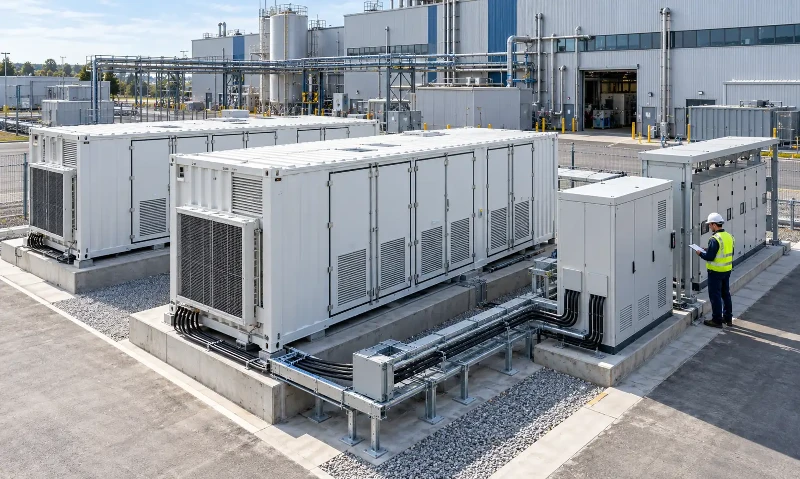
What Must EPCs Verify Before Accepting an Export-Control System?
Export-limitation acceptance begins with the approved connection requirements and the electrical single-line diagram, not a generic response-time target. A project's zero-export requirement, maximum permitted export, measurement location, transient allowances and failure response must be identified before the test procedure is approved.
- Connection boundary: Identify the point at which permitted export is assessed and every load or generator connected behind it.
- Measurement: Verify meter placement, CT and voltage sensing connections, phase mapping, power direction, scaling and data validity.
- Control authority: Confirm which controller can reduce battery discharge, increase charging where available, or curtail other generation where included in the project scope.
- Dynamic response: Record net power when site demand or local generation changes, then compare the event with the project's agreed criteria.
- Failure response: Verify what the installed system does when measurement, communications, controller power or device commands become unavailable.
- Handover: Retain approved settings, FAT and SAT records, event logs, deviations and sign-off responsibilities.
An export-limited site may still have a high-rated battery inverter. The export ceiling applies to the agreed grid connection, while equipment ratings describe the capability of individual devices. The two values are not interchangeable. The commercial reason for choosing such a connection arrangement is explained in National Grid Electricity Distribution's export-limitation guidance, which describes controlling net export where a larger connection could otherwise require network reinforcement.

Where Should Net Export Power Be Measured?
A meter on the battery feeder reports battery activity; it does not necessarily show how much power the entire industrial site imports from or exports to the grid. If the plant also has PV generation or changing production loads, the export-control measurement must represent the relevant agreed connection boundary. The electrical designer should confirm whether that point is described as the point of connection or point of common coupling (PCC) in the project's documentation.
For example, a storage inverter may be discharging while the factory still imports electricity because site demand exceeds local generation. Measuring only inverter output could therefore cause the controller to curtail the wrong amount of power. Similarly, an additional PV feeder that is outside the selected meter boundary could cause the controller to underestimate total site export. Projects with different AC- and DC-coupled storage arrangements still need a clearly defined grid-side measurement and an accurate account of the sources affecting it.
Check the CTs, meter configuration and signal quality
Current-transformer polarity, phase-to-voltage mapping and configured ratios affect the controller's calculation of active power and its direction. An inverted sign or incorrect scaling factor can make exported power appear as imported power. The commissioning plan should therefore identify the measurement verification method, applicable electrical safety controls and the evidence to retain. Verification should be carried out by qualified personnel under an approved procedure, rather than by changing live measurement wiring to provoke a response.
The controller also needs trustworthy data. A normal-looking value that has stopped updating is not the same as a valid, current measurement. The interface specification should describe the meter model, update characteristics, timestamp or freshness checks, communications arrangement and how the system treats invalid measurements. Fiber, copper Ethernet, serial interfaces or other methods may be used where appropriate; the project should verify the chosen combination rather than assume that one medium guarantees an acceptable response.
| Verification Item | Project Information Needed | Acceptance Evidence |
|---|---|---|
| Agreed connection boundary | Approved export limit and single-line diagram | Reviewed drawing identifying the relevant meter and connected feeders |
| Meter power direction | Import/export sign convention and phase assignment | Documented polarity and phase verification |
| CT and voltage scaling | Installed CT/VT ratios and meter configuration | Configuration record and suitable independent verification |
| Measurement update and validity | Data interface, update characteristics and stale-data detection | Interface record and validation test result |
| Parallel generation and site loads | PV, BESS, other generators and major loads within the boundary | As-built feeder review and control-scope confirmation |
| Controller output interface | Supported setpoints, status feedback and loss-of-command behavior | Point list and integrated interface verification |
Battery auxiliaries such as cooling systems also affect measured grid exchange. They should be included consistently in the power balance, with the controller's assumptions checked against the installed electrical arrangement. There is no universal requirement to subtract a fixed auxiliary-load allowance from every inverter setpoint.
Why Can a Sudden Industrial Load Drop Cause Inadvertent Export?
Industrial demand can fall quickly when a compressor, production line or large process load shuts down. Battery discharge and solar output do not necessarily change at the same instant. Until the export-control system detects the new demand and adjusts the participating devices, the site may briefly send unintended power into the network.
Consider an illustrative site using 600 kW with the BESS discharging at 400 kW and the remaining 200 kW imported from the grid. If the industrial load falls to 200 kW before battery output changes, the site could temporarily export approximately 200 kW, ignoring losses and other generation. These figures illustrate the power balance only; they are not commissioning limits or test results.
This phenomenon is known as inadvertent export. The BATRIES interconnection research on inadvertent export examines how load reductions and non-instantaneous control responses can produce temporary injections into the grid. It also discusses why their significance and treatment depend on network conditions and applicable requirements.

Measure the event, not just the final setpoint
A system might return to the agreed export value after a disturbance while still exhibiting a transient that needs review. Conversely, a brief excursion cannot automatically be called a failure without checking the agreed test criteria. EPCs should distinguish among the peak measured net export, the duration of any excursion, the control response and the point at which the system returns to the required operating range.
The acceptance record should show aligned timestamps for site net power, battery active power, available generation, relevant load or disturbance signals, controller commands and device feedback. The logging rate and measurement accuracy must be sufficient for the expected events and the approved test method; a fixed 20 ms sampling interval is not a universal requirement. Ordinary long-interval energy reports may be useful for operations but may not resolve a short load-step event.
Response also depends on the power conversion system's operating characteristics, including its ability to follow an active-power command under the current voltage, temperature and other equipment limits. A controller that issues a correct setpoint cannot, by itself, demonstrate that the installed device reached that setpoint.
How Should EMS and PCS Respond to Export Limits?
The energy management system (EMS) or other site controller uses the net export measurement to calculate permissible output and send commands to the equipment it controls. The battery's power conversion system (PCS) converts electrical power and responds within its supported control functions and operating limits. In US equipment and interconnection documents, however, Power Control System is also abbreviated PCS; that term describes a control function and should not be confused with the battery inverter itself.
Where the project includes solar PV, the system may need to coordinate battery charging and generation curtailment. A battery at a high state of charge may have limited ability to absorb surplus PV, and battery management system (BMS) temperature or protection limits can reduce the permitted charging rate. The control design must state which generator or storage device can be adjusted, who owns that interface and which fallback action applies if the intended control is unavailable.
There is no universal rule that every installation must first serve the load, then charge the battery, then curtail PV. The required command priorities belong in the approved site control narrative. An EPC should check that the energy management and equipment interfaces used by the project can execute that narrative without making unsupported assumptions about charge headroom or external PV access.
What if the PCS cannot follow a curtailment command?
The acceptance procedure should address more than successful command transmission. It should establish how the site controller identifies an unavailable, rejected or ineffective command; how that condition is reported; and what approved alternative response is available. A status bit showing that a setpoint was received is not necessarily proof that export at the agreed connection point has fallen within the permitted range.
For multiple devices, the site integrator should also identify how power limits are shared and whether a failed or constrained unit can cause the remaining system to exceed the export ceiling. These interactions are integration responsibilities unless the contract expressly includes them in the BESS manufacturer's supplied controls.
What Happens When Export-Control Metering or Communications Fail?
An export-limitation scheme cannot rely indefinitely on the last valid meter value. A failed meter, frozen measurement, controller restart, lost network link or missing device feedback can leave the controller unaware of current site conditions. A fault that occurs at the same time as a load reduction may be especially difficult for an open-loop command sequence to handle.
The approved control design should define how invalid measurements are detected, the system's permitted response, the devices affected, and the conditions for resuming normal operation. Possible responses, depending on the approved scheme and available hardware, may include limiting battery discharge, placing equipment in standby, curtailing other generation or operating a separate protective function. These options should not be presented as interchangeable or assumed to exist on every product.
Verify failure detection and recovery separately
A loss-of-data test should demonstrate what happens when values stop updating as well as when a communication path is unavailable. The record should identify the event, alarm, measured power, control command, device response and final state. Fault detection time, active-power reduction time and recovery time are distinct quantities; none has a single universal value for all industrial BESS installations.
Recovery needs its own acceptance conditions. Restoring a communication link does not establish that all device states, setpoints and limits are valid. Before lifting a fallback restriction, the site should verify the conditions specified in the approved control narrative. A blanket two-second timeout or 30–60 second restart delay cannot substitute for project-specific engineering and validated settings.

What Should Factory Acceptance Testing Verify?
FAT confirms the supplied control functions before shipment or site commissioning. Simulated meter values, load disturbances, BMS restrictions, equipment statuses and communication faults can be used to check the control narrative and the system's recorded behavior. The test setup must document which interfaces and devices are real and which are simulated.
For an industrial export-limited project, useful factory checks include correct import/export sign handling, valid and invalid measurements, setpoint calculation after an abrupt change in demand, rejection of unsupported commands, and the specified fallback behavior. If PV curtailment is included in the manufacturer's contracted supply, its interface and simulated response should also be verified. If PV or the site EMS is supplied by another company, the FAT should identify the remaining integration tests rather than claim full-site verification.
The FAT report should retain the software and firmware versions, control configuration, simulated inputs, expected results, observed outputs, unresolved deviations and approval signatures. The wider battery storage procurement process should identify this evidence and the associated responsibility split before the equipment is ordered.
What Should Site Acceptance Testing Verify?
SAT establishes whether the installed equipment and controls behave as intended at the actual industrial site. It covers as-built meter placement, CT/VT wiring and scaling, controller interfaces, device feedback, actual site power flow, fault indications and response under approved test conditions. It does not become complete merely because the FAT passed.
The EPC and site operator should agree a safe, authorized test method with the applicable parties before conducting disturbance or failure-response tests. Deliberately disconnecting meter wiring during discharge, forcing unauthorized grid export or abruptly stopping critical production loads is not an acceptable generic instruction. Where a field disturbance cannot be safely produced, the test plan should record an approved alternative and any limitations on the resulting evidence.
| Verification Area | FAT Evidence | SAT Evidence | Typical Lead, Subject to Contract |
|---|---|---|---|
| Export-limit calculation | Simulated net-power inputs, setpoints and expected outputs | Installed controller configuration and measured response | Control supplier / system integrator |
| Meter polarity and scaling | Interface assumptions and parameter list | Qualified electrical verification and as-built records | EPC / electrical contractor |
| Sudden reduction in site demand | Simulated load-change sequence and controller trend | Authorized disturbance test or approved equivalent, with synchronized records | EPC / control integrator |
| Battery charging unavailable | Simulated BMS charge limit and resulting control decision | Configuration-dependent verification of applicable operating states | BESS supplier / integrator |
| Meter or communication fault | Simulated loss, stale data and fault indication | Approved failure-mode test with observed power and device state | Control supplier / EPC |
| Recovery to normal control | Simulated recovery and permissive checks | Recorded restoration under the agreed commissioning procedure | System integrator / EPC |
| Final sign-off | Factory deviations and approved configuration | As-built settings, test records and closed exceptions | EPC / owner |
The term zero-export commissioning should not be taken to mean that every instantaneous reverse-power excursion is prohibited under every network arrangement. The acceptance criteria must distinguish the approved steady export limit, any permitted transient behavior, and the action required when the system loses control capability.
What Evidence Should EPCs Collect Before Handover?
FAT and SAT results should connect the approved export-control requirements to what was actually installed and tested. A useful evidence package identifies the approved connection boundary and settings, the equipment versions and measurement assumptions, each relevant test condition and the recorded outcome. Where a limitation remains, it should be entered in the exception register rather than hidden behind a general statement that the system passed.
For an export-limited containerized battery energy storage installation, the battery supplier may provide inverter interface information, operating constraints, fault responses and equipment-specific FAT records. The EPC or site integrator may be responsible for the grid-side meter, wider PV controls, site communications and overall SAT. The handover matrix must match the actual supply contract.
| Acceptance Evidence | What It Should Show | Review Owner |
|---|---|---|
| Approved connection requirements | Export limit, measurement boundary, applicable tolerance or transient criteria and required failure response | Owner / EPC |
| Single-line diagram and metering schedule | As-built connection point, parallel generators, CT/VT locations and device identifiers | EPC / electrical designer |
| Meter verification record | Power direction, phase assignment, scaling, validity and interface configuration | Electrical contractor / integrator |
| Control narrative and settings | Setpoint priorities, active equipment, interlocks, fault handling and approved limits | Control integrator |
| Load-change response record | Time-aligned net power, disturbance, commands and equipment feedback | EPC / integrator |
| Failure and recovery record | Observed alarms, fallback state, power response and return-to-service conditions | Control integrator / EPC |
| FAT and SAT reports | Test procedure, versions, pass criteria, observations, deviations and approvals | Supplier / EPC |
| Outstanding exceptions | Open issues, accepted limitations, corrective actions and final disposition | Owner / EPC |
Choose the measurement and logging method with the event in mind. A synchronized transient record should be fast and accurate enough to establish the required response, but the article's test procedure should not invent a universal sampling frequency, measurement tolerance or power-reduction deadline. Those quantities belong to the applicable rules, the approved project specification and the instruments being used.
Which Export-Limitation Rules Apply to the Project?
The technical acceptance method must follow the rules governing the actual connection. In Great Britain, the Energy Networks Association's Engineering Recommendation G100 Issue 2 Amendment 2 addresses customers' export and import limitation schemes. The relevant network operator can impose specific connection and commissioning requirements. For example, National Grid Electricity Distribution's published requirements specify reduction of exported active power to the permitted maximum within five seconds for applicable export-limited connections, including specified fail-safe conditions. This is a particular operator requirement, not a worldwide BESS performance standard.
In California, the California Public Utilities Commission's Rule 21 describes interconnection, operating and metering requirements for facilities within its jurisdiction, including non-export arrangements. The California Energy Commission's equipment lists also contain information about certain Power Control System functionalities and listed configurations. Those lists are not, by themselves, a project SAT procedure or a substitute for the applicable utility's requirements. BATRIES publications inform discussion of inadvertent export but are not an automatically binding acceptance code.
For an international EPC project, the required evidence may therefore differ by country, utility, agreed connection arrangement and equipment scope. The contract should identify the applicable documents and their revisions rather than treating UK G100 declarations, US equipment listings and interconnection research as equivalent certificates.
Confirm the Control Scope Before the BESS RFQ Is Finalized
The most useful time to settle export-control responsibilities is before purchase orders and integration drawings are finalized. For commercial and industrial battery storage projects, buyers should share the site single-line diagram, agreed export limit, PV and load configuration, intended metering scheme, controller ownership, interface requirements and proposed acceptance criteria.
For a project considering Polinovel battery storage equipment, these inputs provide a basis for reviewing the relevant battery and inverter configuration, available equipment data, interface scope and required supplier documentation. Site-wide export-limit compliance remains dependent on the approved control design, the full installation and the responsibilities assigned to each party. No particular Polinovel response time, export-control certification or site-level capability should be assumed without confirmation for the proposed configuration.