

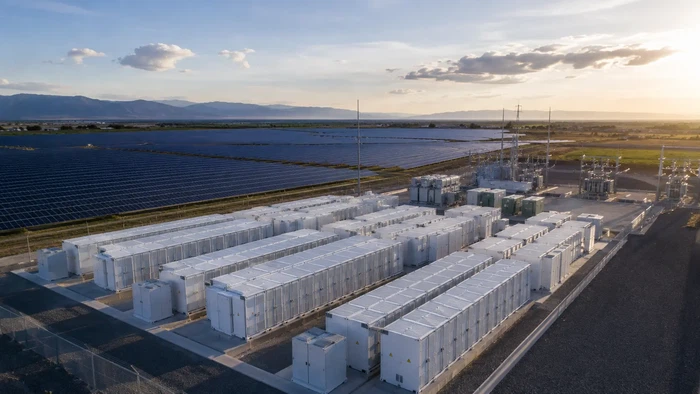
- Largest overall solar-plus-storage project: Edwards & Sanborn in Kern County, California - approximately 3,287 MWh of battery storage paired with 875 MW of solar.
- One of the world's largest solar-powered batteries: the FPL Manatee Energy Storage Center in Florida - 409 MW / 900 MWh, charged directly by an adjacent 74.5 MW solar plant.
- Largest practical commercial & industrial blocks: containerized BESS units of 4–6 MWh per 20-ft container, modular up to 100+ MWh per site.
- Largest residential stack on the market: FranklinWH aPower 2, up to 90 kWh (rarely deployed at full size). A typical home range is 20–60 kWh.
Why "largest" needs a tier
Asking for the largest solar battery is a bit like asking for the largest vehicle. The answer changes completely depending on whether you mean a delivery van, a cargo ship, or a personal car. Solar storage works the same way. A 3,287 MWh utility-scale facility cannot help a homeowner ride out a blackout, and even the largest residential stack would not register on a grid operator's dispatch screen.
To make the comparison useful, this guide breaks the market into four tiers - utility-scale, commercial & industrial (C&I), residential, and portable - and identifies the current capacity leader in each. Most of this article focuses on the utility-scale and C&I categories, because that is where the largest, fastest-growing systems live and where most operators face real selection decisions.
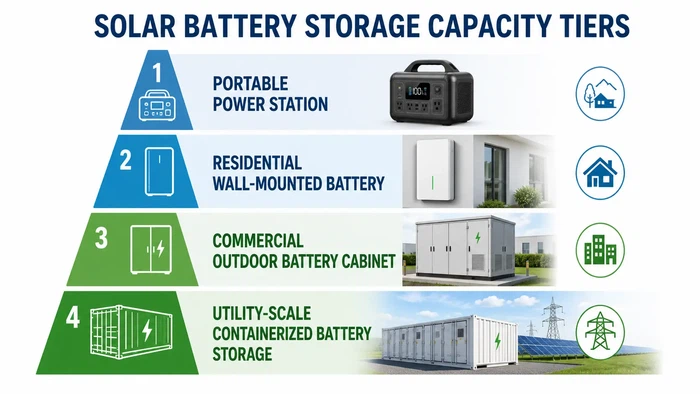
Comparison: top large-scale solar-plus-storage projects
| Project | Location | Battery Capacity | Solar Paired | Known For |
|---|---|---|---|---|
| Edwards & Sanborn | Kern County, CA | ~3,287 MWh | 875 MW | Largest co-located solar-plus-storage project in operation |
| Moss Landing (Phases 1–3) | Monterey County, CA | ~3,000 MWh planned | No (standalone) | Phased modular expansion model |
| FPL Manatee Energy Storage Center | Parrish, FL | 900 MWh / 409 MW | 74.5 MW adjacent | One of the world's largest solar-powered batteries |
| Gemini Solar + Storage | Clark County, NV | ~1,400 MWh | 690 MW | Large solar-paired project serving the Las Vegas region |
Tier 4: utility-scale solar battery storage
Edwards & Sanborn - the current capacity leader
The Edwards & Sanborn Solar and Energy Storage project, developed by Terra-Gen in California's Mojave Desert, remains the largest co-located solar-plus-storage facility in commercial operation. Headline numbers:
- Battery capacity: approximately 3,287 MWh (3.3 GWh)
- Solar generation: 875 MW across roughly 1.9 million panels
- Offtakers include California utilities, the city of San Jose, and several corporate purchasers
The facility shifts daytime solar generation into the evening peak - the hours when California's grid is most stressed and when wholesale prices climb sharply. Read more on how this kind of dispatch works in our overview of grid-scale battery storage.
FPL Manatee Energy Storage Center - a record-setting solar-paired battery
Florida Power & Light's Manatee Energy Storage Center sits next to the company's existing solar generating plant in Parrish, Florida. According to FPL's own project page, the site delivers 409 MW of dispatchable power and 900 MWh of energy - enough stored solar electricity to serve about 329,000 homes for more than two hours. It is widely cited as one of the world's largest solar-powered batteries, with 132 storage containers spread across roughly 40 acres.
Manatee is a useful reference point for two reasons. First, it is fully solar-charged, which means the project economics depend on time-of-day arbitrage rather than market trading alone. Second, its container-based architecture mirrors what is now standard in the C&I market: modular, repeatable building blocks rather than monolithic civil works.
Moss Landing - the modular expansion case study
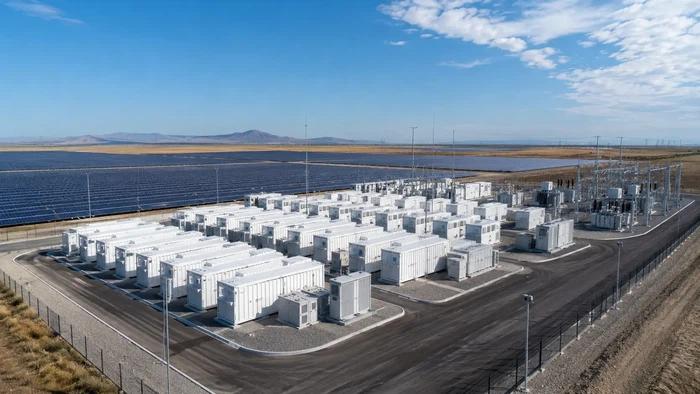
California's Moss Landing Energy Storage Facility started at 300 MW / 1,200 MWh in 2020 and grew in phases. It also became a reference point for safety. Thermal incidents in 2021 and a more serious fire at the Vistra-operated portion of the site in early 2025 prompted regulatory reviews and refits across the industry. The lesson is not that large batteries are unsafe, but that scale tightens the requirements for thermal management, fire suppression, and BMS architecture - choices that should be evaluated against UL 9540, UL 9540A, and NFPA 855 from day one.
How fast is utility-scale storage growing?
According to the U.S. Energy Information Administration, the United States added roughly 10.3 GW of battery storage in 2024, and the agency's Short-Term Energy Outlook has projected 18 GW or more of additions in 2025. By the end of this decade, cumulative U.S. battery storage capacity is expected to exceed 100 GW - a build-out that is reshaping how solar power gets dispatched.
Tier 3: commercial & industrial (C&I) storage
Between residential and utility lies the segment most operators actually buy: commercial and industrial storage. Systems here typically range from about 100 kWh to 10 MWh per site and serve factories, logistics hubs, data centers, hospitals, and community microgrids.
Containerized BESS - the workhorse of the C&I market
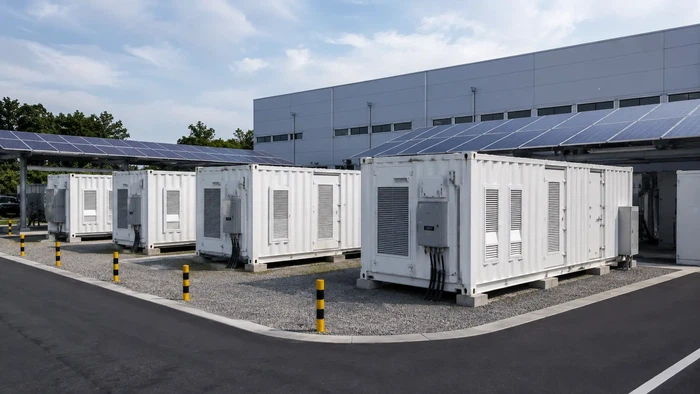
The dominant form factor for sites above ~500 kWh is the containerized system. A modern 20-ft container now packs 4–6 MWh of LFP cells, integrated thermal management, and a power conversion system in a single deliverable unit. Larger sites combine multiple containers to reach tens of MWh. This modular approach is what makes utility-scale projects like Manatee possible, and it scales cleanly down to manufacturing campuses and large data centers. See the containerized BESS product range for current configurations.
Outdoor cabinet BESS - the 100–500 kWh sweet spot
For mid-size commercial buildings - warehouses, retail centers, EV charging hubs, multi-family residential - a container is overkill. The practical sweet spot is 100–500 kWh delivered in an outdoor cabinet, often combining batteries, inverter, and HVAC in one all-in-one enclosure. At this size the system can:
- Reduce demand charges, which often account for 30–50% of a commercial electric bill
- Store midday solar production for evening use
- Provide 2–6 hours of backup to critical loads during outages
- Participate in utility demand-response programs where available
The C&I economic case
Installed costs at C&I scale generally fall between $250 and $450 per kWh, depending on system size, chemistry, balance-of-plant scope, and site complexity. For a facility paying $50,000+ per year in demand charges, a well-sized 300–500 kWh system can produce a payback in roughly 5–8 years - substantially better than residential economics, before any incentives or tax credits are layered on. The U.S. Department of Energy publishes useful reference data on storage cost curves and grid-services value at the DOE Solar Energy Technologies Office.
Tier 2: residential storage in brief
For homeowners, the practical maximum is bounded less by what the market sells and more by what your panel, your local code, and your budget will accept. The current capacity leaders on paper are:
- FranklinWH aPower 2 - 15 kWh per unit, up to 6 units stacked (90 kWh maximum)
- Tesla Powerwall 3 - 13.5 kWh per unit, up to 4 units stacked (54 kWh maximum), 11.5 kW continuous output
- SolaX T-BAT H - 17.5 kWh in a single module
- Villara VillaGrid - 16.6 kWh per unit, lithium titanate chemistry, 20-year warranty
In practice, single-family installations rarely exceed 40–60 kWh. Beyond that point the project usually runs into panel-capacity limits (most U.S. homes have a 200 A service), fire-separation codes, or simple cost: at $900–$1,400 per kWh installed, an 80 kWh stack approaches $100,000 before incentives. The 30% federal Investment Tax Credit helps materially, but the math becomes interesting mainly for homes with frequent multi-hour outages or large time-of-use rate spreads.
Tier 1: portable power
At the bottom of the pyramid sit portable power stations. The category leader for expandable capacity, the EcoFlow DELTA Pro Ultra, reaches roughly 30 kWh with stacked extra batteries - but at that point the system is no longer truly portable. For genuinely portable units under 50 lb, energy density limits cap practical capacity at 2–3 kWh. Portable systems are best understood as supplements for camping, jobsite power, and short-duration phone/laptop backup - not a substitute for a fixed home or commercial battery.
Battery chemistry and usable capacity
Advertised capacity is not always usable capacity. A 15 kWh battery limited to 85% depth of discharge (DoD) only delivers about 12.75 kWh in practice. Chemistry sets both the usable range and the realistic cycle life.
LFP (lithium iron phosphate)
LFP has become the standard for both residential and most C&I deployments. It offers good thermal stability, 6,000+ cycles at 80% DoD, and lower material costs than nickel-based chemistries. Trade-offs include lower volumetric energy density and slightly weaker cold-weather performance. For a deeper look at why LFP is dominating new installations, see our explainer on lithium-ion batteries for solar storage.
NMC (nickel manganese cobalt)
NMC is more compact and performs better in cold weather, which is why several leading residential brands still specify it. It carries a higher cost per kWh and demands tighter thermal management, especially at large scale.
Emerging chemistries for utility scale
Sodium-ion, vanadium redox flow, and iron-air batteries are all reaching commercial deployment for specific niches - typically long-duration (8+ hours) grid applications where lithium-ion economics weaken. Research from the National Renewable Energy Laboratory and others suggests these chemistries will not displace lithium-ion in residential or C&I, but they will shape what utility-scale projects look like by 2030.
What "largest" really costs
Cost per kWh varies by more than 3× across tiers, mostly because installation overhead does not scale linearly:
- Utility-scale: roughly $250–$400 per kWh of installed battery capacity, before solar and grid interconnection costs
- C&I (100 kWh–10 MWh): roughly $300–$500 per kWh installed
- Residential: roughly $900–$1,400 per kWh installed, before tax credits
The gap is not really a markup - it reflects the fixed overhead of permitting, electrical interconnection, BMS commissioning, and installer labor that gets amortized over a much larger capacity at C&I and utility scale. It is also the main reason most homeowners get better value from a thoughtfully sized 20–30 kWh system than from a "maxed out" 60–90 kWh stack.
Choosing the right system size
For utility, C&I, and microgrid buyers, sizing comes down to four practical questions:
- What is the primary value driver? Demand-charge reduction, solar self-consumption, time-of-use arbitrage, backup power, and grid services each imply a different MW/MWh ratio.
- What duration do you need? A 2-hour battery and a 4-hour battery serve different markets. Most C&I projects size for 2–4 hours; some long-duration applications require 6+.
- What is the site's electrical and physical envelope? Available switchgear capacity, transformer headroom, and footprint often constrain the answer more than budget does.
- What chemistry, certification, and safety profile do you require? UL 9540A test data, NFPA 855 compliance, and fire-department approvals are increasingly non-negotiable for projects above 250 kWh.
FAQ
Q: What Is The Largest Solar Battery In The World Right Now?
A: As of May 2026, the Edwards & Sanborn facility in California is the largest co-located solar-plus-storage project in operation, with approximately 3,287 MWh of battery capacity paired with 875 MW of solar. Among batteries that are fully charged from a dedicated solar plant, the FPL Manatee Energy Storage Center (409 MW / 900 MWh) is widely cited as one of the largest in the world.
Q: What Is The Largest Residential Solar Battery Available?
A: The FranklinWH aPower 2 can be stacked to a nominal 90 kWh (six 15 kWh units), which is the largest commercially marketed residential stack. The Tesla Powerwall 3 reaches 54 kWh across four units. In practice, residential installations above 60 kWh are rare because of panel capacity, code, and cost constraints.
Q: How Large Of A Battery Do I Actually Need For My Home?
A: Most homes are well-served by 15–30 kWh of storage. Calculate your evening peak consumption (typically 5–10 PM) and multiply by the number of hours you want covered. A 20–25 kWh system usually provides 24–48 hours of essential-load backup for an average U.S. household or 60–80% solar self-consumption on a typical day.
Q: What's The Difference Between Battery Capacity (KWh) And Power (KW)?
A: Capacity (kWh) measures total energy stored - how long the battery can run. Power (kW) measures instantaneous output - what loads it can run at once. A 13.5 kWh battery with 5 kW output can deliver power for about 2.7 hours at full load, but it cannot start a central air conditioner. The same 13.5 kWh battery with 11.5 kW output can.
Q: Are Solar Batteries Worth The Investment In 2026?
A: The economics depend on the use case. For C&I operators with high demand charges, paybacks of 5–8 years are common. For homeowners, the case is strong when there are frequent outages, large time-of-use rate spreads ($0.30+ peak/off-peak), or net-metering caps. The 30% federal Investment Tax Credit improves the math across all categories.
Q: How Fast Is Utility-Scale Battery Storage Growing?
A: The U.S. added approximately 10.3 GW of battery storage in 2024, and EIA projections call for roughly 18 GW or more in 2025. Cumulative U.S. capacity is expected to exceed 100 GW before the end of the decade, with similar growth happening in China, Europe, and Australia.
Key takeaways
If you are a utility or independent power producer, the frontier is now in the 3–5 GWh range for co-located projects, with developers regularly proposing 4-hour duration as a baseline and longer-duration storage entering the conversation for high-renewable grids.
If you are a commercial or industrial operator, the largest residential products stacked together are almost never the right answer. Purpose-built containerized or cabinet-style C&I systems in the 100 kWh–10 MWh range provide better economics, simpler maintenance, and clearer safety certifications.
If you are a homeowner, the residential "largest" - around 90 kWh on paper - is rarely the residential "smartest." A thoughtfully sized 20–30 kWh system with strong software controls usually delivers more value per dollar than a maxed-out stack.
And if you are evaluating portable units, accept the physics: under 50 lb, you are looking at 2–3 kWh. That is genuinely useful for camping, tools, and short-duration phone backup - and not much else.