

The electricity grid was never designed to store energy. For over a century, power plants generated electricity and pushed it instantly through transmission lines to homes and businesses. Store it? That wasn't part of the plan.
Then solar panels and wind turbines arrived with a problem: they generate power when nature decides, not when humans need it. This mismatch created a $174 billion industry practically overnight-grid scale battery storage-that's fundamentally changing how electricity works.
But here's what most explanations miss: grid batteries aren't just giant versions of what's in your phone. They're orchestrated systems where chemistry, software, and economics intersect in ways that determine whether your state can actually run on clean energy or whether a utility makes money storing wind power at 2am.
This is how the entire system actually works-from lithium ions shuffling between electrodes to algorithms bidding power into markets milliseconds before demand spikes.
The Three-Layer Reality: How Grid Storage Actually Operates
Most articles treat grid batteries as black boxes that "charge and discharge." That's like saying airplanes "go up and come down." True, but useless if you want to understand what's happening.
Grid scale battery storage operates across three interconnected layers, each with its own physics, economics, and failure modes. Miss any layer, and you miss why a battery that works perfectly in a lab can lose money on the grid-or why California's 7.3 GW of storage still saw blackouts in 2020.
Layer 1: The Physical System (Chemistry and Hardware)
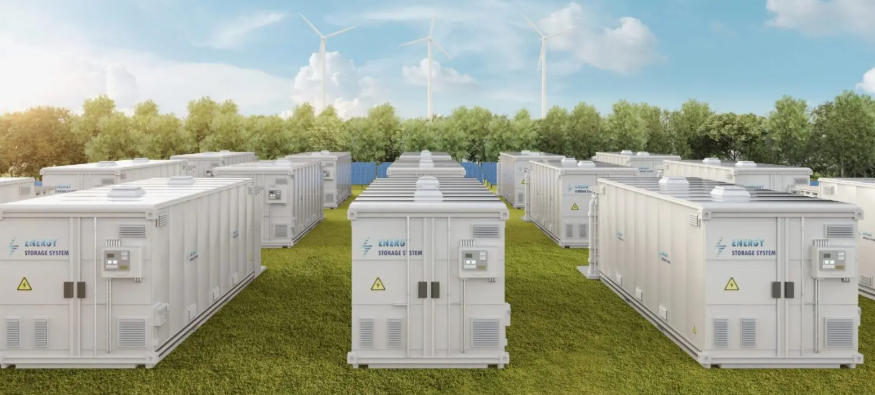
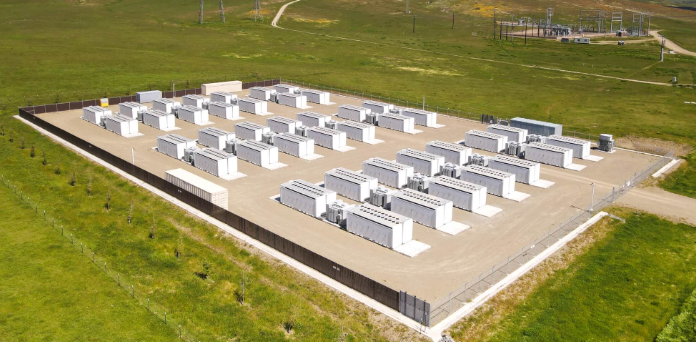
At the bottom sits the electrochemistry-the actual movement of ions that stores and releases energy. Lithium-ion batteries dominate here with 85% market share for a reason: energy density. A single shipping container can hold 3-4 MWh, enough to power 1,000 homes for an hour.
How the chemistry works: Inside each cell, lithium ions shuttle between two electrodes through a liquid electrolyte. During charging, ions migrate from the cathode (typically lithium iron phosphate or nickel manganese cobalt) to the graphite anode. During discharge, they flow back, releasing electrons that travel through an external circuit to become useful electricity.
The round-trip efficiency averages 85%-meaning for every 100 kWh you store, you get 85 kWh back. That missing 15% becomes heat, which is why thermal management systems pump coolant through battery racks 24/7. When that cooling fails, you get what happened in Arizona in 2019: a 2 MWh facility exploded, injuring eight firefighters.
Physical components in a grid battery system:
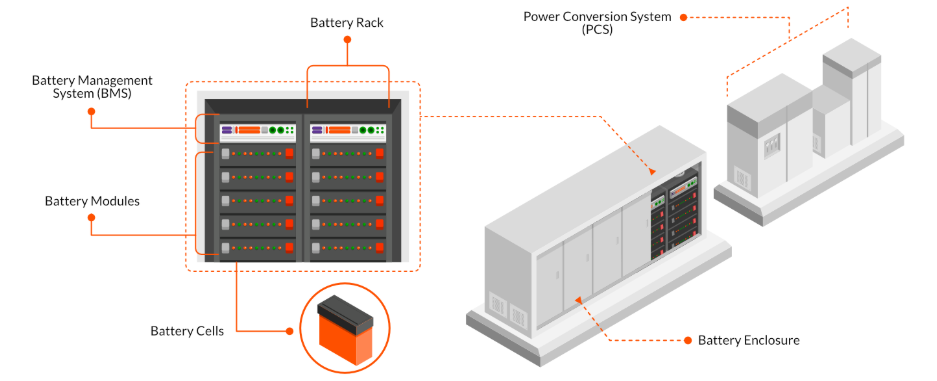
Battery modules: Hundreds or thousands of individual cells wired together. A 100 MW facility might contain 250,000 individual battery cells across multiple container-sized racks.
Battery Management System (BMS): Monitors every cell's voltage, temperature, and state of charge. Think of it as the nervous system-if one cell overheats or underperforms, the BMS isolates it before problems cascade.
Thermal management: Liquid or air cooling systems that maintain optimal temperature ranges (typically 15-35°C). Temperature deviations of just 10°C can cut battery lifespan by 20-30%.
Power Conversion System (PCS): The bi-directional inverter that switches between AC (grid) and DC (battery). This is where electrical engineering gets complex-grid frequency must be matched precisely to 60 Hz, and the PCS handles this thousands of times per second.
Fire suppression: Modern systems use multi-stage detection (thermal imaging, gas sensors) paired with clean agent suppressants. After South Korea experienced 28 battery fires between 2017-2019, safety systems became non-negotiable.
The physical reality: batteries degrade with every cycle. A facility might start with 100 MW capacity but after 6,000 cycles (about 15 years with daily cycling), capacity drops to 80%. Project economics must account for this decline-which brings us to Layer 2.
Layer 2: The Control System (Software and Optimization)
Hardware alone is useless without intelligence. The Energy Management System (EMS) and Supervisory Control and Data Acquisition (SCADA) form the brain that decides when to charge, when to discharge, and at what rate.
Real-time decisions the EMS makes every second:
Grid frequency monitoring: If frequency drops below 59.95 Hz (meaning generation < demand), inject power within 140 milliseconds
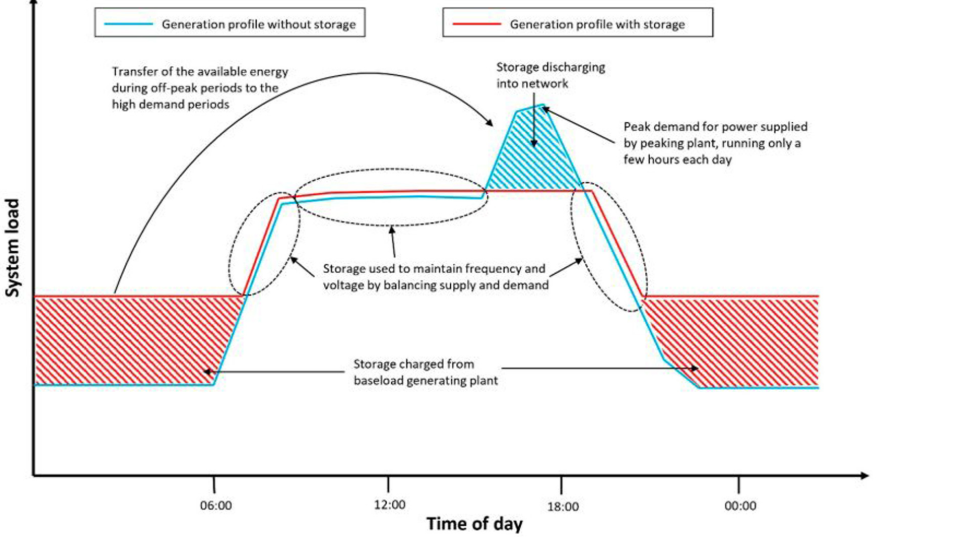
Price signals: Charging at $25/MWh at 3am, discharging at $250/MWh during evening peak
State of charge optimization: Never fully charging or discharging to extend cycle life (typically operating between 10-90% capacity)
Temperature balancing: Adjusting power output if any module exceeds safe temperatures
Here's where most people get confused: grid batteries rarely just charge once and discharge once per day. A single battery might participate in five different markets simultaneously:
Frequency regulation (responding to sub-second fluctuations)
Spinning reserves (standing ready for generator failures)
Peak capacity (replacing expensive peaker plants)
Energy arbitrage (buy low, sell high)
Voltage support (injecting reactive power to stabilize grid voltage)
The Hornsdale Power Reserve in South Australia demonstrated this brilliantly. In December 2017, when a coal plant unexpectedly tripped offline, the 100 MW battery injected power to the grid in 140 milliseconds-so fast that coal generators hadn't even detected the problem yet. That speed prevented a cascading blackout across the state.
The optimization problem: Software must balance degradation against revenue. Cycling faster earns more money but kills the battery sooner. The algorithms solving this are essentially playing a multi-variable poker game where they're betting millions of dollars of battery degradation against uncertain future electricity prices.
Machine learning models now predict grid conditions hours or days in advance, positioning batteries to capture maximum value. A 2024 study by MIT found that AI-optimized batteries earned 15-22% more revenue than rule-based systems-the difference between profitability and red ink.
Layer 3: The Economic System (Market Participation and Revenue)
This is where engineering meets capitalism, and it determines whether grid batteries actually get built. The math is brutal: a 100 MW/400 MWh battery costs roughly $120 million to install. It must generate enough revenue to pay back capital, cover operating costs, and provide returns to investors-all while degrading every single day.
Revenue streams (based on real ERCOT data from 2024):
Ancillary services (frequency regulation, reserves): $40-60/kW-year in markets like ERCOT
Energy arbitrage (price spread capture): $15-30/kW-year, highly volatile
Capacity payments (being available): $10-25/kW-year depending on market
Transmission deferral (avoiding grid upgrades): Site-specific, can be $50-100/kW-year
Total potential revenue: $65-215/kW-year, depending on market design and battery location. A 100 MW battery might gross $6.5-21.5 million annually-but operating costs, degradation reserves, and debt service eat half of that.
The challenge: markets are cannibalizing themselves. When ERCOT had 1 GW of batteries in 2022, frequency regulation paid $80/kW-year. By 2024, with 3.2 GW online, prices fell to $45/kW-year. More batteries competing for the same services pushes margins down-classic supply and demand.
Duration economics create a hard ceiling: Current lithium-ion batteries work economically for 2-6 hour duration. Why? Because going from 4-hour to 8-hour duration doubles the battery cost but doesn't double the revenue. You're adding $600/kW in battery cells to capture maybe $100/kW in additional energy arbitrage.
This is why experts talk about "duration wedges"-lithium-ion handles short-duration (0-8 hours), flow batteries or compressed air could fill medium-duration (8-24 hours), and hydrogen or thermal storage might eventually tackle long-duration (days to weeks). No single technology wins everywhere.
The MW vs MWh Confusion: Why Both Numbers Matter
If you've read about grid batteries and felt confused by "100 MW/400 MWh," you're not alone. This notation captures two completely different properties:
Power capacity (MW) = How fast it can charge or discharge
Energy capacity (MWh) = How long it can sustain that rate
Think of it like a water pipe: Power is the diameter (flow rate), energy is the tank size. A 100 MW battery can instantly inject or absorb 100 megawatts-enough for 75,000 homes-but how long depends on the MWh rating.
100 MW/200 MWh = 2 hours at full power
100 MW/400 MWh = 4 hours at full power
100 MW/800 MWh = 8 hours at full power
Why this matters economically: The MWh portion is expensive (that's the battery cells), while the MW portion is relatively cheap (power electronics). A 4-hour battery costs maybe $300/kWh for the cells plus $200/kW for the power equipment. Doubling the duration (adding more cells) costs far more than doubling the power (bigger inverters).
This cost structure is why you see so many "100 MW/400 MWh" projects (4-hour duration) but almost no "100 MW/2,000 MWh" projects (20-hour duration). The economics break beyond 6-8 hours with current lithium-ion technology.
From Charging to Discharging: The Operational Cycle
Let's walk through a typical operational day for a grid-scale battery in Texas, where energy prices swing wildly.
2:00 AM - Overnight Charging
Wind generation is strong, demand is low. Grid prices drop to $18/MWh. The EMS detects this arbitrage opportunity and begins charging at 80 MW (leaving 20 MW buffer for sudden frequency events). Thermal systems ramp up cooling as battery temperature rises from 22°C to 28°C.
Simultaneously, the battery is bidding capacity into the Responsive Reserve market, earning $0.80/MW for every minute it remains available. It's charging while getting paid to stand ready-value stacking at work.
6:00 AM - Partial Discharge for Morning Ramp
Solar hasn't ramped yet but air conditioners are starting. Prices jump to $45/MWh. The battery discharges 30% of stored energy, earning $27/MWh spread (after 15% efficiency loss). State of charge drops from 90% to 60%.
10:00 AM - Solar Flood, Grid Frequency Event
Massive solar generation pushes prices negative (-$5/MWh). The battery charges opportunistically. Then suddenly: a power plant trips offline. Grid frequency drops from 60.00 Hz to 59.92 Hz in 800 milliseconds.
The battery's frequency response algorithm detects the deviation and injects 40 MW in 140 milliseconds-far faster than any gas turbine can react. Frequency stabilizes at 59.97 Hz. This 140-millisecond response earns frequency regulation revenue of $4,800 for less than 10 seconds of actual work. This is where milliseconds literally equal money.
6:00 PM - Evening Peak
Solar crashes as sun sets. AC loads peak. Demand soars. Prices rocket to $285/MWh. The battery discharges at full 100 MW capacity for 2.5 hours, emptying from 85% to 20% state of charge. This earns roughly $47,000 in energy arbitrage alone.
But here's the hidden cost: that peak discharge just consumed 0.02% of the battery's total cycle life. At 6,000 full-cycle lifetime, each cycle costs approximately $20,000 in degradation (for a $120M battery). The battery earned $47,000 but "spent" $20,000 in accelerated replacement costs. Net value: $27,000, or about $270/MWh.
11:00 PM - Light Charging, Reserve Posture
Prices settle to $32/MWh. Battery charges lightly to 45% capacity, positioning for the next day. It maintains reserve status overnight, earning capacity payments for availability.
Total daily economics: ~$55,000 gross revenue, minus $22,000 degradation cost, minus $3,000 operating expenses = $30,000 net daily contribution. Annual projection: $10.9 million. Against $120 million capital cost, that's a 9.1% cash return before debt service-marginal but workable.
The Technologies: Why Lithium-Ion Dominates (For Now)
Grid storage isn't just one technology. At least six battery chemistries are competing, each with distinct characteristics.
Lithium-Ion (85% Market Share)
Chemistry variants:
Lithium Iron Phosphate (LFP): Safer, longer-lived (6,000-10,000 cycles), but lower energy density. Dominates grid applications-it's what Tesla Megapack uses.
Nickel Manganese Cobalt (NMC): Higher energy density, but more fire-prone. Declining in grid use after the Arizona incident.
Why lithium-ion won the early market:
Costs collapsed 90% between 2010-2023 due to EV production scale-up
Fast response time (milliseconds)
Proven reliability with millions of EV batteries as proving ground
Round-trip efficiency of 85-92%
The ceiling: Lithium-ion hits economic limits at 6-8 hour duration. For seasonal storage, the numbers never work-you'd need roughly $200 trillion of batteries to store 6 weeks of US energy consumption.
Alternative Technologies Emerging
Flow batteries (vanadium redox):
Electrolytes stored in separate tanks, pumped through reaction chambers. Can scale duration independently of power. Longer cycle life (10,000-20,000 cycles) but lower efficiency (65-75%) and higher upfront cost. Best for 8+ hour applications.
Iron-air batteries:
Breathe air to rust iron, reverse the process to discharge. Ultra-cheap materials, duration measured in days. But technology is immature-only pilot projects exist. Could revolutionize long-duration storage if commercialized.
Sodium-ion:
Uses abundant sodium instead of lithium. Potentially 20-30% cheaper at scale, safer, but lower energy density. Chinese manufacturers are deploying first grid-scale projects in 2024-2025.
Second-life EV batteries:
EV batteries "retire" at 70-80% remaining capacity-still usable for grid applications. Redwood Materials built a 63 MWh facility from used EV batteries in October 2025, claiming 30-40% cost savings versus new batteries. The logistics of managing thousands of different battery types remain complex, but the concept is proving viable.
The Safety Reality: Fire Risks and Mitigation
Let's address the elephant in the container: lithium-ion batteries can catch fire. The incidents are rare but catastrophic when they occur.
Documented major incidents:
April 2019, Arizona: 2 MWh NMC battery exploded during maintenance, injuring 8 firefighters. Root cause: poor thermal management and inadequate gas venting.
April 2021, Beijing: 25 MWh LFP facility fire killed 2 firefighters. Investigation revealed faulty BMS failed to detect thermal runaway in one module.
South Korea (2017-2019): 28 fires across energy storage facilities led to shutdown of 522 units (35% of installations). Common factor: inadequate spacing between battery racks and poor ventilation.
Why batteries catch fire (thermal runaway):
When a cell is overcharged, overheated, or physically damaged, internal reactions accelerate. Temperature rises, accelerating reactions further-a positive feedback loop. At ~130°C, the electrolyte starts decomposing, releasing flammable gases. At ~150°C, the separator melts, causing internal short circuit. Temperature spikes to 600-800°C, igniting gases. The reaction spreads to adjacent cells.
One failed cell can cascade through an entire rack in minutes. This is why cell-level monitoring and module-level isolation are critical.
Modern safety systems:
Today's grid batteries employ multi-layer protection that makes them significantly safer than early systems:
Cell-level monitoring: BMS tracks voltage and temperature of every individual cell (thousands per container), isolating any showing anomalies
Thermal imaging: Infrared cameras scan modules every 5 seconds, detecting hotspots before they become critical
Gas detection: Sensors monitor for off-gassing (CO, CO2, volatile organics) that precedes thermal runaway
Physical containment: Modules spaced 20-30cm apart with fire-resistant barriers between racks. Military-grade enclosures tested to withstand internal explosions.
Clean agent suppression: Systems deploy 3M Novec or similar suppressants that extinguish fires without water (which can cause violent reactions with lithium)
Automated shutdown: If any parameter exceeds limits, the system disconnects from the grid and begins controlled cooldown within 2 seconds
Statistical reality: With modern safety systems, the failure rate is approximately 1 in 10,000 MWh-years of operation. That means a 100 MWh facility has roughly 1% annual risk of a serious safety incident-still real risk that must be managed through insurance and emergency planning.
The shift from NMC to LFP chemistry has also dramatically improved safety. LFP's thermal runaway temperature is ~270°C versus ~210°C for NMC, and LFP doesn't release oxygen during thermal runaway (making fires self-limiting rather than explosive).
The Grid Integration Challenge: It's Not Plug-and-Play
You can't just drop a 100 MW battery anywhere on the grid and expect it to work. Integration requires solving interconnection, transmission, and market participation challenges that take 2-4 years-often longer than actually building the facility.
The Interconnection Queue Nightmare
In the U.S., the interconnection queue (the waitlist to connect to the grid) has become a critical bottleneck. As of late 2024, over 2,700 GW of generation and storage projects are waiting-enough to power the entire country twice over.
Median queue time: 4 years from application to interconnection approval. Why so long?
System impact studies: Grid operators must model how a 100 MW battery will affect voltage, frequency, and transmission flows across the regional grid. This requires sophisticated power flow analysis and can take 12-18 months.
Transmission upgrades: If grid infrastructure can't handle the new capacity, developers must pay for upgrades. A $150 million battery project might trigger $40 million in transmission upgrades, destroying project economics.
Regulatory reviews: Environmental permits, local approvals, fire marshal sign-off, utility commission reviews. Each adds months.
Strategic positioning matters: Batteries located at transmission bottlenecks provide extra value by relieving congestion, sometimes earning $50-100/kW-year extra. But these prime locations are scarce and heavily competed for.
Market Participation Complexity
Different grid operators (ISOs) have wildly different rules for battery participation:
ERCOT (Texas):
Fast-responding ancillary services market, co-optimization of energy and reserves, no capacity market (all energy-only). Batteries do well here-hence why Texas has 3.2 GW installed despite deregulated markets.
CAISO (California):
Resource adequacy requirements (capacity obligation), sophisticated day-ahead and real-time markets, net energy metering complications with solar co-location. Complex but lucrative if you navigate it right-7.3 GW installed.
PJM (Mid-Atlantic):
Capacity performance market, pay-for-performance requirements, limited fast-frequency response products. Batteries struggle here compared to gas peakers.
The specifics determine project viability. A battery design optimized for ERCOT's fast-frequency markets would perform poorly in PJM's capacity-focused structure.
The Economics: Do Grid Batteries Actually Make Money?
This is the $120 million question-literally. Let's break down real project economics with actual numbers from recent installations.
Capital costs (2024-2025 estimates):
Battery pack: $200-250/kWh (rapidly falling)
Power conversion system (PCS): $50-80/kW
Balance of system (BOS): $40-70/kW
Construction and integration: $60-100/kW
Land, permitting, interconnection: $30-60/kW
Total installed cost for 100 MW/400 MWh system:
Batteries: 400,000 kWh × $225/kWh = $90 million
PCS: 100,000 kW × $65/kW = $6.5 million
BOS and other: 100,000 kW × $225/kW = $22.5 million
Total: $119 million (or about $1,190/kW and $298/kWh)
Annual operating costs:
Maintenance and monitoring: $25/kW-year = $2.5 million
Augmentation (maintaining capacity as battery degrades): $12/kW-year = $1.2 million
Insurance and land lease: $8/kW-year = $800,000
Total: $4.5 million
Revenue potential (Texas ERCOT example, 2024):
Frequency regulation: 50 MW allocated, $55/kW-year = $2.75 million
Energy arbitrage: ~300 cycles/year, average $35/MWh spread after losses, 400 MWh = $4.2 million
Ancillary services (spinning reserve, etc.): $18/kW-year on remaining 50 MW = $900,000
Transmission congestion relief: $12/kW-year (location-dependent) = $1.2 million
Total: $9.05 million gross
Net annual cash flow:
$9.05M revenue - $4.5M operating costs = $4.55M net
Return metrics:
Simple payback: 26 years (not viable)
But wait-add incentives...
Investment Tax Credit (30% in 2024): -$35.7M upfront cost reduction
Adjusted capital: $83.3 million
Simple payback with ITC: 18.3 years
IRR including ITC and residual value: ~8-9%
That's marginal. A 8-9% return barely clears hurdle rates for infrastructure projects. This is why:
Most grid batteries depend on subsidies (ITC, state grants, utility contracts) to achieve acceptable returns
Early movers captured the best returns When ERCOT had little storage, frequency regulation paid $80/kW-year. By 2025, it'll be closer to $40/kW-year as supply floods the market.
Revenue stacking is essential Projects relying on single revenue stream fail. You must capture 3-5 different value streams to make the numbers work.
Degradation kills weak projects: A battery that degrades 20% faster than modeled turns a barely profitable project into a money loser. This is where engineering excellence separates winners from bankruptcies.
Duration Economics: The 4-Hour Wall and What Comes Next
Most grid batteries you hear about are rated for 4-hour duration. This isn't arbitrary-it's where the economics break.
Why 4 hours became standard:
Typical daily electricity price patterns have one big peak-usually evening (6-9 PM). Solar generation creates a "duck curve" where you need to store 3-4 hours of excess midday solar to discharge during evening peak. Capturing that daily price swing pays for the battery. But storing for 8, 12, or 24 hours? The math falls apart.
The duration dilemma:
Going from 4-hour to 8-hour duration requires doubling the battery pack size while power electronics stay the same. You're adding $400/kW in battery cells to maybe earn an extra $80/kW-year in energy arbitrage-a terrible investment. The incremental revenue from hours 5-8 is much lower than hours 1-4.
This creates a natural ceiling. For lithium-ion, the economic sweet spot is 2-6 hours. Beyond that, you need different technologies.
What fills the duration gap?
8-24 hours (medium duration): Flow batteries, compressed air energy storage, potentially advanced lithium-ion with radically lower cell costs
24-100 hours (long duration): Hydrogen storage, thermal storage, possibly iron-air batteries if they commercialize
Seasonal (weeks to months): Hydroelectric pumped storage, hydrogen, or nothing (too expensive with any current tech)
The U.S. Department of Energy has a Long Duration Energy Storage initiative targeting <$0.05/kWh storage cost for 10+ hour duration. Current lithium-ion is ~$0.15-0.20/kWh for 4-hour storage. That 3-4× cost reduction is needed to make long-duration storage economically viable at scale.
Real-world constraint: Systems with >90% renewable energy need weeks of storage to handle "dunkelflaute" (German term for windless, cloudy weeks). We don't have economically viable technology for this yet. This is why experts talk about 60-80% renewable penetration as more realistic near-term targets, filling gaps with flexible natural gas generation until long-duration storage technology matures.
The Future: Emerging Trends Reshaping Grid Storage
Second-Life Batteries Reach Scale
For years, experts predicted EV batteries would cascade into grid storage after automotive retirement. In 2025, it's finally happening. Redwood Materials' 63 MWh second-life facility demonstrates the model: EV batteries retain 70-80% capacity when automotive applications retire them, but that's plenty for stationary grid storage where weight and volume matter less.
Economics of second-life batteries:
New battery: $200-250/kWh
Refurbished EV battery: $100-150/kWh (includes collection, testing, repackaging)
Savings: 30-40%
The challenge remains logistics and heterogeneity. Unlike new batteries where you order identical units, second-life batteries are a mix of chemistries, sizes, and degradation states. Redwood solved this with a "universal translator" battery management system that coordinates different battery types-complex but effective.
As EV adoption accelerates, by 2030 there could be 1-2 TWh of retired EV batteries available annually-enough to power the entire U.S. for several days. This supply wave will reshape grid storage economics.
AI Optimization Goes Mainstream
Battery storage operators are moving beyond simple rule-based dispatch to machine learning models that predict prices, grid conditions, and optimize degradation-vs-revenue trade-offs in real-time.
What AI enables:
Price forecasting based on weather, historical patterns, and market dynamics
Automated bidding in multiple markets simultaneously
Degradation-aware dispatch (cycling less aggressively when margins are thin)
Predictive maintenance (detecting failing cells before catastrophic failure)
A 2024 MIT study found AI-optimized batteries earned 15-22% more revenue than traditional systems-turning marginal projects profitable. Expect AI dispatch to become table stakes by 2026.
Virtual Power Plants: Aggregating Distributed Batteries
Rather than building centralized megaprojects, some utilities are aggregating thousands of home batteries (like Tesla Powerwalls) into "virtual power plants." California's emergency load reduction program aggregated 17,000 home batteries in 2024, providing 275 MW of flexible capacity during heat waves.
Advantages:
No transmission bottlenecks (batteries are already connected at distribution level)
Faster deployment (no permitting for utility-scale sites)
Lower installation costs (piggyback on solar installations)
Challenges:
Cybersecurity (coordinating thousands of devices creates attack surface)
Customer fatigue (people don't like being cycled hard during emergencies)
Lower capacity factor (residential batteries have other priorities like backup power)
By 2030, virtual power plants could represent 20-30% of total U.S. storage capacity-not replacing utility-scale batteries but complementing them.
Market Design Evolution
Current electricity markets were designed when generators were dispatchable fossil plants. Batteries don't fit cleanly-they're consumers, generators, and grid services all at once. Market reforms are underway:
Co-optimization of energy and ancillary services: Allowing batteries to switch between markets dynamically
Storage-specific products: Like "fast frequency response" that rewards millisecond response times
Capacity accreditation rules: How much "firm capacity" does a 4-hour battery provide? (Ongoing debate)
FERC Order 841 (2018) opened wholesale markets to storage, but implementation remains messy. Expect continued market design evolution through 2030 as storage grows from 2% to potentially 10-15% of grid capacity.
Frequently Asked Questions
How long do grid scale batteries last before needing replacement?
Modern lithium iron phosphate batteries typically last 6,000-10,000 full cycles before degrading to 80% of original capacity. With daily cycling, that's 15-25 years of operational life. However, aggressive cycling for frequency regulation can shorten this to 10-15 years. Many projects budget for battery augmentation every 7-10 years to maintain nameplate capacity.
Why can't we use grid batteries for seasonal energy storage?
Economics. Seasonal storage requires holding energy for weeks or months. A 4-hour battery costs ~$300/kWh installed. To store energy for months, you'd need 100× larger battery packs, pushing costs to astronomical levels. For context: 6 weeks of U.S. energy storage would require roughly $200 trillion in batteries (about 10× U.S. GDP). Alternative technologies like hydrogen might eventually work for seasonal storage, but we're years from economic viability.
Are grid scale batteries dangerous for nearby communities?
Risk is low but non-zero with modern systems. Lithium iron phosphate (LFP) batteries, now the grid standard, are significantly safer than older chemistries. Thermal runaway temperature is higher, and they don't release oxygen during failure. Modern facilities include thermal imaging, gas detection, and clean agent fire suppression. Statistical failure rate is approximately 1 in 10,000 MWh-years. For comparison, natural gas peaker plants have explosion risks, and coal plants emit continuous air pollution. Overall, properly engineered battery storage is safer than most alternatives.
Can batteries completely replace natural gas peaker plants?
For short-duration peaks (2-4 hours), yes-and more cheaply. For extended demand surges (8+ hours) or cold snaps lasting days, no. Current lithium-ion batteries hit economic limits beyond 6 hours. This is why experts view batteries as complementing, not fully replacing, gas generation. As renewable penetration increases, we'll need multi-day storage technologies (flow batteries, hydrogen, compressed air) to fully eliminate fossil backup.
How much does grid scale battery storage actually reduce emissions?
It depends what the battery displaces. If a battery stores solar energy that would otherwise be curtailed and replaces natural gas peaker generation, the emissions reduction is substantial-roughly 0.4-0.5 kg CO2 per kWh of gas generation avoided. However, if a battery charges from a coal-heavy grid and discharges later, net emissions reduction is minimal due to round-trip efficiency losses. The real value comes from enabling higher renewable penetration by solving the intermittency problem. Studies suggest grid storage enables 10-15% additional renewable capacity per GW of 4-hour storage installed.
What happens to grid batteries at end-of-life?
Current recycling recovers 90-95% of valuable materials (lithium, cobalt, nickel) from battery packs. Companies like Redwood Materials and Li-Cycle are building gigawatt-scale recycling facilities. The recycling process involves shredding cells, separating materials through hydrometallurgical or pyrometallurgical processes, and refining them back to battery-grade quality. Recycled materials can make new batteries at ~70% the cost and ~60% the emissions of virgin mining. As the first wave of grid batteries reaches retirement (2030-2035), recycling infrastructure will be critical to maintaining supply chain sustainability.
Why do some states have lots of grid batteries while others have almost none?
Three factors dominate: renewable energy penetration, market design, and state incentives. Texas and California have high solar/wind generation (creating arbitrage opportunities), sophisticated wholesale markets (rewarding fast response), and supportive policies (tax credits, mandates). Meanwhile, states like Kentucky or West Virginia have coal-heavy grids (low price volatility), regulated utility markets (limited competition), and minimal renewable mandates. Until all three factors align, storage deployment stays minimal. Federal incentives (ITC) are helping, but state-level policies remain critical.
The Bottom Line: Storage Enables the Clean Grid, But We're Only 10% There
Grid scale battery storage has grown from essentially zero in 2013 to 26 GW in the U.S. by 2024-an impressive sprint. That's now enough to power roughly 20 million homes for 4 hours. But context matters: total U.S. generating capacity is 1,230 GW. Batteries represent just 2% of that.
The International Energy Agency estimates we need 35× more grid storage by 2030 to hit climate targets-growing from 26 GW to over 900 GW in six years. That's adding more storage every two months than existed in all of 2020.
Can it happen? The trajectories say maybe. Costs fell 90% in the past decade. Installation times dropped from 18 months to 6 months. Supply chains are maturing. AI optimization is adding 15-20% more value from each battery. Second-life EV batteries are creating new, cheaper supply sources.
But three challenges remain existential:
Duration: We need 10+ hour storage to push beyond 80% renewables. Technology exists (flow batteries, iron-air, hydrogen) but costs remain 2-3× too high. Breakthroughs are required, not incremental improvements.
Scale: Building 900 GW of storage requires $400-500 billion in capital plus massive increases in lithium, nickel, and cobalt mining. Supply chains must grow 10× while simultaneously electrifying vehicles and everything else. Bottlenecks seem inevitable.
Market design: Current electricity markets weren't built for storage's unique properties. Regulatory reform is moving slower than technology. Value stacking helps, but fundamental market restructuring will be needed as storage grows from 2% to potentially 15-20% of total capacity.
The physics works. The economics are getting there. What remains uncertain is whether institutional barriers (permitting, interconnection, market rules) can adapt fast enough. Grid storage isn't a miracle cure for clean energy-it's a critical enabling technology that we're racing to deploy at civilization-altering scale. Whether we're sprinting fast enough won't be clear until 2030.
Data Sources
U.S. Energy Information Administration (eia.gov): Capacity statistics, deployment data, market analysis
National Renewable Energy Laboratory (nrel.gov): Technical specifications, cost projections, integration studies
International Energy Agency (iea.org): Global storage trends, Net Zero scenario requirements
Wood Mackenzie / American Clean Power Association: Market forecasts, installation data
Grand View Research (grandviewresearch.com): Market size and growth projections
Advanced Energy Materials (Wiley): Technical safety analysis, degradation studies
MIT Energy Initiative (MIT News): Flow battery research, AI optimization studies
Nature Reviews Clean Technology: Battery technology comparisons, lifecycle analysis
Utility Dive, Canary Media: Industry news, project announcements
Thunder Said Energy (thundersaidenergy.com): Economic modeling, cost analysis