

If your solar panels are sending a large chunk of energy back to the grid every afternoon while your evening electricity bill stays high, you have a self-consumption problem - not a production problem. This guide is written from the perspective of solar system design and energy monitoring, and it focuses on what actually moves the number: load timing, system sizing, and when a battery genuinely earns its place.
Solar self-consumption is the share of solar electricity your home or business uses on-site instead of exporting it. The higher your self-consumption rate, the less grid power you buy - and in most modern utility tariffs, that is where the bill savings live.
What Is Solar Self-Consumption?
Solar self-consumption is the percentage of the electricity your panels generate that gets used directly at the property, rather than exported to the grid or curtailed.
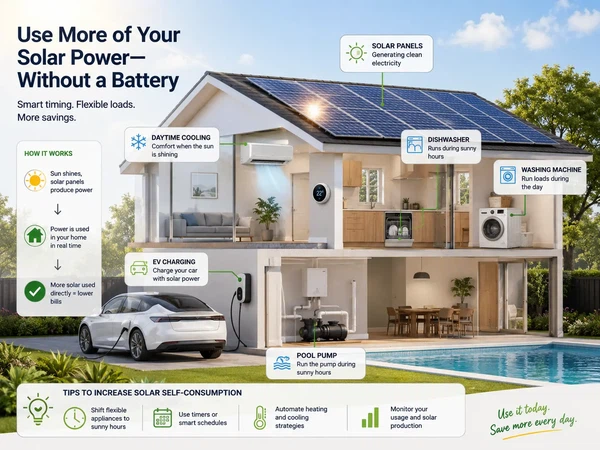
When your air conditioner, refrigerator, EV charger, pool pump, or commercial equipment runs while the sun is up, those loads can pull straight from your solar production. Anything left over either flows to the grid or, if you have storage, charges a battery for later.
Three useful labels to keep separate:
- Self-consumed solar - used on-site as it is produced.
- Exported solar - sent to the grid for credit or compensation.
- Stored solar - held in a battery for evening or night use.
The goal is not to chase 100%. The goal is to capture solar value in whichever form your local tariff rewards most.
A Concrete Example
A 7 kW residential system produces 30 kWh on a clear day. The household uses 12 kWh of that directly (fridge, AC, dishwasher, work-from-home electronics) and exports 18 kWh.
Self-consumption ratio: 12 ÷ 30 = 40%. That is a typical starting point for a daytime-empty household with no scheduling and no battery - and it is usually the easiest baseline to improve.

How to Calculate Your Solar Self-Consumption Ratio
Use this formula:
Solar Self-Consumption Ratio = (Solar Energy Used On-Site ÷ Total Solar Energy Produced) × 100
Worked example:
- Solar energy produced: 25 kWh
- Solar energy used directly on-site: 15 kWh
- Solar energy exported: 10 kWh
- Self-consumption ratio: 15 ÷ 25 × 100 = 60%
Most modern monitoring platforms - SolarEdge, Enphase, Fronius, Tesla, Huawei, GoodWe, and SMA dashboards - report this number directly if a consumption CT clamp or smart meter is installed. Without consumption monitoring, you only see production, and you have to estimate self-consumption from your utility's interval data.
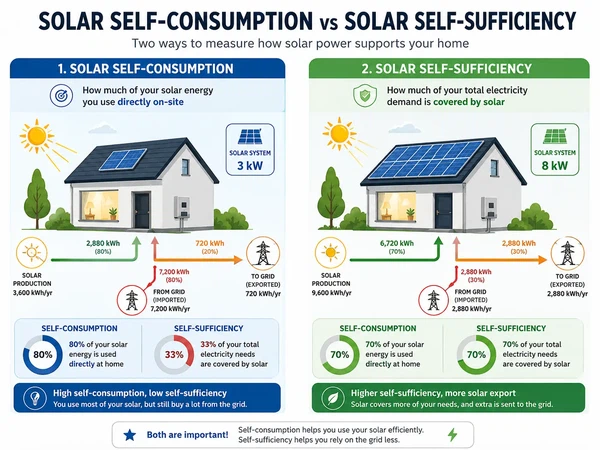
Solar Self-Consumption vs. Solar Self-Sufficiency
People often use these terms interchangeably. They measure different things, and confusing them leads to bad sizing decisions.
| Term | What It Measures | The Question It Answers |
|---|---|---|
| Solar self-consumption | Share of solar production used on-site | Am I using the solar power I generate? |
| Solar self-sufficiency | Share of total electricity demand covered by solar | How much do I still depend on the grid? |
| Grid export | Surplus solar sent to the utility | How much solar am I not using directly? |
A small 3 kW system might hit 100% self-consumption (every kWh gets used) but only 25% self-sufficiency (it covers a quarter of total demand). A large 12 kW system might cover 80% of annual demand but only achieve 35% self-consumption because it overproduces on sunny weekends.
Neither number is "better" on its own. The right design balances both against your tariff structure.
Typical Solar Self-Consumption Rates With and Without Batteries
Users searching "what is a good solar self-consumption rate" want a benchmark. Here are the ranges most installers and monitoring platforms see in the field:
- No battery, no scheduling: 20–35% for a typical residential household where occupants leave during the day.
- No battery, with daytime load shifting (laundry, dishwasher, EV, pool pump): 40–55%.
- With a properly sized battery (around 50–100% of daily consumption): 65–85%, depending on seasonal solar variation.
- Work-from-home households or daytime businesses: often 50–70% before a battery is added, because load and production are naturally aligned.
- Commercial buildings operating Mon–Fri 8am–6pm: 60–80% is common without storage.
The U.S. National Renewable Energy Laboratory and Germany's Fraunhofer ISE have published detailed analyses confirming similar ranges across European and North American residential datasets. If your numbers are far below these ranges, scheduling - not equipment - is usually the first lever to pull.
Why Solar Self-Consumption Matters for Your ROI
The financial case for self-consumption depends on the gap between two numbers: what you pay to import grid electricity, and what your utility pays you for exports. Where those numbers diverge, self-consumption is where the savings live.
Net Metering vs. Export Credit Realities by Region
Self-consumption value is not universal - it is a product of your local tariff:
- United States: Net Energy Metering (NEM) policies vary by state. California's NEM 3.0, in effect since April 2023, dramatically reduced export compensation, making on-site use far more valuable than export. Other states with full retail net metering still favor either approach. The DSIRE database tracks current rules state by state.
- Australia: Feed-in tariffs have dropped to 4–8 c/kWh in most states while retail rates exceed 30 c/kWh, creating a large gap that strongly rewards self-consumption and battery storage.
- United Kingdom: The Smart Export Guarantee replaced earlier feed-in tariffs; export rates are now market-driven and typically far below import rates.
- Germany: Mature self-consumption focus - many residential systems are explicitly designed for high on-site use rather than export.
Before optimizing anything, check the spread between your import rate and your export credit. If the gap is wide, every kWh you shift onto solar is worth real money. If you still have legacy 1:1 net metering, the urgency to chase self-consumption is much lower.
How to Increase Solar Self-Consumption Without a Battery, Ranked by Impact
A battery is rarely the first thing to buy. The biggest gains usually come from load shifting strategies that cost nothing or close to it. Ranked by typical impact for a residential system:
1. Move EV Charging to Daytime (Highest Impact)
For households with an EV, charging is often the single largest controllable load - frequently 7–11 kWh per session. Shifting from overnight charging to midday solar absorption can lift self-consumption by 10–20 percentage points on its own.
If your car is at home during the day, set the charger to start when solar surplus exceeds 2 kW. Smart chargers from Wallbox, Zappi, or Tesla support solar-following modes. If you are not sure whether to install a Level 2 home EV charger with solar-aware scheduling, that decision is now usually a higher-leverage spend than a battery.
2. Schedule Heat Pump Water Heating and Pool Pumps
Heat pump water heaters (3–5 kWh per heating cycle) and pool pumps (1–2 kW for several hours) are big, flexible, daytime-friendly loads. Most modern units support timer scheduling natively.
Suitable for: any household with these appliances. Not suitable: gas water heating, no pool. Verification: monitoring app should show a flatter midday export curve within one week.
3. HVAC Pre-Cooling or Pre-Heating
In hot climates, run AC harder between 11am and 3pm to pre-cool the building, then ease off after 4pm when solar drops. Works best in well-insulated homes; less effective in leaky older houses.
4. Dishwasher, Laundry, and Dryer Timers
Smaller individual gains (1–3 kWh per cycle) but cumulatively meaningful. Most modern appliances have built-in delay-start.
5. Reduce Standby Loads
Lowest impact for self-consumption ratio specifically - but reducing parasitic loads (300–800 W in an average home) does cut total bills.
Before You Buy a Battery, Check These 3 Numbers
This is the single most common mistake we see: customers buy a battery before they know whether it will pay back. Before you sign anything, pull these three numbers from your monitoring app and utility portal:
- Daily average solar export (kWh). If you export less than 4–5 kWh per day, a battery has very little surplus to absorb. Optimize scheduling first.
- Evening grid import between 5pm and 10pm (kWh). This is what a battery would actually offset. Less than 5 kWh per evening, and the battery's economic case weakens.
- The price gap between your import rate and your export credit (¢/kWh). Multiply this gap by the kWh a battery would cycle daily, then by 365, to estimate annual savings. A 20 ¢/kWh gap × 8 kWh/day × 365 = roughly $580/year. Compare against installed battery cost to see real payback.
If all three numbers are high, a battery probably makes sense. If any one is low, fix that bottleneck first.
When a Solar Battery Makes Sense for Self-Consumption
Battery storage is one of the most effective equipment-based ways to lift self-consumption - but only after the prerequisites above are met. Pairing solar with battery storage tends to make sense when:
- You routinely export 8+ kWh/day and import 6+ kWh after sunset.
- Your utility uses time-of-use rates with expensive evening peaks.
- Your export credit is below 50% of your import rate.
- You face frequent grid outages and value backup power.
- You are planning to add an EV, heat pump, or induction cooking - loads that will increase your evening consumption.
It makes less sense when you already use most production directly (work-from-home with an EV charging at noon), when you have favorable legacy net metering, or when your evening consumption is genuinely low.
One technical note worth raising with your installer: AC-coupled and DC-coupled architectures behave differently for retrofits versus new installs. Our breakdown of AC-coupled vs DC-coupled battery storage covers efficiency and compatibility tradeoffs in detail. For sizing questions specific to homes, see how to choose a residential battery energy storage system.

How to Design a New Solar System for Higher Self-Consumption
If you have not installed yet, this is when self-consumption thinking pays off the most.
Use Your Load Profile First, Panel Count Second
Two homes with identical 9,000 kWh annual usage can have wildly different optimal designs. A daytime-heavy household (work-from-home, midday EV charging, pool) supports a larger array; an evening-heavy household needs either a smaller array or storage to make sense.
Ask your installer to model production against at least 12 months of interval data from your utility - not just an annual total. The U.S. Department of Energy publishes guidance on sizing residential solar that reinforces this load-first approach.
Don't Oversize Without a Plan
Adding capacity to a system that already exports 60% of production rarely improves savings - unless you have a near-term plan for an EV, heat pump, electric water heater, or expanded business operations. Oversizing as a "future-proof" hedge only works if the future loads are realistic.
Consider Split-Orientation Arrays
A pure south-facing array (in the northern hemisphere) maximizes total annual production. A split east-west or south-west layout produces less in total but spreads output across more hours of the day - often a better fit for self-consumption-focused households with morning and afternoon peaks.
Residential vs. Commercial Solar Self-Consumption
The two contexts call for very different optimization playbooks.
Residential Checklist
- Install consumption monitoring (CT clamp or smart meter).
- Identify your three largest controllable loads (typically EV, HVAC, water heating).
- Set timers and solar-aware schedules before evaluating storage.
- Re-measure self-consumption ratio after one billing cycle.
- Only then evaluate battery sizing against the 3-number test above.
Commercial Checklist
For commercial sites, self-consumption logic broadens to include demand charges, which can make up 30–50% of a commercial bill. The strategies that move the needle differ:
- Match operating hours to production. Businesses operating Mon–Fri 8am–6pm often achieve 60–80% self-consumption naturally. Weekend operations are the leak - solar production on Saturdays and Sundays often goes mostly to export.
- Tackle demand charges directly. Solar shaves consumption charges; peak shaving with a battery tackles demand charges. These are two different bill line items and require different sizing logic.
- Map equipment loads to solar production. HVAC, refrigeration, compressors, and process heating are the typical big movers.
- Plan for weekend exports. If your weekend export is large and your weekday export is small, storage may be worth less than for a residential customer.
For a deeper view of commercial economics, see our breakdown of how commercial energy storage saves businesses money.
Common Mistakes to Avoid
Chasing 100% Self-Consumption
A 100% self-consumption number from a tiny system is not an achievement - it just means the system is too small to cover your usage. Optimize for total annual savings, not for a single ratio.
Buying a Battery Before Reading Your Data
Without a baseline export and evening import number, battery sizing is guesswork. The most common outcome of guesswork is an oversized system that never fully cycles.
Ignoring Seasonal Variation
Spring exports tell a different story from summer AC-driven self-consumption. Pull at least 12 months of monitoring data before drawing conclusions. The U.S. Energy Information Administration publishes seasonal residential consumption data that confirms how dramatically usage shifts across the year.
Treating Net Metering as Permanent
Tariff structures change. California's NEM 3.0 transition is the most-cited recent example, but Australian states, U.K. SEG terms, and U.S. utility rate cases reshape export economics regularly. Build flexibility into your system rather than betting on today's tariff lasting 25 years.
A 7-Day Solar Self-Consumption Audit
This is an actionable audit, not a checklist of generalities. Each day specifies what to measure and what decision the data drives.
Day 1 - Capture Production and Export Curves
Open your monitoring app. Record peak production hour, daily total kWh, and total kWh exported. Decision: if exports are under 3 kWh/day, your system is likely undersized - skip ahead to system upgrade evaluation.
Day 2 - Pull Utility Interval Data
Most U.S. and EU utilities provide 15-minute or 30-minute interval data through customer portals. Identify the three highest-consumption hours each day. Decision: if those hours are after 7pm, you are an evening-heavy household - battery candidacy goes up.
Day 3 - Inventory Flexible Loads
List every load over 500 W that runs on a schedule you can change: EV, water heater, pool pump, dishwasher, washer, dryer, HVAC. Estimate each one's kWh per cycle. Decision: the top two by kWh are your scheduling priorities.
Day 4 - Shift One High-Impact Load
Move one big load into the solar window - EV charging is the usual winner. Don't change anything else; you are isolating the variable.
Day 5 - Compare Day 4 Data to Day 1
Look at exports specifically. A 10–20% drop in daily export confirms the change is working. Decision: if the drop is under 5%, the load wasn't actually large enough or didn't fully overlap with production hours - adjust timing.
Day 6 - Add a Second Load Shift
Stack one more change - water heater schedule, pool pump, or HVAC pre-cool. Watch evening import as well as midday export.
Day 7 - Decide on Equipment Upgrades
Calculate the residual gap: how much do you still export, and how much do you still import after sunset? Run those numbers through the 3-number test earlier in this guide. Decision: if both numbers are still high, you have a defensible case for a battery quote. If exports are now low, the battery case is weak - keep optimizing scheduling.
FAQ
Q: What Is A Good Solar Self-Consumption Rate?
A: For a typical residential system without storage, 30–50% is normal. With load shifting, 50–60% is achievable. With a properly sized battery, 70–85% is realistic. Daytime businesses often hit 60–80% without any storage. Anything below 25% suggests a load-timing problem rather than a system design issue.
Q: Can I Increase Solar Self-Consumption Without A Battery?
A: Yes - and most homes should try this first. Shifting EV charging, heat pump water heating, pool pumps, and laundry into daylight hours typically raises self-consumption by 15–25 percentage points at zero hardware cost.
Q: Is Battery Storage Worth It For Solar Self-Consumption?
A: It depends on three numbers: daily solar export, evening grid import, and the import-to-export price gap. If you export 8+ kWh/day, import 6+ kWh after sunset, and your tariff has a wide gap (common under California NEM 3.0, Australian feed-in tariffs, and most U.K. SEG arrangements), the battery case is strong. Otherwise, scheduling changes deliver better return per dollar.
Q: What Is The Difference Between Solar Self-Consumption And Self-Sufficiency?
A: Self-consumption measures how much of your solar production you use on-site. Self-sufficiency measures how much of your total electricity demand solar covers. A small system can have 100% self-consumption but 20% self-sufficiency - and vice versa.
Q: Does Net Metering Still Matter If I Focus On Self-Consumption?
A: Yes. Even high-self-consumption systems export some surplus, and that exported energy still earns credit. The question is how much that credit is worth relative to using the energy directly - and that ratio is what drives the entire optimization.
Q: Do I Need A Smart Home System To Improve Self-Consumption?
A: No. Built-in delay timers on appliances, a solar-aware EV charger, and a pool pump time switch handle 80% of the gain. Smart home integration becomes valuable for households running multiple coordinated loads or for commercial sites with complex operating patterns.
Q: Can Businesses Benefit More From Solar Self-Consumption Than Homes?
A: Often, yes - at least for businesses operating during daylight hours. Offices, retail, schools, and light industrial sites typically achieve 60–80% self-consumption without any storage because their load and solar production naturally overlap. The exception is weekend exports for Mon–Fri operations.
Conclusion: Optimize Around Your Energy Pattern, Not the Average
Solar self-consumption is not just a metric - it is the lens that reveals whether your system is actually built around how you live and operate. The order of operations is consistent across every site we've designed for:
- Measure production, export, and consumption with monitoring data, not assumptions.
- Shift the two largest controllable loads into the solar window.
- Re-measure after a billing cycle.
- Run the 3-number test before pricing storage.
- Match storage size to the actual gap, not to a marketing default.
The best solar system is the one designed around your real load profile, your local tariff structure, and your realistic future loads - not the largest array a roof can hold or the biggest battery a salesperson can sell.