

Residential and Small-Scale Buyers
For a typical home battery system in the 5-20 kWh range, there are four main places to buy.
Solar installation companies remain the most common entry point. Sunrun, SunPower, and hundreds of regional installers sell battery systems bundled with solar panels, handling design, permitting, installation, and warranty under a single contract. Simple, but expensive: fully installed residential systems through these companies typically run $1,000-$1,200 per kilowatt-hour. That is a significant markup over hardware-only pricing, but you are paying for someone else to deal with permitting, electrical work, and utility interconnection paperwork.
Online comparison platforms like EnergySage aggregate competing quotes from pre-vetted local installers. Similar platforms include SolarReviews and EnergyPal. Installed costs shown typically range from $800 to $1,200 per kWh depending on region and equipment. They will not sell you the battery directly, but they let you compare three to five installer bids side by side - and that price transparency alone tends to save buyers 15-20% versus accepting the first quote that walks through the door.
Big-box retailers and specialty online stores are the budget route. Home Depot and Lowe's stock select models. Signature Solar, EG4 Electronics, and Sol-Ark sell equipment directly at $156-$252 per kWh for the battery unit alone. The catch: many state incentive programs, including California's SGIP and Connecticut's Energy Storage Solutions, require installation by certified professionals. Buying hardware online and hiring your own electrician may disqualify the project from rebates worth $5,000-$16,000.
Manufacturer direct sales are the fourth option. Tesla sells Powerwall through its website; Enphase and Franklin WH follow similar models. Cleanest warranty chain, but you are locked to that single brand.
One often-overlooked channel: local electrical cooperatives and municipal utilities offering battery leasing or group-buy programs. These can cut upfront costs by 20-30% and almost always meet state incentive certification requirements.
Mid-Scale Commercial and Project Buyers: 50 kWh to 1 MWh
This is where the buying process gets complicated - and where the right sourcing decision has the biggest financial impact. Residential buyers have turnkey installers. Utility-scale buyers have dedicated procurement teams and advisory firms. Commercial buyers in the 50 kWh to 1 MWh range fall in between, often navigating supplier evaluation, permitting, and system integration without dedicated resources. The channels below serve this segment, but each comes with tradeoffs you should understand upfront.
Authorized distributors and regional value-added resellers (VARs) are the workhorses of commercial BESS sales. They hold regional inventory, handle system sizing, verify inverter-battery compatibility, and coordinate installation. Good ones cut lead times from the 6-8 weeks of a direct Asia shipment down to days. Find them through manufacturer partner locator pages or at industry events like RE+.
Manufacturer direct purchasing is where commercial buyers get the most value, and it becomes viable once project size crosses roughly 100-200 kWh. Going direct opens up customization that distributor channels simply cannot offer: specific enclosure dimensions for tight mechanical rooms, tailored BMS parameters for unusual duty cycles, communication protocol adjustments for integration with existing building management systems or SCADA platforms. It also means pricing 30-50% below retail because you are cutting out intermediary markup. The tradeoff is coordination for installation, permitting, and commissioning - but for buyers with basic project management resources, the savings justify it.
What separates a useful manufacturer from a risky one at this scale? Engineering flexibility. Can they adjust the enclosure to fit your site constraints? Will they configure the BMS to work with your existing inverter brand? Do they hold UL 9540 and UL 1973 certification alongside CE and IEC 62619, or just one standard? These questions filter fast.
The key is finding manufacturers with genuine OEM/ODM flexibility rather than companies that just sell a fixed catalog. Look for suppliers who work across multiple form factors. Polinovel, as one example, builds containerized BESS in the 2-5 MWh range with liquid cooling and integrated fire suppression, outdoor cabinet systems from 60 kW to 225 kWh with IP55 ratings for tighter spaces, and high-voltage battery modules compatible with major inverter brands including Deye, Growatt, SMA, and Victron. That kind of cross-brand inverter compatibility is critical when you are retrofitting storage into an existing solar installation rather than building greenfield. Systems use 314Ah prismatic LFP cells - the same large-format tier adopted by industry leaders - with 6,000+ cycle life at 80% depth of discharge and certifications spanning UL 9540, UL 1973, CE, and IEC 62619.
B2B sourcing platforms - Alibaba, Global Sources, Made-in-China - list thousands of BESS manufacturers and are useful for benchmarking pricing. But exercise serious caution. Verify safety certifications independently, request reference projects, and insist on factory audit reports. The cheapest quote on a B2B platform often comes from a supplier cutting corners on thermal management or fire suppression. A useful filter: ask whether the supplier has completed UL 9540A cell-level and unit-level thermal runaway propagation testing. Suppliers who have invested in that testing are generally more serious operations.
EPC contractors are the turnkey option, adding 15-25% to hardware costs but eliminating all project management burden. Worth it if you lack in-house engineering. Ask potential EPCs for their interconnection queue success rate and average timeline from contract to commissioning - those two numbers reveal more than any brochure.
Enterprise and Utility-Scale Procurement: 1 MWh and Above
At this scale, procurement is a formal process with multi-million-dollar stakes and 15-25 year performance horizons.
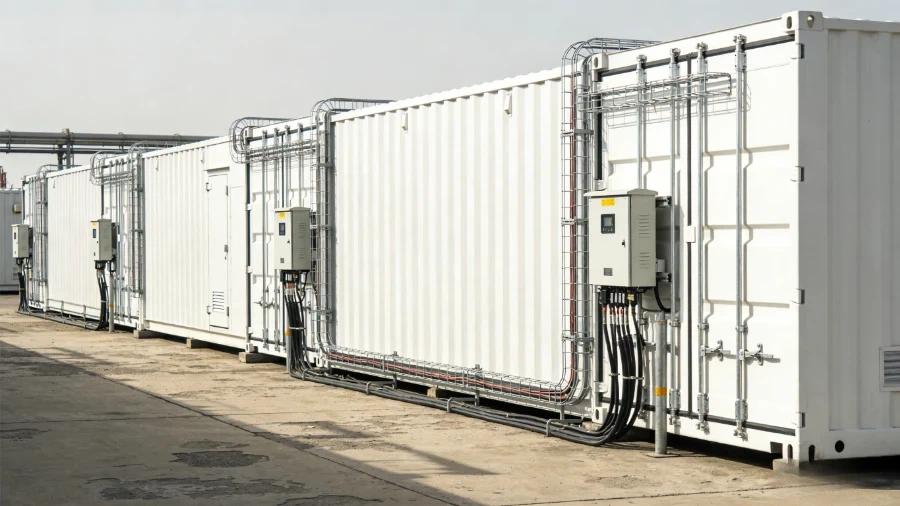
Direct manufacturer relationships dominate. CATL (38.2% global market share in early 2025), BYD (16.9%), Tesla Energy, Sungrow, and Fluence maintain dedicated enterprise sales teams for projects above several megawatt-hours. Engagement begins with a formal RFP specifying capacity, power rating, discharge duration, site conditions, and performance guarantees. Include payment milestones tied to manufacturing checkpoints to protect against delays. For projects in the 1-10 MWh range - too large for off-the-shelf commercial products, not large enough to command attention from the top five - mid-tier manufacturers with strong C&I track records and OEM flexibility, including companies like Polinovel, often deliver faster response times and more attentive engineering support than the giants whose sales pipelines prioritize 100+ MWh deals.
System integrators like Fluence, FlexGen (which acquired Powin's assets in 2025, now supporting 25+ GWh across 200+ sites), and Wärtsilä combine cells, power conversion systems, and energy management software from different vendors into unified systems. Their value is software: platforms like Fluence's Mosaic and FlexGen's HybridOS use AI-driven dispatch to maximize revenue across multiple grid service markets.
Independent advisory firms like Clean Energy Associates provide procurement support including supplier qualification and manufacturing quality audits. Their analysis shows roughly 30% of BESS defects originate during cell manufacturing, with system-level integration issues accounting for nearly 50%. Having an auditor in the factory is standard for projects above 10 MWh.
Policy is reshaping this tier fast. The IRA's 45X manufacturing tax credit ($35/kWh domestic production) narrows or eliminates the 15-20% price premium of US-made systems over Chinese imports. Section 301 tariffs on Chinese cells rise from 7.5% to 25% in 2026. For procurement teams planning projects with 2026-2027 commissioning dates, modeling both domestic and imported supply chain scenarios is no longer optional - the cost difference can swing by 20-30% depending on which tariff schedule applies at your delivery date.
What to Evaluate No Matter Where You Buy
Safety certifications come first. UL 9540 and UL 1973 are the minimum for US commercial deployment. Municipalities increasingly require UL 9540A thermal runaway testing for permitting. No certification, no permit, no insurance - it is that simple. For projects with international deployment potential, look for suppliers who also carry CE and IEC 62619 so you are not re-qualifying hardware for every new market.
Battery chemistry matters for long-term economics. LFP (lithium iron phosphate) now represents roughly 80% of new stationary storage deployments, offering superior thermal stability and cycle life exceeding 6,000 cycles. Cell-level costs reached about $115/kWh in 2024, and LFP packs using 300Ah+ large-format cells averaged $137/kWh for complete systems. NMC still serves space-constrained installations, but the cost and safety advantages of LFP have made it the default chemistry for anything that sits on a concrete pad rather than inside a vehicle. If a supplier is pushing NMC for a stationary application without a clear space-constraint justification, ask why.
Supplier financial stability is underrated. Multiple BESS companies have gone bankrupt in recent years - Powin filed in 2025, its assets acquired by FlexGen - stranding customers without warranty support or spare parts access. Before committing to any supplier, investigate their production capacity utilization, revenue trajectory, geographic customer diversification, and whether they maintain spare parts inventory accessible within your region. A 10-year warranty from a company that might not exist in 5 years is worth nothing.
Total cost of ownership goes far beyond hardware price. Installation adds $40,000-$150,000+ for commercial systems depending on whether your site needs transformer upgrades, switchgear, or trenching. One industrial facility in Louisiana spent $210,000 on site preparation for a $480,000 system because aging electrical infrastructure required $140,000 in upgrades to handle bidirectional power flow. Annual maintenance runs $8,000-$40,000 depending on scale. A system priced 20% below competitors may cost more over 15 years if it degrades faster. Always request a levelized cost of storage (LCOS) projection - it accounts for efficiency losses, degradation, and operating expenses across the full system life, making it the most honest comparison metric.
Matching Your Project to the Right Supplier
Residential buyers: comparison platforms and certified local installers. Prioritize installer track record over brand loyalty.
Commercial and industrial buyers: engage 3-5 manufacturers or distributors with proven deployments at similar scale. The suppliers worth your time offer multiple form factors and can grow with your project. If a manufacturer only sells one product shape to every customer, that tells you something about their engineering depth. Request reference contacts from installations with similar capacity and application - a supplier who freely connects you to existing customers has nothing to hide. Ask about containerized system sizing methodology: does the supplier model your actual load profile, or do they just recommend their standard product? The answer reveals whether you are buying engineering or inventory.
Utility-scale buyers: structured RFPs, independent technical advisors, manufacturing quality audits. Weight your evaluation: technical performance and safety (30%), total cost of ownership (25%), manufacturer stability (20%), warranty and support (15%), delivery logistics (10%). With sodium-ion technologies entering production and tariff structures shifting annually, do not lock yourself into single-source dependency for a 20-year infrastructure asset. Maintain qualified backup suppliers.
Wherever you land on the scale spectrum, the core principle holds. The right place to buy a BESS is less about finding the lowest price and more about matching supplier capabilities to your project's specific demands - the right chemistry, the right form factor, the right certifications, and the right after-sales support in your region. That alignment is what separates a high-performing energy storage system from an expensive regret.
FAQ
Q: How much does a BESS cost per kWh in 2025?
A: Costs vary by purchasing channel. Hardware-only pricing from online retailers runs $156–$252/kWh. Fully installed residential systems average $800–$1,200/kWh through solar installers. Commercial and industrial systems purchased directly from manufacturers typically land at $137–$165/kWh for the battery pack, with total turnkey costs of $400–$630/kWh after adding power conversion, thermal management, fire suppression, and installation.
Q: Can I buy a BESS directly from the manufacturer?
A: Yes, most manufacturers engage directly once project size exceeds 100–200 kWh. Direct purchasing opens up OEM customization - enclosure sizing, BMS tuning, inverter protocol matching - and typically saves 30–50% compared to retail distributor pricing. For residential-scale systems, only a few brands like Tesla and Enphase sell direct to homeowners; most require going through certified installers.
Q: What certifications should a BESS have before I buy?
A: At minimum, any system deployed in the United States needs UL 9540 (system-level safety) and UL 1973 (battery cell safety). Many municipalities now also require UL 9540A thermal runaway propagation test reports as a permitting condition. For international deployment, CE marking and IEC 62619 certification are essential. Systems lacking proper certification risk permit rejection, insurance denial, or both.
Q: What is the difference between containerized BESS and outdoor cabinet BESS?
A: Containerized systems house batteries, inverters, cooling, and fire suppression in a standard shipping container, typically ranging from 1 MWh to 5+ MWh. They suit utility substations, industrial parks, and large renewable integration projects. Outdoor cabinet systems are smaller (60–225 kWh), compact enough for rooftops, parking structures, or commercial buildings with limited footprint. The right form factor depends on your capacity needs and available installation space.