

A lithium-ion battery pack is an expensive, energy-dense object. Treat it well and it lasts a decade. Mistreat it for a few minutes and you can permanently degrade the cells, or in the worst case start a fire. The component that prevents the worst case is the battery management system, or BMS.
Whether you are designing a pack, integrating one into a product, or evaluating a vendor's spec sheet, this guide covers what a BMS actually does, what architectures exist, why a real one is non-negotiable, and how to pick the right one for your application.

On This Page
- What Is a Battery Management System?
- How a BMS Actually Works
- Core Functions of a BMS
- Main BMS Architectures
- BMS vs Protection Board (PCM)
- Why a BMS Matters
- Choosing the Right BMS by Application
- A 7-Step Selection Checklist
- Common Mistakes When Buying a BMS
- FAQ
What Is a Battery Management System?
A battery management system is the electronic controller that monitors and protects a rechargeable battery pack, most often a lithium-ion or LiFePO4 pack made of multiple cells in series and parallel. It measures what each cell is doing, calculates how the pack is behaving as a whole, and intervenes when something drifts outside safe limits.
A BMS is not the same as a simple protection board (sometimes called a PCM, or Protection Circuit Module). A protection board reacts to a handful of fault conditions such as overcharge, over-discharge, and short circuit. A real BMS does all of that, and also balances cells, estimates state of charge and state of health, manages temperature, and usually communicates with the rest of the system over CAN, RS485, UART, or Bluetooth. The distinction matters because the marketplace mixes the two terms freely, and many cheap "BMS" boards are protection boards in disguise.
Inside a complete energy storage product, the BMS is one of several building blocks. If you want to see how it sits alongside the cells, PCS, EMS, and thermal hardware, our breakdown of the eight core components of a battery energy storage system is a good companion read.
How a BMS Actually Works
Every BMS runs the same four-step loop, thousands of times per second.
Sense. Voltage taps on every cell, a current sensor (shunt or Hall-effect) on the main current path, and NTC thermistors at strategic points feed raw data into the BMS.
Calculate. A microcontroller turns those measurements into derived values: state of charge, state of health, available power, cell imbalance, average temperature.
Decide. The firmware compares everything against safety thresholds and operating rules.
Act. When needed, the BMS opens MOSFETs or contactors to cut current. It may also trigger a balancing circuit, ask a charger to slow down, or fire a fault flag to the host system.
That closed feedback loop is what separates a managed battery system from a battery with a protection chip stuck on top.

Core Functions of a Battery Management System
Different BMS designs emphasize different jobs. A competent battery management system handles most or all of the following.
Cell-Level Monitoring
The BMS continuously reads the voltage of every cell in the series string, the current flowing in and out of the pack, and temperatures at one or more points. Cell-level visibility is what makes pack-level decisions trustworthy. Averaging at the pack level hides exactly the kind of single-cell drift that causes failures.
Cell Balancing
In any multi-cell pack, cells age slightly differently. Without balancing, the weakest cell hits its upper voltage limit first during charging, forcing the BMS to stop charging the entire pack and leaving usable capacity stranded.
Two approaches dominate. Passive balancing burns off excess energy from the higher cells through small resistors. It is simple, cheap, and adequate for most consumer and light-industrial packs. Active balancing moves energy from higher cells to lower cells through capacitors, inductors, or DC-DC converters. It is more efficient and recovers more usable capacity, but it adds cost and complexity. Active balancing tends to pay off in large packs (EV traction, grid-scale storage) where every kilowatt-hour matters.
SOC, SOH, and SOF Estimation
Three state values look similar but mean different things.
- State of Charge (SOC): how full the pack is right now, expressed as a percentage. Drives the range or runtime indicator the user sees.
- State of Health (SOH): how much usable capacity remains compared to a brand-new pack. A pack at 80% SOH has lost 20% of its original capacity.
- State of Function (SOF): whether the pack can deliver the power demanded right now, given current SOC, SOH, and temperature.
Cheap units report SOC. Better units track SOH. Premium units report SOF, which is what you actually want when reliable performance is on the line. For an introduction to how cells gain and lose capacity over their lifetime, the Battery University article BU-808 is a good plain-language resource.
Protection
A serious BMS guards against overcharge, over-discharge, overcurrent (in both directions), short circuit, and high or low temperature. Each threshold should be configurable, and response time matters as much as the threshold itself. Short-circuit response is typically in the 100–500 microsecond range; anything in the millisecond range is too slow for high-current applications.
Thermal Management
For passively cooled packs the BMS simply derates or cuts off when temperatures stray. For actively cooled packs it commands fans, pumps, or heaters to keep cells inside their working window. Most lithium-ion cells charge safely between roughly 0–45°C and discharge over a wider range, but they are happiest in the 15–35°C band; cycle life falls off at both extremes. For specific limits, our reference on lithium battery temperature ranges covers what charging, discharging, and storage actually look like in practice. On the hardware side, choosing between air and liquid cooling shapes how much work the BMS has to do thermally.
Communication
Most modern BMSs talk to the outside world. CAN bus is standard for vehicles and industrial systems, RS485 dominates in stationary energy storage, UART or I²C is common in small consumer packs, and Bluetooth is increasingly common in e-bikes and portable power. In a stationary system the BMS also coordinates with a higher-level energy management system (EMS), which handles dispatch decisions, tariffs, and grid signals. The two are often confused but they sit at different layers.
Data Logging and Diagnostics
Higher-end BMSs log fault events, cycle counts, and historical extremes. That log becomes invaluable for diagnosing returned packs, validating warranty claims, and improving the next product revision. In our own RMA work, the BMS log is usually the first thing we read; a pack with no usable history is a pack you cannot defend.
Main Types of BMS Architectures
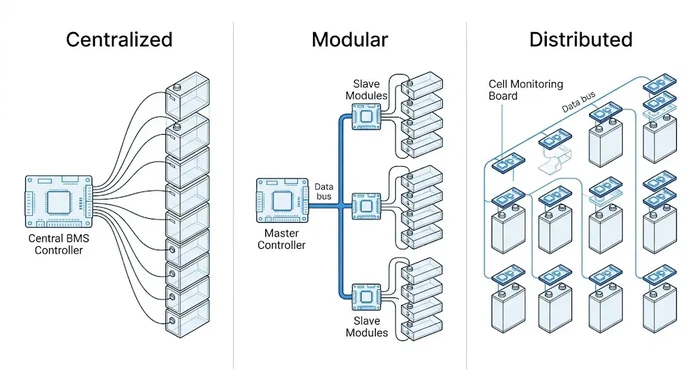
There are three classical architectures for a battery management system. Picking the right one is mostly a question of pack size and complexity.
| Architecture | How It's Built | Strengths | Weaknesses | Typical Use |
|---|---|---|---|---|
| Centralized | One PCB does everything; wires run from each cell to the central board. | Cheapest, simplest, easiest to service. | Wiring becomes messy and noisy in large packs; limited scalability. | Small packs (≤16S), e-bikes, power tools, portable products. |
| Modular | Several identical "slave" boards each handle a group of cells; one master coordinates. | Scales easily; cleaner wiring; serviceable module-by-module. | More expensive; needs internal communication. | Mid-to-large packs, light EVs, mid-size ESS. |
| Distributed | A small "cell board" sits on every cell or small group; minimal wiring. | Cleanest wiring; best signal integrity; highest scalability. | Most expensive; more components to qualify. | Automotive EVs, large grid-scale storage. |
A useful working rule we apply when scoping new builds: under about 16 cells in series, centralized is fine. Between 16 and 100, modular usually wins on cost-of-installation versus reliability. Above 100 cells, distributed pays for itself in cabling cost, signal integrity, and field serviceability. These are starting points, not laws; specific projects can pull either way.
BMS vs Protection Board (PCM): What's the Difference?
This is the single biggest source of confusion in the BMS market.
| Protection Board (PCM) | BMS | |
|---|---|---|
| Primary job | Cut off on faults | Monitor, manage, communicate |
| Cell balancing | Rare | Standard |
| SOC / SOH | No | Yes |
| Temperature management | Basic, often single thermistor | Multi-point, sometimes active |
| Communication | None | CAN / RS485 / BLE / etc. |
| Use when | 1–4S small packs, low cost | Multi-cell packs, long life, safety-critical apps |
If a vendor is calling a $5 board for a 10-cell pack a "BMS," ask whether it does cell balancing, reports SOC over a data bus, and lists a real microcontroller part number. If the answer is no, it is a protection board.
Why a BMS Matters: The Real Risks of Going Without One
The word "important" gets used loosely. Here is what actually goes wrong in a lithium pack with no proper battery management system, or with one that is undersized for the job.
Safety. Lithium-ion cells fail through a chain reaction called thermal runaway. An internal short or overcharge raises one cell's temperature, which accelerates the failure, which raises the temperature further, until the cell vents flammable electrolyte. A BMS that catches the precursor (abnormal voltage, abnormal current, abnormal temperature trend) can interrupt the chain before it becomes a fire.
Lifespan. Even persistent imbalances of tens of millivolts between cells shorten pack life noticeably. The strongest cell finishes charging first and gets cycled across a narrow band; the weakest cell does the heavy lifting and ages even faster. Without balancing, a pack's usable capacity shrinks asymmetrically over months rather than years. In packs we've opened up after warranty returns, a balance circuit that never engaged is one of the most common root causes of premature capacity loss.
Performance. Without accurate SOC and SOH, the system either underuses the pack (capacity left on the table) or overuses it (range or runtime claims that do not match reality). For end users, "my battery dies way faster than the indicator says" is almost always a BMS problem, not a cell problem.
Compliance. Lithium battery products today are pulled into a stack of standards, and a real BMS is usually what makes them passable. Skipping one effectively closes off serious markets. The most common ones to know:
- UN 38.3: a transport-safety test series that lithium cells and packs must pass to be shipped by air, sea, or road. Defined by the UN Manual of Tests and Criteria.
- UL 2271: covers batteries for light electric vehicles such as e-bikes and e-scooters.
- UL 1973: covers stationary and motive battery systems, including most ESS products. Requires documented BMS protection logic.
- IEC 62619: international safety standard for industrial lithium secondary cells and batteries.
- ISO 26262: functional safety for road vehicles. Required where the OEM specifies it for traction batteries.
For a deeper look at what UL certification involves on the ESS side, see our note on why BESS products need UL certification. You can also browse the standards themselves through UL Solutions.
Choosing the Right BMS by Application
Different applications stress a battery management system in completely different ways. The same "100A" label means very different things in a power tool and in a solar storage rack.
Electric Vehicles and E-Mobility
EVs and e-bikes need high continuous current, fast peak response, accurate SOC for range estimation, CAN communication, and (where the OEM requires it) ISO 26262 functional-safety design. Modular or distributed architectures dominate at the higher end.
Energy Storage Systems (ESS)
Stationary storage prioritizes long calendar life, high cycle count, accurate SOH tracking, and clean integration with inverters over Modbus or CAN. Cells are usually LiFePO4 for safety. Wide voltage windows (48V to 800V+) push designs toward modular or distributed BMSs. Most of our containerized BESS projects, for example, use a modular master-slave BMS so that any one rack can be serviced without taking the whole site offline.
Power Tools
Power tools care about peak current and short-circuit response above all else. The motor pulls huge transient currents on startup and on stall. Here, BMS performance comes down to MOSFET selection (low Rds(on)) and the ability to ride out brief peaks without nuisance shutdowns.
Portable and Consumer Electronics
Compact size, low cost, and tight integration matter most. A small centralized BMS with passive balancing and basic protection is usually enough.
Marine and Starting Power Systems
Cranking-style applications demand very high peak discharge currents for short bursts, plus protection against vibration, humidity, and salt. Look for sealed designs, high peak-to-continuous current ratios, and robust thermal protection.
Chemistry choice also drives BMS configuration. Our overview of different battery types for energy storage walks through how LFP, NMC, and others behave, which in turn changes voltage thresholds, balancing strategy, and thermal limits the BMS has to enforce.
How to Pick a BMS
Use this in order. Skipping a step is how most BMS purchases go wrong.
- Confirm cell count and chemistry. How many cells in series (the "S" number)? Lithium-ion (3.7V nominal), LiFePO4 (3.2V nominal), or something else? The BMS must match exactly.
- Calculate continuous and peak current. Use the worst-case load. Continuous current matters for thermal sizing; peak current matters for MOSFET and trace selection.
- Pick continuous current with margin. Aim for at least 25–30% headroom over your real continuous load (a common pack-engineering rule of thumb, not a hard number). A BMS rated exactly at your operating current will run hot and age fast.
- Verify the protection set. Overcharge, over-discharge, overcurrent (charge and discharge), short circuit, and temperature should all be present and configurable.
- Choose the balancing type. Passive is fine for most packs under about 10 kWh. Choose active balancing only when capacity recovery and long life justify the added cost.
- Match the communication interface. CAN for automotive, RS485 for ESS, BLE for portable, or none for a standalone power pack.
- Check the MOSFETs and the build quality. Ask for the MOSFET part number and look up its datasheet. A name-brand MOSFET with low Rds(on) is one of the strongest indicators of a serious BMS.
Common Mistakes and Red Flags When Buying a BMS
- Trusting the headline current rating. A board labeled "100A" may use MOSFETs that derate to 60A under real thermal conditions. Check the datasheet.
- Confusing peak with continuous. A BMS that handles 200A for one second is not a 200A BMS.
- Ignoring the protocol. Branded power-tool packs (Dewalt, Milwaukee, etc.) often use proprietary handshakes; a generic BMS may simply refuse to power the tool.
- Skipping temperature sensors. A single NTC for an entire 20S pack cannot tell you if one corner is overheating.
- Buying on price alone. The cheapest "BMS" for a multi-cell pack is almost always a protection board with marketing on top.
FAQ
Can I use a lithium battery without a BMS?
For a single cell at low current, technically yes. For any multi-cell lithium pack, and especially anywhere humans are nearby, no. The risk of thermal runaway, cell imbalance, and rapid degradation makes a BMS effectively mandatory.
What's the difference between a BMS and a battery charger?
A charger pushes energy into the pack. A BMS decides whether that's safe and tells the charger when to stop. Many systems have both, working together over a communication bus.
Does a BMS extend battery life?
Yes, meaningfully. By preventing overcharge, over-discharge, and cell imbalance, a competent BMS can substantially extend the cycle life of a lithium pack compared to running it unprotected. The exact ratio depends on chemistry, depth of discharge, and temperature.
What does cell balancing actually do?
It keeps every cell in the series string at nearly the same state of charge so the pack can be fully charged and discharged without one cell hitting its limit prematurely.
SOC vs SOH: what's the difference?
SOC tells you how full the battery is right now. SOH tells you how much capacity the battery has lost over its lifetime. A pack can be at 100% SOC and only 70% SOH if it's old.
Are BMS and PCM the same thing?
No. A PCM (protection board) only reacts to fault conditions. A BMS adds balancing, state estimation, communication, and often thermal management.
How much current should my BMS support?
Aim for at least 25–30% above your real-world continuous current, with peak handling for startup or stall events. Always check the actual MOSFET specs, not just the marketed rating.
Centralized, modular, or distributed: which one do I need?
Small packs (under about 16S): centralized. Medium packs and light EVs: modular. Large EV or grid-scale: distributed.
Should I retrofit a BMS to an existing battery pack?
For a pack that was originally shipped without one, the answer depends on what's already inside. If there is only a basic protection board, swapping in a real BMS can extend useful life and add monitoring, but the retrofit needs to match the original cell count, chemistry, and current path. For packs already wired for a BMS that has failed, replacement is straightforward. For sealed OEM packs (especially from major brands), retrofits often fail because of proprietary handshakes between the pack and the host equipment, and we generally do not recommend it.
The Bottom Line
A battery management system is what makes lithium-ion batteries usable at scale. It senses, calculates, and acts on what the cells are doing, balances them, tracks their health, and talks to the rest of the system. Skipping a real BMS, or settling for a protection board dressed up as one, costs you on safety margin, lifespan, and ultimately money.
Before you buy, lock down four things: cell count and chemistry, continuous and peak current with margin, the exact protection set you need, and the communication interface your system speaks. Match those to the right architecture for your pack size and you will avoid the most expensive mistakes in lithium battery design.
If you are sizing a BMS for a specific application (EV traction, energy storage, power tools, marine starting, or portable power), start from the application's current and protocol requirements and work backward. That is the difference between a pack that lasts five years and one that fails in five months.